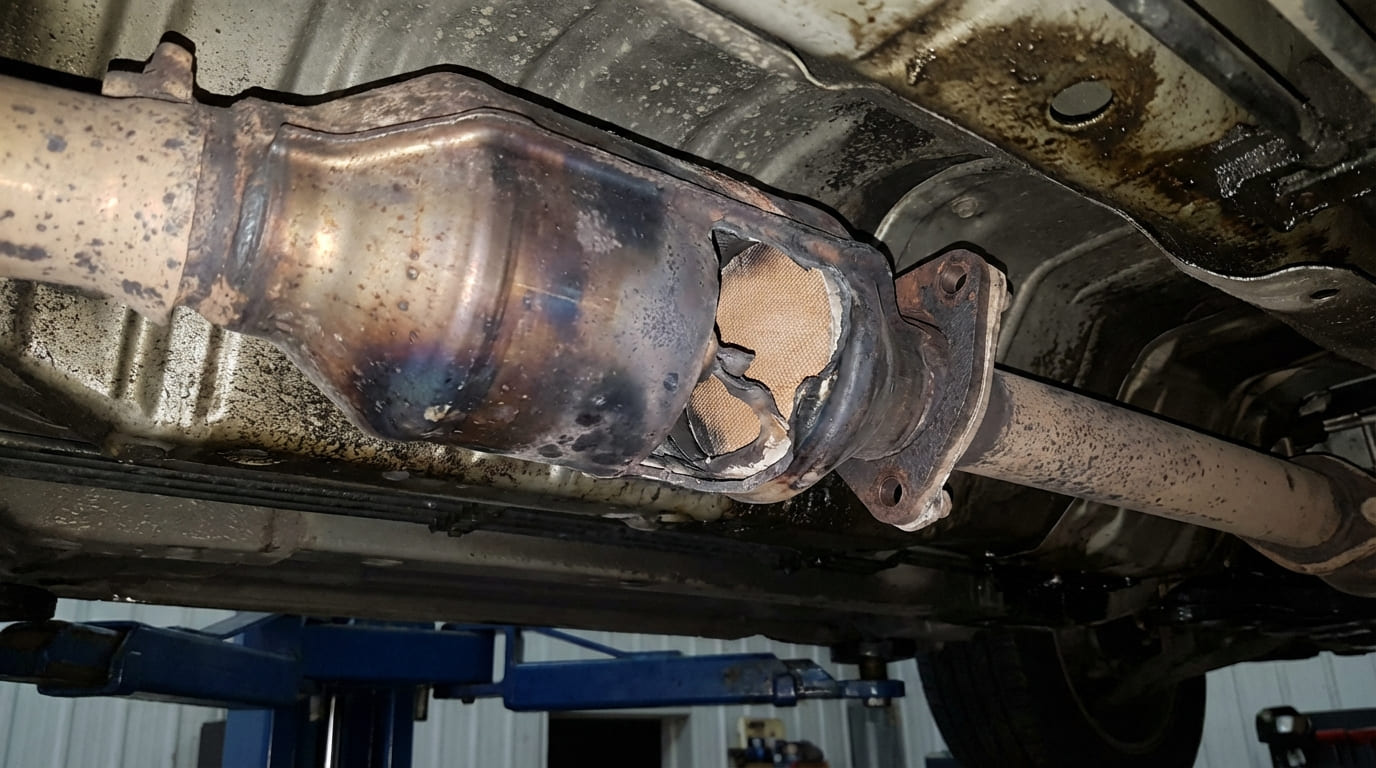
In my two decades as a shop foreman, I’ve seen catalytic converters fail for many reasons — and just as often replaced when they weren’t the real problem. The check engine light and a P0420 code often point the finger at the converter, but more times than not, it’s a symptom, not the source. Replacing it without diagnosis is a gamble. Here’s what actually kills a catalytic converter — and how to know for sure before you spend hundreds or thousands.
How to Diagnose Catalytic Converter Failure
Before condemning the converter, rule out false triggers. Many failures stem from engine issues that go unnoticed until damage is done. Start with these diagnostic steps:
- Scan for codes: P0420/P0430 indicate low efficiency, but don’t confirm internal damage.
- Check fuel trims: Long-term trims above +10% suggest excess fuel entering the exhaust.
- Inspect O2 sensor data: Compare upstream and downstream sensor activity. A healthy converter shows post-cat O2 switching less than 50% of upstream.
- Test for exhaust leaks: Especially after the converter — air intrusion can mimic low efficiency.
- Perform a backpressure test: Use a gauge at the upstream O2 sensor port. Over 2.5 PSI at 2,500 RPM suggests blockage.
- Do a rattle test: Tap the converter with a rubber mallet. A rattle means broken substrate.
- Use a borescope: Visually inspect the ceramic honeycomb. Look for melting, cracks, or debris.
In my shop, we never replace a converter without first checking misfires, fuel trims, and oil consumption. More than half the time, the real issue is upstream — and replacing the converter alone guarantees a repeat failure.
Main Causes of Failure and How to Check Them
1. Overheating (Thermal Overload)
Excessive heat is the leading cause of premature failure. The ceramic substrate melts or collapses when temperatures exceed 1,800°F. This is almost always due to unburned fuel or engine faults.
How to Check:
- Scan for misfire codes (P030x). Use live data to monitor misfire counters under load — some misfires only appear during acceleration.
- Inspect ignition components: coils, plugs, and wires. High-mileage vehicles often develop weak coils.
- Test fuel pressure: After shutdown, pressure should hold steady. A drop within minutes indicates leaking injectors.
- Check for oil or coolant in combustion: Blue smoke = oil; white smoke = coolant.
- Measure backpressure: High readings point to restriction — possibly from a partially melted converter.
I’ve saved countless converters by catching a misfire early. If your car is misfiring, fix it within a few hundred miles. A $150 coil can prevent a $1,000 converter job.
2. Chemical Contamination (Catalyst Poisoning)
Contaminants coat the precious metals inside the converter, reducing its ability to convert pollutants. This happens gradually and is often tied to fluid leaks or improper additives.
How to Check:
- Review maintenance history: Was high-ZDDP oil used? Was non-OEM RTV sealant applied near intake or valve covers?
- Inspect for oil consumption: More than a quart every 1,500 miles increases phosphorus exposure.
- Check coolant system: A small head gasket or EGR cooler leak can introduce silicates.
- Ask about fuel additives: MMT or leaded fuels — even occasionally — can poison the catalyst.
- Borescope inspection: Look for white or crusty deposits (silicon), dark sludge (oil), or reddish residue (lead).
Once poisoned, the converter cannot be cleaned. Prevention is key.
3. Physical Damage
The ceramic core is fragile. Impacts, thermal shock, or internal blockage can crack or collapse it.
How to Check:
- Rattle test: Tap the converter. A loose rattle means broken substrate.
- Visual inspection: Look for dents, especially from road debris or improper jacking.
- Check for thermal shock: Did the driver go through deep water with a hot exhaust?
- Inspect for carbon buildup: Common in short-trip drivers. The converter never reaches operating temperature, so soot accumulates.
I once diagnosed a “failed” converter that was actually blocked by a chewed-up catalytic reducer from a previous repair. Always inspect the entire exhaust path — foreign objects do get in.
4. Age and Normal Wear
Even with perfect maintenance, converters degrade. Noble metals sinter over time, reducing surface area. Efficiency drops slowly.
How to Check:
- Monitor post-cat O2 sensor: Minimal switching indicates reduced storage capacity.
- Review vehicle history: No misfires, oil consumption, or fuel issues? Age may be the culprit.
- Consider mileage: Most OEM units last 10–15 years or 150,000+ miles under ideal conditions.
If the engine is clean and all other causes are ruled out, replacement may be unavoidable.
Costs and Repair vs Replace Decisions
| Issue | Typical Repair Cost | Repair vs Replace Logic |
|---|---|---|
| Ignition coil failure (causing misfire) | $150–$300 | Fix first. Prevents further converter damage. Always replace all coils if one failed on high-mileage engine. |
| Leaking fuel injector | $400–$800 | Replace affected injector. Test fuel pressure hold. |
| Head gasket leak (coolant) | $1,200–$2,500 | Address before converter replacement. Silicate contamination will ruin new unit. |
| Oil consumption (worn rings/seals) | $2,000+ (engine work) | Converter replacement without fixing oil burn is temporary. Consider vehicle value vs repair cost. |
| OEM catalytic converter replacement | $900–$2,500 | Only after root cause is fixed. Use OEM or CARB-compliant part to avoid future codes. |
| Universal/consumer converter | $300–$600 | Higher failure rate. Often lacks proper thermal management. Not legal in all states. |
In my shop, we refuse to install a new converter if oil consumption exceeds a quart per 1,000 miles. It’s not worth it — the customer will be back in 12 months with the same issue.
Diagnostic Decision Guide
| Symptom / Code | Most Likely Causes | Less Common Causes |
|---|---|---|
| P0420/P0430 (Low Efficiency) | Misfire, oil/coolant contamination, aging catalyst | Exhaust leak post-cat, faulty post-O2 sensor, PCM issue |
| White smoke + coolant loss | Head gasket, cracked cylinder head | EGR cooler leak, intake manifold gasket (GM 3.1L/3.4L) |
| High backpressure (>2.5 PSI at 2,500 RPM) | Converter substrate collapse, crushed pipe | Muffler blockage, foreign object, pre-cat failure |
| Rattling from exhaust when cold | Broken substrate, impact damage | Loose heat shield, broken hanger, resonator |
Critical Best Practices
- ✅ Diagnose misfires completely before replacing the converter. Misfires are the top cause of thermal failure.
- ✅ Inspect upstream and downstream O2 sensors. A lazy post-cat sensor can mimic converter failure.
- ✅ Check for exhaust leaks downstream of the converter. Even a small leak can dilute exhaust and trigger a code.
- ✅ Use a borescope to confirm internal condition. Visual proof beats guesswork.
- ⚠️ Avoid replacing the converter without fixing oil or coolant consumption. You’re just installing a time bomb.
- ⚠️ Avoid cheap universal converters. Many don’t meet thermal or emissions specs and fail early.
- ⚠️ Don’t ignore driver habits. Frequent short trips prevent light-off temperature, leading to carbon buildup.
Real-World Lessons from the Shop
A 2012 Toyota Camry came in with a P0420. Owner replaced the upstream O2 sensor twice. Fuel trims were normal, but borescope showed carbon blockage — not melting. Live data revealed intermittent cylinder 3 misfire under load. Replaced coil and cleared code. Converter was fine. Lesson: Intermittent misfires are easy to miss. Always test under real-world conditions.
A 2008 Ford F-150 had a rattle and P0420. Converter replaced a year prior. Rattle test confirmed broken substrate. Compression test showed 25% oil consumption. Customer added a quart every 750 miles. New converter failed in 10 months. Root cause never fixed. Lesson: Oil contamination doesn’t stop with a new converter.
A 2015 Honda Accord had a P0420. No misfires, clean trims. But a hissing sound led to a small exhaust leak at the downpipe gasket. Sealed it, cleared code — gone for good. Post-cat O2 was reading false lean due to air ingress. Lesson: A $20 gasket can save you $900.
Catalytic converter failure is almost never random. It’s the end result of ignored engine issues. Diagnose the engine, not just the code. Fix the cause, not the symptom. And always — always — verify with data, not assumptions.