Over two decades in the shop, few complaints have made me pause more than a customer describing a fuel odor inside the cabin. It’s one of those issues that can range from a minor annoyance to an imminent safety threat. I’ve learned the hard way that jumping to conclusions—like assuming it’s “just a loose gas cap”—can lead to missed diagnoses or, worse, sending someone home with a fire risk under the hood. What follows is how I approach these cases, step by step, with an emphasis on process, not shortcuts. If you smell gasoline inside your car, treat it seriously: it could be raw fuel, exhaust fumes, or vapor infiltration. Here’s how to find and fix it.
Fuel System Leaks
Fuel leaks are the most urgent cause of a gasoline smell. Raw fuel near hot components creates a fire hazard. The odor may enter the cabin through the HVAC system, floorboards, or vapor migration. Not all leaks drip—some seep only under pressure or when hot. Diagnose methodically.
Engine Bay and Under-Vehicle Leaks
Leaking fuel in the engine bay or along the fuel line path can vaporize quickly and get drawn into the cabin air intake. Common sources include:
- Fuel injector O-rings: Degrade over time, especially on high-mileage engines. A single leaking O-ring can drip fuel onto a hot intake manifold, creating strong fumes.
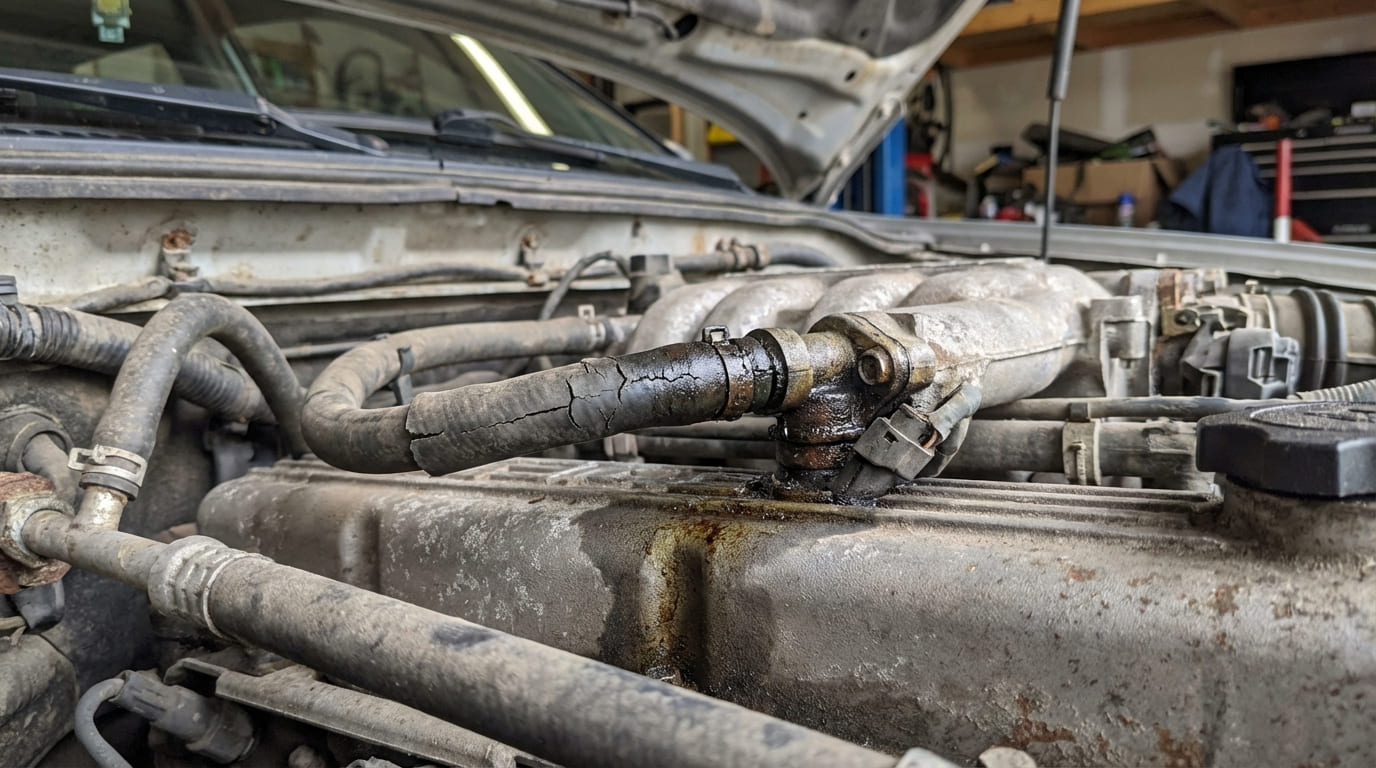
- Fuel lines and fittings: Rubber hoses crack; metal lines corrode or vibrate loose. Direct injection systems (2,000+ psi) can spray a fine mist that evaporates but leaves a potent smell.
- Fuel rail or HPFP seals: Aluminum rails can develop hairline cracks. High-pressure fuel pump (HPFP) seals often fail on turbocharged engines after 80,000 miles.
- Fuel filter housing: Especially if located in the engine bay. Leaks often occur after DIY filter changes with improper sealing.
- Fuel tank or filler neck: Gaskets around the fuel pump module are common failure points. A punctured tank from road debris can leak vapor even without visible dripping.
How to Check:
- Inspect the engine bay with the engine off, then running. Look for wetness, crusty residue, or fuel pooling.
- Use a UV dye (add to fuel tank) and UV light after running the engine—this reveals even intermittent seepage.
- For undercarriage leaks, raise the vehicle safely. Check fuel lines near frame rails, clamps, and suspension points for chafing or rust.
- Perform a fuel pressure test: attach a gauge and monitor for a drop over 10–15 minutes. More than 5 psi loss indicates a leak.
Repair vs Replace: Small hose leaks can be fixed with OEM-style clamps ($5–$15). Replacing a fuel rail or HPFP seal may cost $300–$800 in labor. Fuel tank replacement: $600–$1,200. If the tank is rusted or punctured, replacement is safer than repair.
In my shop, we always replace fuel injector O-rings in sets—even if only one is leaking. They age together, and the labor to access them is the same. Use light oil (not grease) to seat them properly.
Evaporative Emission (EVAP) System Faults
EVAP system leaks are the most common cause of fuel odors without visible fuel. The system traps fuel vapors and routes them to the engine. When a component fails, vapor escapes—often near the fresh air intake, allowing fumes into the cabin.
Common Sources:
- Fuel cap seal: Cracked or hardened seals won’t hold pressure. Some caps click but still leak.
- EVAP canister: Mounted in fender or near tank, it can crack—especially from impact or age.
- Purge or vent valves: Stuck open = continuous vapor flow. Common on high-mileage vehicles.
- EVAP lines: Nylon lines are vulnerable to rodent damage. A pinhole leak can trigger codes or cause odor.
- Fuel tank pressure sensor: Rare, but seal failure here allows vapor egress.
How to Check:
- Scan for codes: P0440 (large leak), P0442 (small leak), P0455 (gross leak). But don’t rely on codes—some leaks don’t trigger them.
Test the fuel cap with a pressure tester. It should hold 1 psi for 30 seconds. Replacement cap: $15–$40.
Inspect all EVAP lines visually. Check the canister under the fender well—common rodent target.
Use a smoke machine: Introduce smoke at the EVAP test port. Watch for puffs at connections, canister, or lines. Add UV dye for pinpoint accuracy.
Command purge and vent valves via bi-directional control. Listen for clicks and verify they seal during smoke test.
Repair vs Replace: A cracked canister: $120–$250. Rodent-damaged lines: $80–$150 with labor. Most EVAP repairs are parts-intensive but labor-light. Always use OEM-style spring clamps—hose clamps cut nylon lines over time.
In my shop, we never assume one leak is the only leak. I’ve seen cases where a small line crack and a failing canister combined to create a persistent smell. Smoke test the entire system—even if you find one issue.
Exhaust System Issues (Unburnt Fuel Fumes)
Not all “gasoline smells” come from liquid fuel. Unburned hydrocarbons in the exhaust smell like raw gas—especially if the catalytic converter is failing. These fumes can enter the cabin via leaks near the firewall.
Common Sources:
- Engine running rich: Caused by leaking injectors, faulty O2 sensors, dirty MAF, or bad coolant temp sensor.
- Exhaust manifold crack or gasket leak: Especially near the firewall. Fumes get drawn into the cabin under acceleration.
- Catalytic converter failure: Clogged or degraded converters can’t oxidize fuel, leading to strong odor—sometimes mixed with sulfur.
How to Check:
- Scan for codes: P0172 (system too rich), P0420 (catalyst efficiency), or O2 sensor codes.
Monitor live data: Check short-term (STFT) and long-term (LTFT) fuel trims. If both are above +10%, the engine is running rich.
Inspect exhaust manifold and downpipe for soot, cracks, or ticking noises on cold start.
Use an exhaust gas analyzer: High HC (hydrocarbon) levels confirm unburned fuel.
Repair vs Replace: Fix root cause first. A $120 MAF sensor can prevent a $1,200 catalytic converter replacement. Exhaust manifold repair: $200–$500. Cat replacement: $700–$2,000.
In my shop, we always test fuel trims before touching the fuel system. I once replaced a customer’s injectors unnecessarily—only to find the real issue was a faulty coolant temperature sensor fooling the ECU into rich mode.
Interior and HVAC-Related Causes
Sometimes the source is simple: fuel spilled in the trunk, soaked floor mats, or external fumes pulled in by the HVAC system.
Common Sources:
- Spilled fuel under floor mats or in trunk
- Fuel-soaked rags, tools, or clothing stored in the vehicle
- External fumes: parking near gas pumps, driving behind diesel trucks
- Cabin air filter saturated with fuel or exhaust odor
- Exhaust leak near fresh air intake
How to Check:
- Remove floor mats and inspect under seats and trunk. Smell each area directly.
Switch HVAC to recirculation mode. If the smell fades in 2–3 minutes, the source is likely external.
Inspect the cabin air filter. If it reeks, replace it—even if it looks clean. Cost: $15–$40.
Check for exhaust leaks near the firewall or cowl. A cold start test helps: listen for hissing or ticking.
Repair vs Replace: Interior cleanup: absorbent pads, baking soda, and time. Replace cabin filter. If exhaust is the culprit, repair the leak—don’t rely on recirculation long-term.
Diagnostic Decision Table: When You Smell Gasoline Inside
| Observation | Most Likely Causes | Less Common But Possible | Recommended Next Step |
|---|---|---|---|
| Smell strongest at startup, fades quickly | Fuel injector O-rings, HPFP seal | EVAP purge valve stuck open | Visual inspection of engine bay, UV dye test |
| Smell constant, worse at idle | EVAP system leak, fuel cap | Fuel tank vent valve leak | Smoke test, OBD2 scan for EVAP codes |
| Smell with exhaust odor, worse under load | Exhaust manifold leak, rich condition | Catalytic converter failure | Exhaust inspection, live data scan |
| Smell only when in fresh air mode | External fumes, cabin air filter | Exhaust leak near intake | Switch to recirculation, inspect filter |
| Smell after refueling, triggers check engine light | Fuel cap not sealed, EVAP canister | Fuel tank overfill, vent restriction | Check cap, scan for P0455/P0442 |
Best Practices: Do and Avoid
- ✅ Clean fuel injector bore and O-ring groove before reassembly. Debris prevents sealing.
- ✅ Use OEM-specified torque on fuel rail bolts. Over-torquing cracks aluminum rails.
- ✅ Replace EVAP line clamps with OEM-style spring clamps. Hose clamps fail over time.
- ⚠️ Don’t replace a fuel cap without testing the old one. Many “bad” caps actually hold pressure.
- ⚠️ Don’t assume a smoke test failure is the only leak. Multiple small leaks can combine.
- ⚠️ Don’t ignore when the smell occurs. Pattern matters: cold start, after refuel, in traffic?
Situation: A 2014 sedan came in with a strong fuel smell after every refuel. No check engine light. Initial inspection showed no leaks.
Initial Assumption: Loose fuel cap or overfilling.
Deep Dive: I tested the cap—it held pressure fine. Smoke test revealed no EVAP leaks. Then I noticed the smell was strongest near the rear passenger floor. Removed the trim and found fuel residue around the fuel pump module gasket.
Nuanced Lesson Learned: Not all fuel tank leaks drip under the car. Vapor can migrate through the chassis and condense in the cabin. Always check the pump seal—even if the tank isn’t wet externally.
Situation: A customer complained of a gasoline smell only when idling in traffic. No codes, no visible leaks.
Initial Assumption: EVAP system issue.
Deep Dive: Smoke test passed. Then I monitored fuel trims—LTFT was +18%. Further testing revealed a contaminated MAF sensor. The engine was running rich, dumping unburned fuel into the exhaust.
Nuanced Lesson Learned: A fuel smell isn’t always from liquid fuel. Combustion inefficiency can produce vapor that mimics a leak. Always verify engine performance before disassembling fuel systems.
Situation: SUV with intermittent fuel odor, mostly on cold mornings. No codes, no leaks found during two prior visits.
Initial Assumption: Possibly a false alarm.
Deep Dive: I asked the owner to drive with the HVAC on recirculation. The smell disappeared. Switched to fresh air—odor returned. Smoke test showed no EVAP leaks. Then I noticed a small crack in the exhaust manifold near the firewall. On cold start, exhaust was being drawn into the fresh air intake.
Nuanced Lesson Learned: The HVAC system doesn’t discriminate between odors. What smells like gasoline might be exhaust. Always test HVAC modes and consider airflow dynamics.
In my experience, the most effective diagnoses come not from jumping to the most obvious answer, but from methodically ruling out possibilities—especially the ones that don’t show up on a scan tool. A fuel smell inside the cabin is a symptom, not a diagnosis. The real work begins when you start asking not “what could it be?” but “what would I miss if I stopped here?” Always consult the specific service manual for your vehicle’s EVAP test procedures, pressure specs, and component locations—what’s true for one platform may not apply to another.