In my shop, a rough idle or hesitation under acceleration often leads me to the throttle body. It’s a small part with a big job: controlling airflow into the engine. But modern throttle bodies do more than just open and close—they’re central to engine performance, idle control, and even transmission behavior. Misdiagnosing it leads to wasted time and money. This guide cuts through the noise and gives you what you need: how it works, how to test it, when to clean or replace it, and how to avoid common pitfalls.
Primary Function: Airflow Regulation
The throttle body controls how much air enters the engine. A butterfly valve (throttle plate) opens and closes based on driver input. More air means more fuel can be added, increasing power. Less air reduces engine speed. This is the foundation of engine load and response.
Engine Speed, Load, and Vacuum
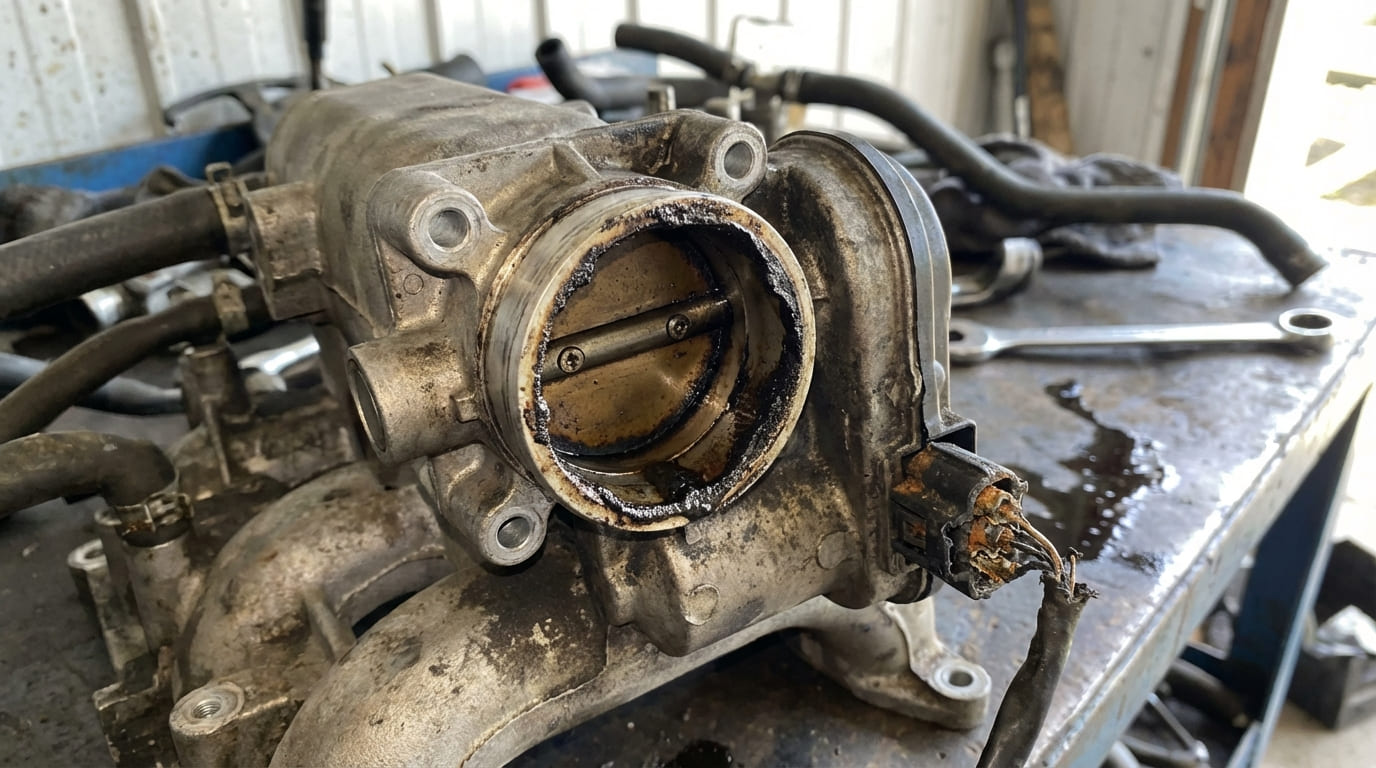
Throttle plate position directly affects engine speed and vacuum. At idle, the plate is nearly closed, creating strong vacuum. This vacuum powers the brake booster and PCV system. If the throttle body is dirty or leaking, vacuum drops—leading to hard brake pedal effort or emissions issues. Carbon buildup can prevent the plate from closing fully, causing high idle or stalling.
Integrated Components and How They Fail
Modern throttle bodies aren’t just air valves—they’re sensor hubs. Understanding the components helps you diagnose faster and avoid throwing parts at a problem.
Throttle Position Sensor (TPS)
The TPS tells the ECU the throttle plate angle. It’s a potentiometer that outputs a voltage signal. This data controls fuel delivery, ignition timing, and transmission shifts. A failing or drifting TPS causes hesitation, rough shifts, or check engine lights.
Most TPS units output 0.4–0.9V at idle and 4.0–4.8V at wide open throttle (WOT), but always check the service manual—specs vary by make and model.
In my shop, we always graph the TPS signal with a scan tool. A tiny voltage drop during a smooth sweep—missed on a digital readout—can cause a stumble under light load. Graphing catches what numbers hide.
Idle Air Control (IAC) Valve (Non-ETC Systems)
On older cable-operated systems, the IAC bypasses air around the closed throttle plate to control idle speed. It adjusts for cold starts and loads like A/C or power steering. When it sticks or clogs with carbon, idle becomes erratic or stalls occur.
Cleaning sometimes helps, but many IAC valves fail internally and need replacement. On some vehicles, the IAC is part of the throttle body assembly—replacing it means replacing the whole unit.
Electronic Throttle Control (ETC) / Drive-by-Wire
Modern vehicles use ETC—no cable. The accelerator pedal has an APP (Accelerator Pedal Position) sensor that sends a signal to the ECU. The ECU then commands a motor in the throttle body to open the plate.
The ECU uses torque-based logic. If traction control detects wheel slip, it can reduce throttle even if your foot is on the floor. This integration means failures can mimic mechanical issues.
We once had a Ford F-150 with “Reduced Engine Power.” Everyone blamed the throttle body. Scan tool showed P2135—APP/TPS correlation fault. The throttle body was fine. One APP sensor had a cracked solder joint. Always check the pedal sensor before replacing the throttle body.
Common Problems and How to Diagnose Them
Carbon buildup is the #1 issue—especially in direct-injection engines where fuel doesn’t clean the intake. But symptoms can point to sensors, motors, or leaks. Diagnose systematically.
How to Check for Carbon Buildup
Remove the air intake tube and inspect the throttle plate and bore. Even a thin, dark layer can restrict airflow at idle. If the plate is touching carbon when closed, it can’t seal—causing idle issues.
If the engine runs rough at idle but smooths out at higher RPMs, carbon is likely the cause. Clean before replacing parts.
How to Test the TPS
Use a scan tool to monitor TPS voltage or percentage. Slowly press and release the accelerator. The signal should rise and fall smoothly without drops or spikes.
For a more detailed test, use a digital multimeter with min/max capture. A break in the resistive track will show as a voltage jump.
| Symptom | Most Likely Causes | Diagnostic Priority |
|---|---|---|
| Rough Idle | Carbon buildup, IAC failure, vacuum leak, TPS drift | Visual inspection → Smoke test → Scan tool data → Clean or replace |
| Stumble/Hesitation | TPS signal drop, carbon restriction, ETC motor lag | Graph TPS sweep → Check for carbon → Monitor ETC response time |
| High Idle | Stuck IAC, carbon holding plate open, vacuum leak | Inspect plate position → Smoke test → Monitor IAC steps |
| Reduced Engine Power | APP/TPS correlation fault, ETC motor failure, wiring issue | Scan for DTCs → Check APP and TPS signals → Test motor resistance |
| Stalling at Idle | IAC failure, carbon blockage, gasket leak | Check IAC operation → Inspect for leaks → Clean throttle body |
Diagnostic Procedures That Work
Diagnosis starts with inspection and ends with data. Never replace a throttle body without testing.
Visual and Physical Inspection
- Remove the intake tube and inspect the throttle plate and bore for carbon.
- Check wiring and connectors for damage or corrosion—especially in coastal areas.
- Use a smoke tester to check for vacuum leaks around the throttle body gasket. Propane or carb cleaner tests are unreliable and risky.
Scan Tool Data You Must Check
- TPS Voltage/Percentage: Should sweep smoothly from idle to WOT. Watch for drops or flat spots.
- APP Sensor Data: In ETC systems, APP and TPS signals must correlate. A mismatch triggers limp mode.
- IAC Position/Duty Cycle: If the ECU commands movement but the IAC doesn’t respond, it’s mechanical.
- DTCs: Common codes include P0120–P0124 (TPS), P0505 (IAC), P2100–P2112 (ETC). These are clues, not verdicts.
Multimeter Testing (For Advanced Users)
- TPS Resistance: Should change smoothly with throttle movement. Use min/max capture to catch intermittent breaks.
- IAC Coil Resistance: Typically 8–12 ohms. Open or shorted coils fail the test.
- ETC Motor Resistance: Requires OEM specs and wiring diagram. Not DIY-friendly—wrong pinout can fry the ECU.
A 2008 Toyota Camry came in with high idle after a throttle body cleaning. The tech had forced the plate open with a screwdriver. We found the ETC motor gears were stripped. Never force a drive-by-wire throttle plate. Use a scan tool to command it open or have an assistant press the pedal.
Maintenance and Repair: What You Need to Know
Regular cleaning prevents most idle issues. But repairs on ETC systems require care—and sometimes professional tools.
Throttle Body Cleaning (DIY-Friendly)
- Disconnect the air intake tube.
- Use a throttle body cleaner (not carb cleaner—it damages sensors).
- Apply to the plate and bore. Use a soft brush or cloth.
- For ETC systems, do not force the plate. Use a scan tool or have someone press the accelerator.
- Reinstall and perform an idle relearn (see below).
If the problem returns quickly, check for oil consumption or PCV system issues—excess crankcase vapors cause rapid carbon buildup.
Idle Relearn Procedure
Many ETC systems require an idle relearn after cleaning or battery disconnect. Some do it automatically after a drive cycle. Others need a specific sequence or scan tool command.
Failure to relearn causes lingering idle issues. Consult the service manual for your vehicle.
Replacement: When and How
Some throttle bodies allow individual sensor replacement. Most modern units are integrated—replace the whole assembly.
- TPS Replacement: If serviceable, may require calibration via scan tool.
- IAC Replacement: On some models, it’s a standalone part. On others, it’s part of the throttle body.
- Complete Throttle Body: For ETC systems, replacement often requires programming, security PIN, or module matching. DIY swaps may bolt on but won’t work.
OEM parts are recommended for ETC systems. Aftermarket units often have calibration issues.
A 2015 Honda Civic had rough idle and stalling. Customer replaced the IAC and spark plugs. Scan tool and smoke test were clean. But removing the intake revealed heavy carbon on the throttle plate—preventing full closure. Cleaning fixed it. Mechanical blockage can mimic electronic failure. Always look first.
Recommended and Avoid
- ✅ Recommended: Clean throttle body every 30,000–50,000 miles on vehicles with carbon issues.
- ✅ Recommended: Use a smoke tester for vacuum leaks—more accurate than propane.
- ✅ Recommended: Clean bolt threads with a tap before reinstalling. Prevents galling and ensures proper torque.
- ✅ Recommended: Perform idle relearn after cleaning or replacement.
- ⚠️ Avoid: Reusing torque-to-yield bolts. They lose clamping force and can cause leaks.
- ⚠️ Avoid: Abrasive pads or tools on the throttle bore. Scratches trap carbon.
- ⚠️ Avoid: Forcing the throttle plate open on ETC systems. Damages motor gears.
- ⚠️ Avoid: Assuming “Reduced Engine Power” means a bad throttle body. Check APP sensors and wiring first.