In my 20 years as a mechanic, the fuel pressure regulator (FPR) is one of those quiet, behind-the-scenes parts that rarely gets attention—until it fails. When it does, symptoms like rough idle, misfires, hard starts, or fuel in the vacuum line can send DIYers and even pros down the wrong diagnostic path. The truth is, the FPR has one critical job: maintain the correct fuel pressure so your engine gets the right amount of fuel at the right time. Let’s cut through the noise and focus on what matters—how it works, how to test it, and how to know when to replace it.
Core Function of the Fuel Pressure Regulator
The fuel pressure regulator ensures the fuel injectors spray the correct amount of fuel by maintaining a consistent pressure difference between the fuel rail and the intake manifold. This pressure differential—typically 35–45 psi on many factory systems—is what allows the engine control unit (ECU) to accurately calculate fuel delivery based on injector pulse width. If the pressure fluctuates, so does the fuel volume, leading to drivability issues.
How It Maintains Fuel Delivery Accuracy
Fuel injectors are calibrated to deliver a precise amount of fuel at a specific pressure. If pressure drops, less fuel flows—even if the ECU opens the injector for the same duration. This causes a lean condition. If pressure rises, too much fuel flows, creating a rich condition. The FPR prevents this by adjusting fuel pressure in response to engine load.
How It Prevents System Damage
The fuel pump can generate more pressure than the system can handle. The FPR acts as a relief valve, sending excess fuel back to the tank via the return line (in return-style systems). Without it, high pressure could damage injectors, fuel lines, or the pump itself—especially under heavy load.
How Fuel Pressure Regulators Work
Vacuum-Referenced Regulators (Return-Style Systems)
Most common on older and performance vehicles, these regulators use engine vacuum to adjust fuel pressure. Inside is a spring and diaphragm. Manifold vacuum pulls against the spring, opening a valve that allows excess fuel to return to the tank. At idle (high vacuum), fuel pressure drops. Under load (low vacuum), pressure increases—keeping the differential steady.
Non-Vacuum-Referenced Regulators (Returnless Systems)
Found in modern vehicles, these regulators are located inside the fuel tank, part of the fuel pump module. They maintain a fixed pressure—no vacuum line involved. The ECU may adjust fuel pressure by varying pump speed via pulse-width modulation (PWM), but the regulator itself doesn’t respond to engine load. These are harder to test without access to the fuel rail test port or scan tool data.
Types of Fuel Pressure Regulators
Return-Style Systems
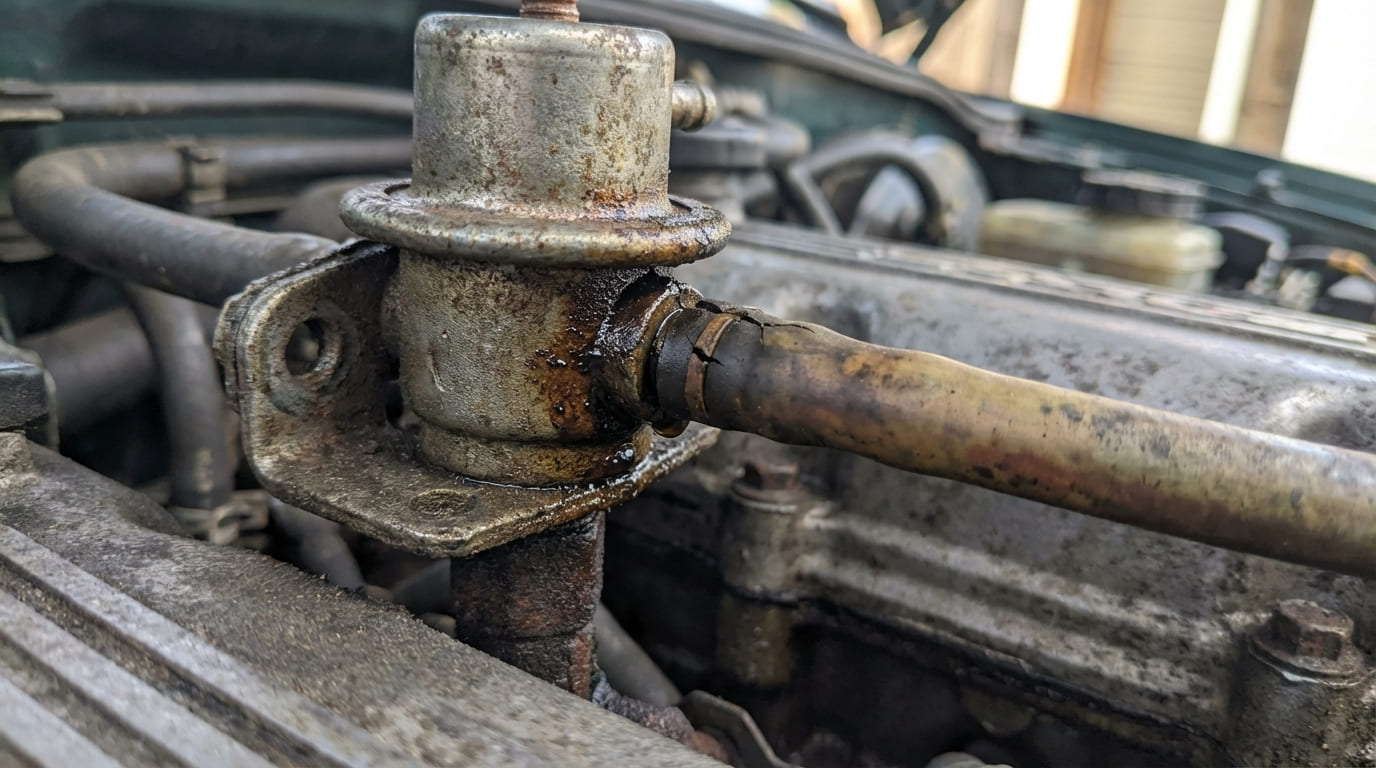
The regulator is mounted on the fuel rail or in-line, with a dedicated return line running back to the tank. These are easier to diagnose with a fuel pressure gauge. Common issues include vacuum line leaks, diaphragm failure, or clogged return lines. Most aftermarket performance builds use this style for easier tuning.
Returnless-Style Systems
No return line—fuel pressure is regulated in-tank. This reduces evaporative emissions and fuel heating. Diagnosis requires checking pressure at the rail test port or using live data from the fuel rail pressure sensor. If pressure is off, the entire in-tank module may need replacement—costing $400–$800. Always check electrical supply before assuming mechanical failure.
What Happens When the Fuel Pressure Regulator Fails
Low Fuel Pressure (Lean Condition)
Causes misfires, hesitation, and lean codes like P0171 or P0174. But don’t assume it’s the regulator—check the fuel filter, pump, and for vacuum leaks first. A clogged filter is a far more common cause than a failed FPR.
High Fuel Pressure (Rich Condition)
Results in black smoke, fuel smell, fouled spark plugs, and poor fuel economy. In extreme cases, fuel can dilute engine oil if the regulator’s diaphragm ruptures and dumps fuel into the intake via the vacuum line. This is a clear sign of regulator failure.
Fuel in the Vacuum Line
If you pull the vacuum hose off the regulator and find liquid fuel, the diaphragm is ruptured. Replace the regulator immediately. This is one of the most definitive failure signs.
Where to Find the Fuel Pressure Regulator
On return-style systems, it’s typically mounted on the fuel rail. Some older V8s have it at the end of the fuel line. Returnless systems house it in the fuel tank. Inline regulators are rare—mostly in older trucks or marine engines. Rail-mounted units are easier to access but more exposed to heat and vibration.
How to Diagnose a Bad Fuel Pressure Regulator
You can’t diagnose fuel pressure issues by smell or guesswork. You need a fuel pressure gauge with the correct adapters. Many modern cars have a Schrader valve on the fuel rail—just like a tire valve. If not, you’ll need a T-fitting or quick-connect tool.
Testing Return-Style Regulators
- Relieve fuel pressure by pulling the fuel pump fuse and cranking the engine until it stalls.
- Connect the gauge to the test port or fuel line.
- Turn the key to “run” to prime the system—note static pressure.
- Start the engine and check running pressure.
- Disconnect the vacuum line from the regulator—pressure should increase by 5–10 psi (the amount of manifold vacuum).
- Pinch the return line briefly—pressure should spike. If it doesn’t, the regulator may be stuck open.
- Shut off the engine and monitor pressure for 10 minutes. A drop of more than 5–10 psi suggests a leak—could be the regulator, injectors, or fuel pump check valve.
Testing Returnless-Style Regulators
- Connect the gauge to the fuel rail test port.
- Check static and running pressure against manufacturer specs.
- Monitor pressure stability under load. It should remain within a narrow range.
- Use a scan tool to view live fuel rail pressure sensor data and fuel trim values. Wild swings suggest regulation issues.
- If pressure is low, check voltage at the fuel pump connector. A 1–2 volt drop can significantly reduce pump output.
Repair vs. Replace: Cost and Practicality
A replacement fuel pressure regulator costs $30–$120 for return-style systems. Labor is typically 0.5–1 hour. For returnless systems, the entire in-tank module may need replacement—$400–$800 parts and labor. Before replacing, always test fuel pressure and electrical supply. A $10 vacuum line or $5 fuel filter can save you hundreds.
| Part | Average Cost | Labor Time |
|---|---|---|
| Fuel Pressure Regulator (return-style) | $30–$120 | 0.5–1 hour |
| Fuel Pump Module (returnless system) | $300–$700 | 2–4 hours |
| Fuel Pressure Gauge (tool) | $40–$100 | N/A |
Best Practices and Common Mistakes
- ✅ Recommended: Always relieve fuel pressure before disconnecting lines. Pull the fuel pump fuse and run the engine until it stalls.
- ✅ Recommended: Clean the fuel rail and regulator area before removal. Dirt can cause leaks or damage seals.
- ✅ Recommended: Replace the vacuum line to the regulator if present. Old rubber cracks and causes false readings. I replace it every time—it’s cheap insurance.
- ⚠️ Avoid: Reusing old O-rings or seals. They harden and won’t seal. A $2 seal kit prevents leaks and callbacks.
- ⚠️ Avoid: Assuming a bad regulator just because you smell fuel. Check for leaking injectors, cracked fuel lines, or soaked engine insulation first.
- ⚠️ Avoid: Over-tightening regulator bolts. Aluminum fuel rails crack easily. Torque to spec—usually hand-tight plus a quarter turn.
Diagnostic Scenarios and Real-World Causes
| Symptom | Most Likely Causes | Less Common But Possible |
|---|---|---|
| Low fuel pressure at idle | Stuck-open FPR, clogged fuel filter, weak fuel pump | Kinked fuel line, collapsed sock filter in tank, voltage drop to pump |
| High fuel pressure | Stuck-closed FPR, blocked return line, collapsed return hose | Wrong regulator installed, aftermarket pump without regulator |
| Fuel in vacuum line | Failed FPR diaphragm | Contaminated vacuum line, misrouted hose |
| Pressure drops rapidly after shutdown | Leaking FPR, leaking injector, faulty fuel pump check valve | Check valve seat contamination, air in fuel line (rare) |
Situation: A 2008 V6 pickup came in with rough idle and black smoke. Customer said it started after a fuel filter change.
Initial Assumption: I thought maybe the filter was installed backward or was defective.
Deep Dive: Hooked up the gauge—pressure was 60 psi at idle, way above spec. Disconnected the vacuum line: no change. Pinched return line: pressure spiked, then dropped fast. Found the return line was kinked under the frame rail—probably during the filter job.
Nuanced Lesson Learned: High pressure isn’t always a failed regulator. A blocked or kinked return line can mimic the same symptoms. Always inspect the entire fuel path, not just the component.
Situation: 2012 sedan with P0172 (system too rich) and hard hot starts. Fuel smell in cabin.
Initial Assumption: Classic FPR diaphragm leak—fuel getting into intake via vacuum line.
Deep Dive: Pulled the vacuum line—dry. Gauge showed normal pressure. Then I checked live data: short-term fuel trims were swinging wildly. Found a split in the intake boot after the MAF. Unmetered air wasn’t the issue—it was leaking fuel from a cracked rail o-ring, vaporizing under the hood.
Nuanced Lesson Learned: Fuel odor doesn’t always mean a bad regulator. Look for external leaks, soaked insulation, or even a leaking injector body before tearing into the FPR.
Situation: A returnless system on a 2015 SUV with low pressure and lean codes. Technician replaced the in-tank module—no change.
Initial Assumption: Bad pump assembly, even though it was new.
Discovery: Checked wiring at the connector—found 2.3 volts drop between the battery and the pump power feed. Corroded splice in the harness under the rear seat.
Nuanced Lesson Learned: In returnless systems, low pressure isn’t always mechanical. Voltage matters. A pump can’t generate pressure if it’s not getting full voltage. Always test supply and ground before condemning components.
The fuel pressure regulator does one job: keep fuel pressure stable so your engine runs right. But diagnosing it requires looking at the whole system—fuel pump, lines, filters, vacuum, and electrical supply. Don’t replace parts based on symptoms alone. Test with a gauge, verify with data, and always consult the factory service manual for specs. That’s how you fix it right the first time.