In my shop, one of the most common questions I get from DIYers and junior techs alike is about air filter replacement intervals. It seems simple on the surface, but real-world conditions can make it anything but straightforward. Over two decades of engine work—from daily drivers to tow rigs and performance builds—I’ve learned that while manufacturers provide guidelines, the actual service life of an air filter depends heavily on usage, environment, and even the type of filter itself.
Standard Replacement Interval and Real-World Adjustments
Most vehicle manufacturers recommend replacing the air filter every 12,000 to 15,000 miles or once per year, whichever comes first. This is a solid baseline for average driving: suburban commutes, mixed city/highway use, and clean climates. Always check your owner’s manual—some European or performance models recommend intervals as short as 7,500 miles, while others extend to 30,000 under “ideal” conditions. Treat these as starting points, not absolutes.
From a cost and practicality standpoint, a standard paper air filter costs $15–$30. Replacing it on schedule is one of the highest-return maintenance tasks you can do. Skipping it risks fuel trim issues, MAF contamination, and long-term carbon buildup—repairs that start at $100+.
In my shop, we always inspect the air filter at every oil change. It takes less than five minutes and often reveals hidden issues—oil saturation, rodent nests, torn media—before they become engine problems.
Key Factors That Change Replacement Frequency
Driving Environment and Vehicle Use
Where and how you drive matters more than mileage alone. Dust, debris, and stop-and-go traffic accelerate filter loading. Here’s how real-world conditions affect service life:
- Dusty or unpaved roads: Replace every 7,500–10,000 miles. Fine dust clogs filters fast—sometimes so severely it mimics a restricted exhaust.
- Construction zones or desert climates: Silica and concrete dust are abrasive and hydroscopic (absorb moisture). These can turn a filter into a brick-like mass in under 6,000 miles.
- High pollen or rural areas: Organic matter like pollen, leaves, and insects can bridge filter pleats, reducing airflow even if the filter doesn’t look dirty.
- Urban stop-and-go traffic: Soot from exhaust and brake dust accumulate over time. While not immediately damaging, long-term exposure degrades filter efficiency.
- Heavy towing or hauling: Engines pull more air, increasing contaminant intake. Inspect every 7,500 miles; replace as needed.
- Frequent short trips: Moisture from incomplete warm-ups mixes with crankcase vapors, coating the filter. This sticky layer traps dirt more aggressively than dry media.
- Extended idling (e.g., delivery vans, police cruisers): Uneven airflow can cause one-sided clogging. Check for warped housings or kinked intake ducts.
Air Filter Type and Service Life
The filter material significantly impacts longevity and maintenance needs:
- Standard cellulose paper: $15–$25. Good for 12,000–15,000 miles in normal conditions. Replace—never clean. Degrades when wet or oily.
- Synthetic media (extended-life): $25–$40. Resists moisture and holds more dirt. Can last 20,000–25,000 miles in clean environments. Still not cleanable.
- Reusable cotton gauze (e.g., K&N): $50–$100. Marketed for 30,000–50,000 miles but requires cleaning and re-oiling every 15,000–25,000 miles. Over-oiling is a common mistake—it contaminates the MAF sensor.
Reusable filters aren’t inherently better. In my experience, neglected oiled filters cause more MAF issues than any other single factor. If you won’t maintain it properly, stick with OEM paper.
How to Check Air Filter Condition [DIY Guide]
Visual inspection is fast, free, and highly effective. Do this every oil change or every 6 months.
- Locate the air filter housing—usually a black plastic box near the front of the engine bay connected to a large intake tube.
- Unclip or unscrew the housing cover. Use care—plastic tabs break easily, especially in cold weather.
- Remove the filter and hold it up to a bright light. If you can’t see light through the pleats, it’s time to replace it.
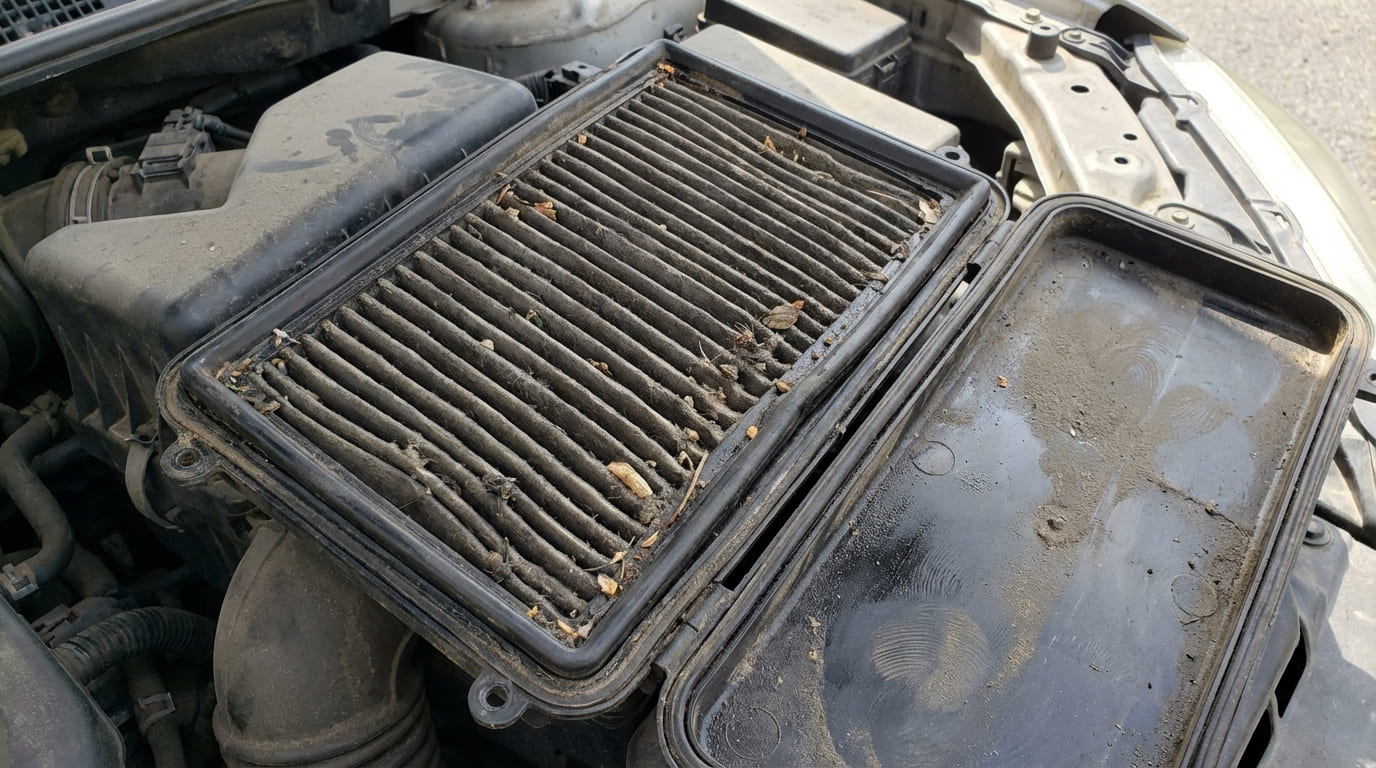
- Inspect for: dark caking (dust), oily residue, tears, collapsed pleats, or signs of rodent nesting.
- While the housing is open, wipe out debris with a clean cloth and inspect the intake tube for cracks or looseness.
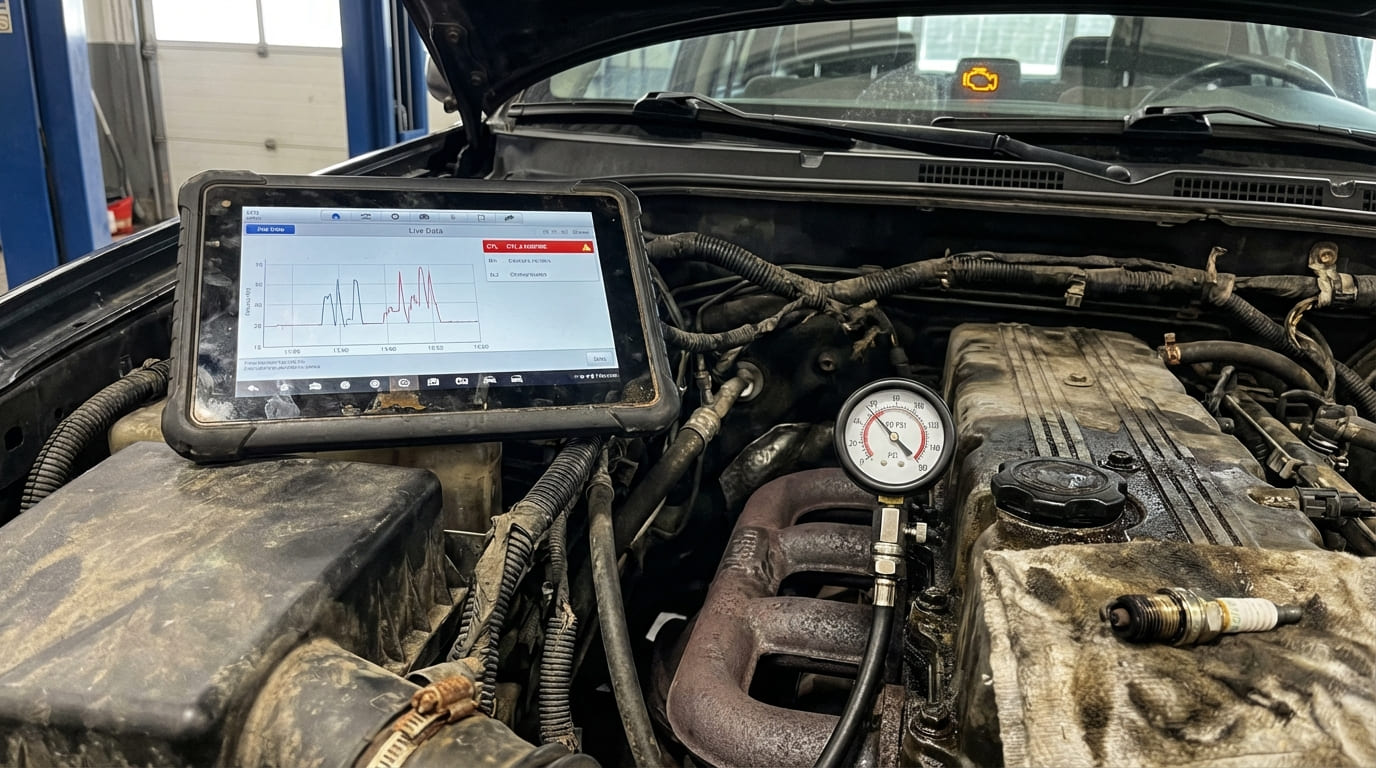
If you have a scan tool, monitor Mass Airflow (MAF) sensor readings at idle. Compare to factory specs—typically 2.5–5.0 g/s depending on engine size. A reading 10–15% below expected may indicate restriction, but rule out a dirty MAF first.
What Happens If You Wait Too Long?
A clogged air filter doesn’t always trigger a check engine light, but the damage accumulates:
- Rich air-fuel mixture due to reduced airflow—ECU adds more fuel, hurting economy.
- Loss of power and throttle response, especially under acceleration or load.
- Fuel economy drops 5–10% in moderate clogs; up to 15% in severe cases.
- Increased risk of MAF sensor contamination—dirt bypasses a saturated filter.
- Carbon buildup on intake valves (in direct-injected engines) due to low airflow velocity and rich mixtures.
I’ve seen engines with 20,000-mile-old filters lose 30 hp on a dyno. Replacing the filter restored most of it. Don’t underestimate airflow.
Best Practices and Common Mistakes
- ✅ Inspect the filter every oil change. Takes 5 minutes, prevents big issues.
- ✅ Clean the air box and intake tube during replacement. Loose debris can get sucked in.
- ✅ Use OEM or high-quality aftermarket filters with proper sealing flanges. Cheap filters can leak unfiltered air.
- ⚠️ Never reuse a paper filter—even if it looks clean. Internal media can be compromised.
- ⚠️ Avoid over-oiling reusable filters. A wet shine is too much—oil migrates to the MAF.
- ⚠️ Don’t assume a new filter fixes performance issues. If power doesn’t return, check MAF, vacuum leaks, or fuel trims.
Diagnosing Filter Condition: What It Tells You
| Observed Condition | Most Likely Causes | Recommended Action |
|---|---|---|
| Uniformly dark gray, caked with fine dust | Normal dirt accumulation in dusty environment | Replace filter; inspect intake ducting for cracks or leaks |
| Oily saturation, especially on upstream side | Excessive crankcase vapors (failed PCV valve), turbo blow-by, or over-rich fuel condition | Check PCV system, turbo seals, and fuel trims before replacing filter |
| Filter torn or crushed | Improper installation, rodent damage, or foreign object ingestion | Replace filter, inspect intake tract for debris, secure housing |
| One-sided clogging | Uneven airflow—kinked intake hose, misaligned housing, or collapsed duct | Inspect entire intake path; ensure housing seals evenly |
| Filter appears clean but MAF readings low | Dirt on MAF sensor, intake air leak, or ECU adaptation error | Do not replace filter—clean MAF and perform smoke test for leaks |
Real-World Lessons from the Shop
Situation: A 2018 Silverado 1500 came in with poor fuel economy and sluggish acceleration. Owner insisted the filter was “only 10,000 miles old.”
Discovery: Filter looked clean, but MAF reading was 2.1 g/s (expected: 3.8). After cleaning the MAF sensor, readings normalized and driveability improved.
Lesson: A clean filter doesn’t guarantee clean airflow. Past oil or debris can contaminate the MAF and mimic restriction.
Situation: A Subaru Outback used on gravel roads had a P0172 code (too rich). Filter was greasy, not dirty.
Discovery: Failed PCV valve was pushing oil mist into the intake. The filter was a symptom, not the cause.
Lesson: Oil in the filter means something else is wrong. Fix the source—PCV, turbo seals, or engine wear—before replacing parts.
Situation: A Ford F-150 with a 3-year-old K&N filter had poor throttle response and high fuel trims.
Discovery: Filter was under-oiled and crusty. MAF sensor was coated in sticky residue from degraded oil.
Lesson: Reusable filters require real maintenance. Neglect causes more problems than a $20 paper filter changed yearly.
In my shop, I treat every air filter inspection as a diagnostic window into engine health. What you find—or don’t find—can reveal driving habits, PCV issues, or intake leaks. Always check the filter, but always ask: Why is it this way? That’s where real mechanical insight begins.