Yes, a clogged fuel filter can absolutely cause hesitation during acceleration. In my two decades of diagnosing drivability issues, I’ve seen restricted fuel filters mimic more complex engine problems. When the filter can’t deliver enough fuel under load, the engine runs lean, misfires, and stumbles—especially during moderate to heavy throttle. But before replacing anything, you must confirm the issue. Many other problems look identical. This guide gives you the diagnostic steps, tools, and real-world insights to get it right the first time.
How a Clogged Fuel Filter Causes Acceleration Hesitation
During acceleration, the engine needs a rapid increase in fuel. The fuel pump pushes gasoline through the filter to the injectors. If the filter is clogged, fuel volume drops even if pressure seems normal at idle. Under load, pressure falls, the air-fuel mixture goes lean, and combustion becomes unstable. The PCM tries to correct with fuel trim, but it can’t fix a physical restriction. The result: hesitation, surging, or power loss.
This typically doesn’t affect starting or idling because fuel demand is low. The problem shows up when you press the throttle hard or climb a hill. That’s why testing under load is critical.
How to Diagnose a Clogged Fuel Filter
Never replace the fuel filter on suspicion alone. Test first. Here’s the proven diagnostic path I use in my shop.
Fuel Pressure Test (Key Diagnostic Step)
A fuel pressure gauge is essential. Scan tool data can help, but it’s not a substitute for direct measurement. Follow these steps:
- Relieve fuel pressure safely—cycle the key off/on 3–4 times without starting, or use a scan tool to shut off the pump.
- Connect a mechanical fuel pressure gauge to the Schrader valve on the fuel rail or use an inline T-fitting.
- Turn the key to ON (engine off): record static pressure. It should reach spec quickly and hold.
- Start the engine: note idle pressure. It should stay within 5 PSI of static on most port-injected systems.
<5>Perform a load test: with engine running, hold 2,500–3,000 RPM in park (or during a road test under acceleration). Watch for pressure drop.
If pressure drops more than 5–10 PSI under load, there’s a restriction. A clogged filter is a likely cause—but not the only one.
Fuel Flow Test (Confirm the Restriction)
When pressure is borderline, test actual fuel volume. This confirms whether the system can deliver enough fuel over time.
Steps:
- Depressurize the fuel system.
- Disconnect the fuel line after the filter (at the rail or before the injectors).
- Route the line into a graduated container.
- Jumper the fuel pump relay or use a scan tool to run the pump for 30 seconds.
- Measure fuel output.
Most passenger cars should deliver about 1 liter (1,000 ml) in 30 seconds. Always check the factory spec—some high-performance or diesel engines need more. If flow is below 80% of spec, the filter or another part of the fuel system is restricting flow.
In my shop, we always do a flow test if hesitation is load-dependent but pressure looks okay at idle. I’ve caught failing pumps and kinked lines this way—problems a pressure test alone would miss.
Other Causes of Acceleration Hesitation (Don’t Blame the Filter Too Soon)
Many issues mimic a clogged fuel filter. Use this table to compare symptoms and narrow the cause.
| Scenario | Most Likely Causes | Supporting Evidence | Less Common But Possible |
|---|---|---|---|
| Hesitation under load, low fuel pressure at idle | Weak fuel pump, clogged filter, kinked fuel line | Flow test confirms volume loss; pump whines under load | Collapsed pickup sock in tank, blocked fuel tank vent |
| Hesitation with normal fuel pressure, lean codes (P0171/P0174) | MAF sensor contamination, vacuum leak, faulty O2 sensor | LTFT > +15%; smoke test reveals leaks; MAF reading erratic | Exhaust restriction, EGR valve stuck open |
| Intermittent misfire under acceleration, no pressure drop | Failing ignition coil, worn spark plugs | Misfire counters on scan tool; weak spark during test | Carbon-fouled injectors, valve train wear |
| Hesitation only when engine is hot | Vapor lock, failing fuel pump, heat-soaked components | Symptoms go away after cooldown; pressure normal when cold | PCM overheating, ECT sensor drift |
Repair vs Replace: Cost and Practical Advice
Replacing a fuel filter is often cheaper than diagnosing it—but skipping diagnosis leads to comebacks. Here’s what you need to know.
Typical costs:
- Fuel filter (OEM): $25–$70
- Aftermarket filter: $15–$40 (some restrict flow—stick to reputable brands)
- Professional labor: $80–$150 (varies by location and filter location)
- Fuel pump (if needed): $200–$600+
When to replace:
- Vehicle has over 60,000 miles and filter has never been changed
- Debris found in old filter or fuel tank
- Flow and pressure tests confirm restriction
When to suspect something else:
- Pressure and flow are normal
- Lean codes persist after filter replacement
- Symptoms are intermittent or temperature-dependent
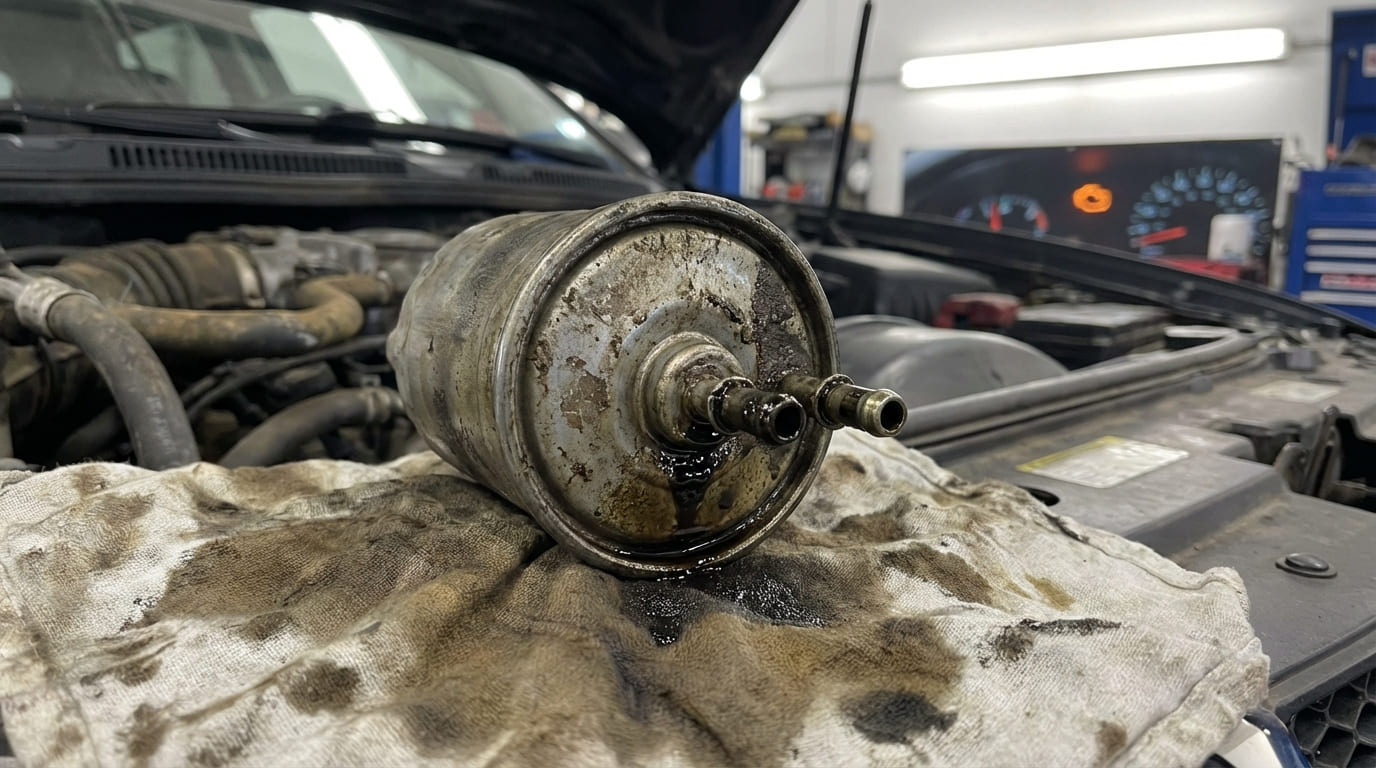
I always inspect the old filter when I replace it. Black sludge means bad fuel or tank rust. Fine sand-like particles suggest poor fuel quality. Either way, if the tank is contaminated, a new filter will clog fast. In those cases, I recommend flushing the tank or advising the owner to switch gas stations.
Pro Tips from the Shop
- ✅ Always check fuel pump voltage and ground at the connector near the tank. Low voltage (below 11V) can cause low pressure that looks like a clogged filter.
- ✅ Use OEM or high-flow aftermarket filters. Some cheap filters flow fine when new but collapse under sustained load.
- ✅ Don’t ignore the fuel tank pickup sock. It’s the first filter. If it’s clogged, the in-line filter won’t matter.
- ⚠️ Never skip pressure relief. On modern cars, a sudden release can spray fuel or damage the system. Follow the factory procedure.
- ⚠️ After replacing the filter, road test under the same conditions that caused the hesitation. Verify the fix.
On a 2012 Ford Fusion, I found hesitation wasn’t from the filter—it was a kinked fuel line after exhaust work. The filter was clean. Moral: restriction isn’t always at the filter. Trace the whole fuel path.
A Subaru came in with a P0171 code and hesitation. Pressure looked good—until I did a sustained hill climb. Then it dropped 12 PSI. The pump was failing under load. Lesson: test under real-world conditions.
I replaced an old filter on a Honda as a guess. Hesitation stayed. Turned out to be a tiny vacuum leak at the brake booster. Always verify with testing, not age.
A clogged fuel filter can definitely cause acceleration hesitation—but so can many other issues. Test fuel pressure and flow before replacing parts. Confirm the repair with a real-world test drive. When in doubt, consult the factory service manual for exact specs. Your time and money are better spent on diagnosis than on guesswork.