Not all cracks are equal. Here’s how I decide repair vs. replacement.
1. Engine Block Material
Cast iron: More forgiving. Responds well to welding and pinning. Heat management is critical—preheat to 500–600°F, cool slowly.
Aluminum: Tricky. Oxidizes fast, warps under heat. TIG welding requires preheating, precise technique, and post-weld stress relief. Often not worth the risk unless it’s a rare engine.
2. Crack Location
This is the biggest factor. Use this guide:
| Location | Repairable? | Notes |
|---|---|---|
| External surface, non-structural (e.g., near freeze plug) | Yes | Pinning or sealant often works |
| Cylinder wall or deck surface | Sometimes | Sleeving possible if crack is isolated |
| Between water jacket and oil gallery | No | High risk of cross-contamination; replace |
| Main bearing web or crank support | No | Structural integrity compromised; replacement required |
3. Crack Size and Type
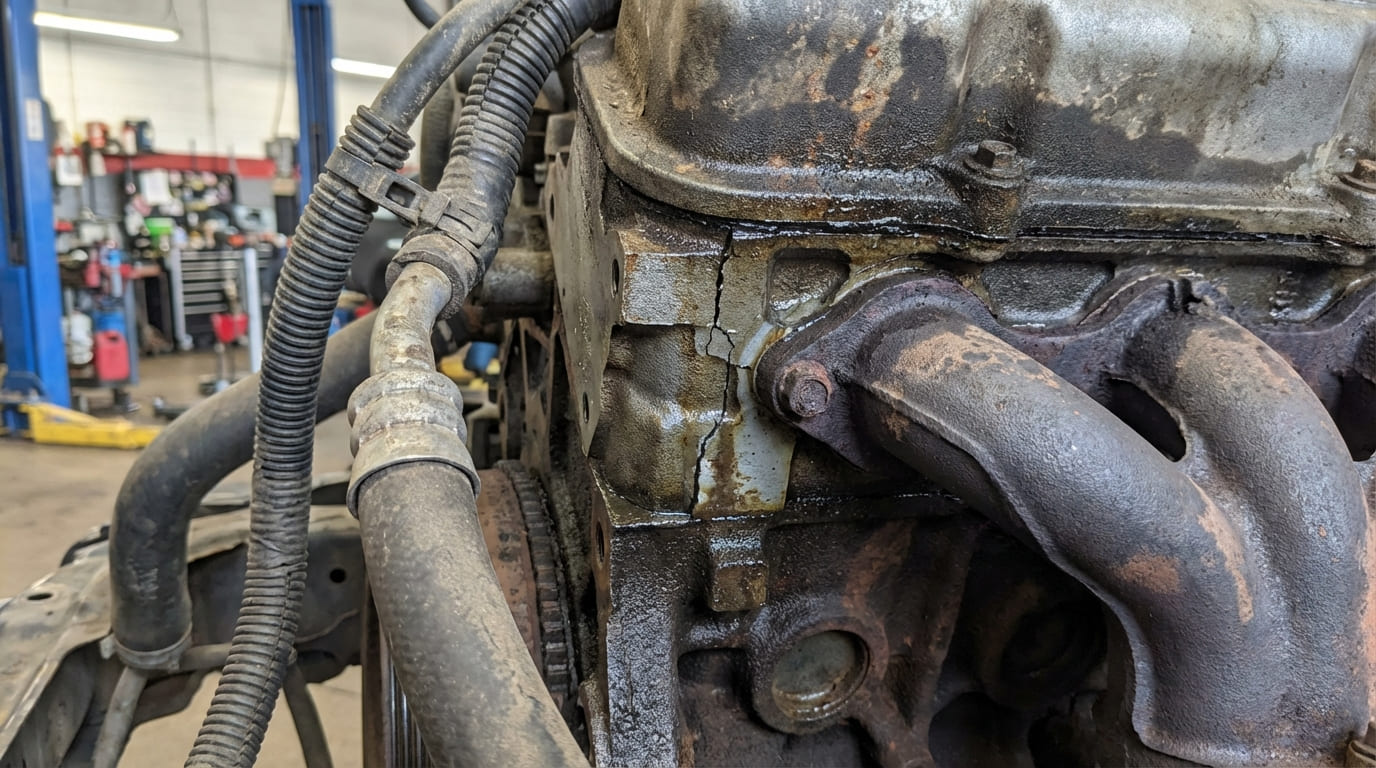
Hairline, static cracks in low-stress areas may be repairable. Deep, branching, or growing cracks (evidenced by multiple rust trails) are red flags. If the crack moves under engine load, it will likely fail again.
4. Cost vs. Value
Repair costs vary widely. Here’s a realistic breakdown:
| Repair Method | Labor + Parts (Est.) | Best For |
|---|---|---|
| Chemical sealant (temporary) | $50–$100 | Minor external leaks; short-term fix |
| Pinning (e.g., Lock-N-Stitch) | $600–$1,200 | Cast iron, linear cracks, rare engines |
| TIG welding (cast iron) | $800–$1,500 | Controlled shop environment only |
| Sleeving cylinder | $1,000–$2,000 | Isolated bore damage |
| Used block replacement | $800–$2,000 | Most aluminum blocks, high-mileage engines |
| New crate engine | $2,500–$6,000+ | Performance builds, no good used options |
Rule of thumb: If repair costs exceed 60% of the car’s value, replacement is smarter. Exceptions: classic, rare, or sentimental vehicles.
I once spent $1,800 repairing a 1969 Camaro’s original 350 block. The car was a frame-up resto—owner wanted every part original. On a daily-driver Altima? I’d have said “junk it and drop in a used engine.” Know your customer’s goals.
Repair Methods That Work (And When to Use Them)
If the crack passes the feasibility test, here are the proven methods.
Welding
Best for cast iron. Use nickel-rod TIG welding. Must preheat to 500–600°F, weld slowly, then cool in an insulated blanket. Post-weld, recheck with dye penetrant or MPI. Aluminum welding is possible but risky—only attempt with proper equipment and expertise.
Pinning (Stitching)
I use Lock-N-Stitch for long, linear cracks in cast iron. Drills overlapping holes along the crack, inserts metal pins, peens them for compression. No heat, so no warping. Ideal for vintage blocks. Labor-intensive but durable when done right.
Chemical Sealants
Products like Bar’s Leaks or Alumaseal can stop tiny external leaks. I’ve used them to get a customer home or through winter. But they’re not a repair. Risk of clogging heater cores or radiators is real. Only recommend as temporary.
Machining and Sleeving
If one cylinder bore is cracked but the rest of the block is sound, sleeving can work. Bore out the damaged area, press in a new sleeve, hone to spec. Must meet OEM tolerances (0.0005”–0.0015” taper). Expensive, but saves a good block. Rarely feasible on aluminum due to expansion differences.
Critical Best Practices After Repair
- ✅ Pressure test the block after any repair—simulate operating conditions
- ✅ Recheck flatness with a straightedge and feeler gauge—max 0.002” deviation over 6” for cast iron, 0.0015” for aluminum
- ✅ Use new head bolts—never reuse torque-to-yield (TTY) fasteners
- ✅ Perform a post-repair chemical test—ensure no combustion gases are still leaking
- ✅ Clean all threads with a bottoming tap—debris alters torque values
- ⚠️ Avoid skipping decking—welding or pinning can warp the surface slightly
- ⚠️ Avoid assuming the repair is permanent—monitor coolant and oil closely for 500 miles
A 2005 GM 4.8L came in with coolant loss and white smoke. Customer replaced intake gaskets twice. Pressure test held, but chemical test showed combustion gases. Dye penetrant revealed a crack from cylinder wall to water jacket. Lesson: Not every 4.8L coolant issue is the intake manifold. Test under combustion pressure, not just cooling system pressure.
A 1978 Ford 302 had a crack near the distributor. We pinned it with Lock-N-Stitch, magnafluxed it, and pressure tested. Held for 10 years. Lesson: Sentimental value justifies repair—when the crack isn’t in a critical zone.
A 2012 Honda Accord had oil in coolant. No visible crack. After head removal, dye and ultrasonic tests found a micro-crack in the deck near cylinder 3. Block replaced. Lesson: Aluminum blocks can crack invisibly. Always test beyond the surface.
Bottom line: A cracked block isn’t automatically a death sentence. But it’s not something to gamble on. Diagnose thoroughly, assess location and material, run the numbers, and choose the safest, most cost-effective path. When in doubt, replace. Your reputation—and the customer’s engine—depend on it.