In my two decades as a master mechanic working in both dealership and independent shops, I’ve seen fuel filter neglect cause more misdiagnosed, expensive repairs than almost any other overlooked service. It doesn’t kill the engine overnight, but it triggers a chain reaction that can lead to fuel pump failure, injector damage, and even destroyed catalytic converters. This article breaks down exactly what happens over time, how to diagnose it, and when replacement makes financial sense.
What Actually Fails — And When
A clogged fuel filter doesn’t just reduce performance—it stresses the entire fuel system. The damage unfolds in stages, starting subtly and escalating to catastrophic failure if ignored.
Stage 1: Fuel Starvation and Performance Loss
The first sign is reduced fuel flow under load. The engine may idle fine, but struggles when you need power. This happens because the filter blocks debris over time, restricting flow. The fuel pump compensates by working harder, but eventually can’t keep up.
Common symptoms include:
- Hesitation or stumbling during acceleration
- Lean fuel codes (P0171, P0174)
- Extended cranking before startup
- Intermittent misfires (P030x codes)
On modern returnless systems, the powertrain control module (PCM) increases pump speed to maintain pressure. But if the filter is too clogged, even max pump speed won’t deliver enough fuel at wide-open throttle.
In my shop, we always check fuel pump current draw before replacing any sensor or pump. A clogged filter forces the pump to draw excess current—often over 4.5 amps. If you see that, suspect restriction before anything else.
Stage 2: Fuel System Contamination
When a filter becomes severely clogged, it can rupture. The paper or mesh media tears, releasing trapped debris into the fuel stream. Now you’re not just dealing with restriction—you’re injecting sand, rust, and sludge into precision components.
This is where secondary damage begins.
Fuel injectors get clogged or damaged
Modern fuel injectors, especially in GDI engines, operate with tolerances tighter than 5 microns. Even fine sediment can stick to pintle seats or erode nozzle tips. Once this happens, spray pattern degrades, causing poor atomization and incomplete combustion.
Diagnose with:
- Idle quality and misfire history
- Scope testing injector current waveforms
- Flow testing injectors off the engine
Rebuilding or replacing injectors costs $80–$150 each. Most shops recommend replacing all if one fails due to contamination.
High-pressure fuel pump (HPFP) failure in GDI engines
In gasoline direct injection systems, the low-pressure fuel pump feeds the HPFP. If the filter is clogged, the HPFP runs starved of fuel. This causes metal-on-metal contact inside the pump, leading to:
- Scored plungers
- Failed check valves
- Complete pump seizure
HPFP replacement costs $600–$1,200, including labor. On many engines, it requires timing cover removal and camshaft alignment.
I’ve torn down HPFPs that failed at 90,000 miles—only to find the root cause was a clogged in-tank filter. Always verify low-side fuel delivery before condemning the HPFP.
Fuel rail and pressure sensor contamination
Debris can settle in the fuel rail, especially in dead-end sections. On some V6 engines, this blocks the fuel pressure sensor port, causing false low-pressure readings and triggering P0087 codes.
Cleaning is rarely possible. Most rails are sealed and must be replaced—costing $200–$400.
Fuel tank contamination loop
A ruptured filter can send debris back into the tank. The fuel pump’s inlet sock then clogs, reducing flow further. Now the system is stuck in a self-sustaining contamination cycle.
Solution: Drop the tank, flush it thoroughly, and replace the pump module. Labor-intensive and costly—$500+.
Stage 3: Engine and Emissions Damage
Long-term lean operation doesn’t just hurt the fuel system. It damages internal engine components and destroys emissions hardware.
Catalytic converter meltdown
Lean misfires dump raw fuel into the exhaust. When it hits the catalytic converter, it ignites and creates extreme heat—over 2,000°F. This melts the ceramic substrate, causing blockage and backpressure.
Symptoms:
- P0420/P0430 (catalyst efficiency)
- Loss of power
- Rattling noise from broken substrate
Converter replacement: $900–$2,500. And if the root cause (clogged filter) isn’t fixed, the new one will fail too.
Valve and piston damage
Lean combustion burns hotter. Over time, this can cause:
- Exhaust valve warping or cracking
- Valve seat recession (especially on older engines)
- Piston ring wear from increased cylinder temps
These issues require major engine work. Not common, but I’ve seen it on high-mileage vehicles with chronic fuel delivery problems.
Spark plug damage
Lean misfires leave ashy deposits on spark plugs. Prolonged exposure can erode electrodes. While plugs are cheap to replace ($15–$30 each), they’re a symptom—not the cause.
How to Diagnose a Clogged Fuel Filter
Don’t guess. Test. Here’s how I do it in the shop.
Fuel pressure and volume test
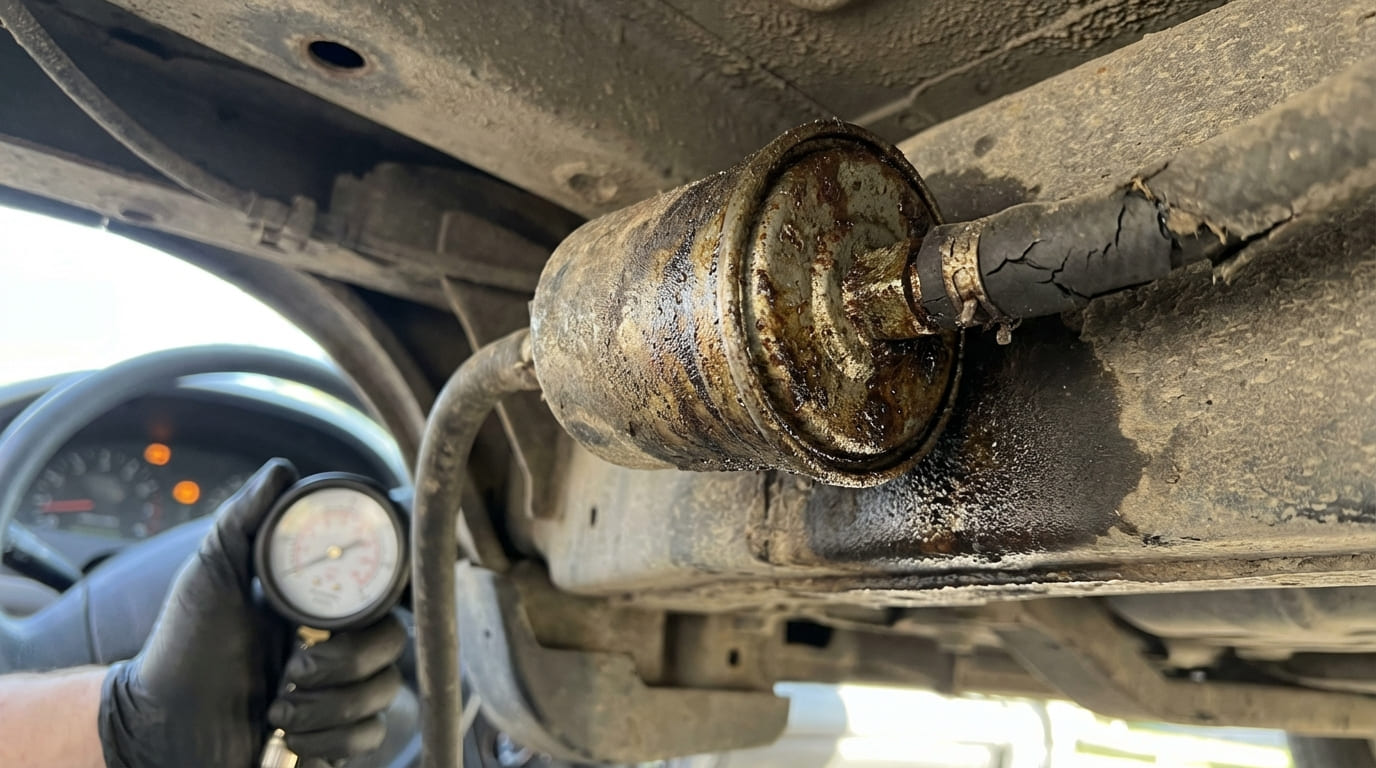
Connect a calibrated gauge to the fuel rail test port. Measure:
- Static pressure (key on, engine off)
- Running pressure at idle
- Pressure during snap-throttle or road load
A drop of more than 10% under load suggests restriction. But pressure alone isn’t enough.
Run a volume test: disconnect the fuel line and run the pump for 30 seconds into a graduated container. Most port-injected systems should deliver at least 1 liter in 30 seconds. GDI systems vary—check service manual specs.
Fuel pump current draw test
Use a DC current clamp on the pump’s power wire. A healthy pump draws 2.5–3.5 amps. Over 4.5 amps? The pump is straining—likely due to a clogged filter.
This test is non-invasive and catches problems early, before pressure drops are obvious.
Visual inspection after removal
Once replaced, cut open the old filter with a filter saw. Look for:
- Dark sludge (oxidized fuel)
- Rust flakes (water contamination)
- Sand or dirt (poor fuel quality)
- Collapsed media (cheap filter)
The type of debris tells you about fuel quality and tank condition—helpful for advising the customer on future maintenance.
Repair vs Replace: Cost and Viability
Replacing a fuel filter is cheap compared to the damage it prevents. But location and labor vary.
| Filter Type | Part Cost | Labo | Total Estimated Cost |
|---|---|---|---|
| In-line (accessible) | $15–$30 | 0.5–1 hour | $80–$150 |
| In-tank (requires pump module removal) | $50–$120 (filter or sock) | 2–3 hours | $300–$600 |
| GDI high-pressure filter (if equipped) | $40–$80 | 1–2 hours | $150–$300 |
For in-tank filters, many manufacturers don’t list a service interval. Some call it “lifetime.” But in real-world conditions, I recommend replacement every 80,000–100,000 miles—especially if the vehicle uses ethanol-blended fuel or is driven in dusty environments.
“Lifetime” doesn’t mean forever. It means “for the life of the pump—if conditions are ideal.” In my shop, we’ve pulled in-tank filters at 90,000 miles packed with rust. Don’t wait for failure.
Best Practices for Replacement
Follow these steps to avoid comebacks and ensure reliability.
- ✅ Depressurize the fuel system before disconnecting lines. Pull the fuel pump relay and run the engine until it stalls.
- ✅ Clean the area around the filter. Dirt can fall into open fuel lines, especially on underbody-mounted in-line filters.
- ✅ Use OEM-spec or higher-quality filters. Cheap filters may have weak media that collapses under vacuum.
- ⚠️ Never reuse damaged fuel line quick-connects. They’re inexpensive and critical for leak-free operation.
- ⚠️ Don’t skip the current draw test when diagnosing drivability issues. It’s one of the fastest ways to spot fuel system strain.
- ⚠️ Don’t assume a new pump fixes the problem. If the filter was clogged, debris may have already damaged the pump or injectors.
Real-World Failure Scenarios
| Symptom | Most Likely Cause | Less Common Causes | Diagnostic Priority |
|---|---|---|---|
| Lean codes (P0171/P0174), no misfires | Clogged fuel filter or weak pump | Vacuum leak, dirty MAF, exhaust leak pre-cat | Check fuel pressure and volume first |
| P0087 (Low fuel pressure) | Restriction in low-pressure system (filter, sock) | HPFP failure, low voltage, faulty sensor | Verify low-side delivery before HPFP teardown |
| Intermittent stumble under load | Fuel starvation from clogged filter | Failing ignition coil, fuel pump | Monitor fuel pressure during road test |
| P0420 (Catalyst efficiency) | Repeated misfires from lean condition | Aged converter, O2 sensor, exhaust leak | Rule out fuel and ignition issues first |
Situation: 2014 F-150, 110,000 miles, P0087 after HPFP replacement. Code returned in two weeks.
Discovery: Low-side fuel pressure dropped to 48 psi at WOT (spec: 55–62). Volume test: 700 ml/30 sec. In-tank filter clogged with rust.
Lesson: Never replace an HPFP without verifying low-pressure supply. The filter and tank were the real culprits.
Situation: 2008 Camry, 95,000 miles, P0171. MAF and air filter replaced—no fix.
Discovery: Fuel pressure dropped under load. Pump current: 4.8 amps. Replaced in-line filter—problem solved.
Lesson: Lean codes aren’t always air-related. Test fuel delivery before replacing sensors.
Situation: Subaru Outback, 120,000 miles, two catalytic converters replaced in 18 months.
Discovery: In-tank filter clogged, pump drawing 5.2 amps. Chronic lean misfires overheated the cats.
Lesson: Converter failure is a symptom. Find the root cause—often hidden in the fuel system.
Modern fuel is cleaner, but ethanol blends attract water and degrade rubber components. In coastal or rural areas, fuel quality varies widely. I recommend replacing accessible filters every 60,000 miles and inspecting in-tank filters at 100,000 miles—especially on vehicles used for towing or off-road driving.
Preventive filter replacement is one of the best investments you can make. It costs a fraction of the repairs it prevents.