In my experience, the piston is one of the most misunderstood components in an internal combustion engine. It’s easy to oversimplify it as just a “plug” that moves up and down, but in reality, it’s a critical structural and functional link between combustion and motion. I’ve seen seasoned techs jump to conclusions about piston failure—only to find out the root cause was something entirely different. Let’s break down exactly what pistons do, how they fail, and how to diagnose issues correctly.
Primary Function: Converting Combustion Into Motion
The piston’s core job is to convert the high-pressure explosion from combustion into linear motion, which the connecting rod and crankshaft then transform into rotational power. This happens during the four-stroke cycle. Each stroke places unique demands on the piston, and understanding this helps in diagnosing performance or damage.
The Four-Stroke Cycle and Piston’s Role
- Intake Stroke: As the piston moves down, it creates vacuum to draw in air and fuel. A proper seal from the piston rings prevents reversion and ensures efficient cylinder filling. If rings are worn, you may see poor idle quality or hesitation.
- Compression Stroke: The piston rises, compressing the air-fuel mix. Ring seal is critical here—any leakage reduces compression and can cause hard starts or misfires. A compression test or leak-down test can confirm seal integrity.
- Power Stroke: Ignition forces the piston downward. This is where peak pressures occur—often over 1,000 psi. The piston must withstand this force without deforming and transfer it efficiently through the rod.
- Exhaust Stroke: The piston pushes out burnt gases. Even here, ring seal matters—poor sealing can allow oil into the combustion chamber, leading to blue smoke or carbon buildup.
Connecting Linear Motion to Crankshaft Rotation
The piston connects to the crankshaft via the wrist pin and connecting rod. As the piston moves up and down, the rod converts this into rotational movement. The changing rod angle creates side loading on the piston skirt, which is why skirt design and bore finish are crucial. Misalignment or excessive clearance leads to piston slap or scuffing.
How to check: If you hear knocking or slap at startup that goes away when warm, measure piston-to-bore clearance using a micrometer and dial bore gauge. Compare to factory specs—typical clearance for cast pistons is 0.0015″–0.0025″, but varies by design.
Piston Assembly: Components and Real-World Function
Each part of the piston assembly plays a role in performance and durability. Failure in one often affects the whole system. Diagnosing piston issues starts with knowing what each component should do—and what damage tells you.
Key Components and Practical Insights
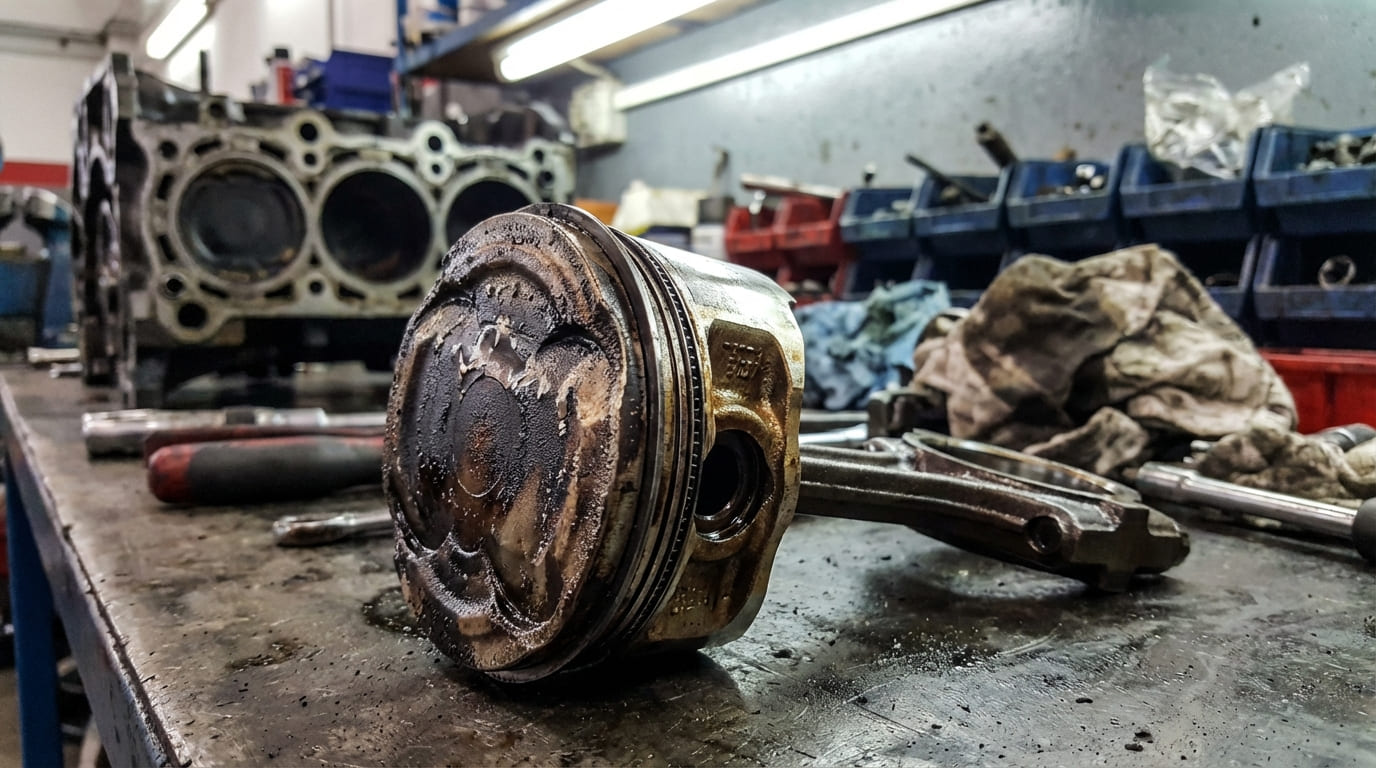
- Piston Crown: Exposed to flame temperatures over 600°F. Damage like melting or erosion usually points to detonation or pre-ignition—not weak materials. Check ignition timing, fuel trim, and cooling system function first.
- Piston Skirt: Guides the piston and handles side thrust. Oval or cam-ground skirts compensate for thermal expansion. Scoring or wear suggests lubrication issues or incorrect clearance.
- Wrist Pin: Connects piston to connecting rod. Wear shows as a rhythmic knock under load, not RPM-dependent. Inspect for play during teardown—excessive movement means replacement is needed.
- Piston Rings: Top ring seals combustion pressure; second ring assists sealing and scrapes oil; oil control ring returns excess oil. Stuck or broken rings cause oil consumption and compression loss. Always check end gap during rebuilds—even pre-gapped rings can be off if the bore is oversized.
- Ring Lands: Thin sections between grooves. Fractured ring lands are common in modern high-compression engines under sustained knock. A borescope can spot cracks before total failure.
- Connecting Rod: Handles tension and compression. Look for bending or stretching during inspection. Even slight rod stretch can cause piston-to-head contact.
- Connecting Rod Bearings: Wear patterns tell a story. Wiped bearings often mean oil starvation; uneven wear suggests misalignment. Always inspect bearing contact after removal.
Materials and Manufacturing: What Matters for Durability
Piston material affects strength, heat resistance, and expansion. Choosing the right type matters for repair or upgrade decisions.
| Material/Type | Pros | Cons | Best For |
|---|---|---|---|
| Cast Aluminum | Inexpensive, good heat dissipation | Lower fatigue strength, cracks under high load | Stock naturally aspirated engines |
| Forged Aluminum | Strong, resists detonation, handles boost | More expensive, requires correct clearance | Performance, turbocharged, or high-compression builds |
| Hypereutectic | Tighter cold clearance, quieter cold start | Brittle—can crack if misinstalled | Modern OEM engines with tight noise targets |
| Steel | Extreme durability, high heat resistance | Heavy, costly, rare in gasoline engines | Heavy-duty diesel applications |
Cost note: Forged pistons typically run $80–$150 each, while cast replacements are $40–$80. Hypereutectic sets are $60–$100. Factor in machining (bore/hone: $150–$300) and labor (assembly: $800–$1,500) when deciding repair vs. replace.
In my shop, we always measure piston-to-bore clearance—even with new OEM-spec pistons. Factory specs vary by model, and assuming “it’s standard” leads to slap or seizure. Always use a dial bore gauge and micrometer. Don’t guess.
Common Piston Failures: Diagnosis Over Assumption
Piston damage is rarely the root cause—it’s a symptom. Replacing pistons without diagnosing why they failed leads to repeat issues. Use physical inspection and data to trace the real problem.
| Observed Symptom | Most Likely Causes | Less Obvious Causes | Diagnostic Steps |
|---|---|---|---|
| Vertical scoring on skirt | Inadequate lubrication, overheating | Contaminated oil, incorrect clearance | Check oil flow, run oil analysis, measure bore and piston |
| Melted or eroded crown | Detonation, pre-ignition | Lean air-fuel ratio, EGR failure, low-octane fuel | Scan for knock sensor activity, inspect for carbon, check fuel trims |
| Broken ring land | Sustained detonation, high cylinder pressure | Carbon jamming, insufficient ring end gap | Borescope, leak-down test, verify ring gap after installation |
| Excessive piston slap (cold) | Worn skirt, excessive clearance | Thermostat failure (engine never warms fully) | Listen cold vs. hot, verify operating temperature, measure clearance |
Situation: A 2015 F-150 came in with a misfire and low compression on cylinder 3. The borescope showed a cracked piston crown.
Initial Assumption: The tech thought it was a faulty piston—maybe a casting defect.
Deep Dive: We pulled the head and found heavy carbon buildup and a clogged EGR port. The knock sensor data showed repeated correction, but the PCM couldn’t compensate enough.
Nuanced Lesson Learned: The piston didn’t fail because it was weak—it failed because sustained low-speed pre-ignition (LSPI) created extreme pressure spikes. The real fix was cleaning the intake, replacing the EGR valve, and using the correct oil (with proper detergents).
Situation: A rebuilt 5.7L Hemi developed piston slap after 2,000 miles. The builder insisted the clearances were correct.
Initial Assumption: Everyone blamed the machinist—maybe the bore wasn’t honed right.
Deep Dive: We measured the pistons and found they were hypereutectic but installed with clearance at the high end of spec. The engine never reached full operating temp due to a thermostat issue.
Nuanced Lesson Learned: Hypereutectic pistons need precise clearance and full warm-up to function correctly. The slap wasn’t from wear—it was from insufficient expansion. The thermostat was the silent culprit.
Best Practices: What to Do (and Not Do)
- ✅ Recommended: Use a plateau hone on cylinder walls to preserve crosshatch. This helps rings seat faster and reduces break-in wear. Don’t over-hone—smooth walls prevent proper ring seal.
- ✅ Recommended: Torque rod bolts with a calibrated wrench and follow factory sequence. For torque-to-yield (TTY) bolts, never reuse unless the service manual explicitly allows it. Reused TTY bolts lose up to 30% clamping force.
- ✅ Recommended: Check ring end gap with a feeler gauge—even if rings are pre-gapped. Bore wear or oversizing changes gap. Typical minimum is 0.003″ per inch of bore diameter.
- ⚠️ Avoid: Reusing torque-to-yield rod bolts. In 15 years of engine builds, I’ve seen reused TTY bolts cause more rod bearing failures than any other single mistake.
- ⚠️ Avoid: Skipping end gap checks. A ring with too little gap can expand and butt-end, leading to breakage and catastrophic engine damage.
- ⚠️ Avoid: Over-tightening wrist pin clips. Use proper tools—needle-nose pliers can crack the piston. A cracked piston may run for thousands of miles before failing suddenly.
The piston rarely lies. But it often points to a problem that started elsewhere—ignition, fuel, cooling, or oil. Always combine physical inspection with scan data and customer history. The most reliable diagnoses come from context, not just parts.