Pre-Cleaning Diagnostic Verification
Before cleaning, confirm the throttle body is actually the problem. Many symptoms attributed to carbon buildup stem from other issues like vacuum leaks, sensor faults, or fuel system problems.
Symptoms of a Dirty Throttle Body
- Rough idle, stalling, or hesitation—especially when cold or under light load
- Check Engine Light with codes P0505 (Idle Air Control) or P2101 (Throttle Actuator Control)
- Gradual decline in fuel economy or throttle response
These symptoms overlap with MAF sensor issues, vacuum leaks, and EGR problems. Always rule those out first.
How to Check for Carbon Buildup
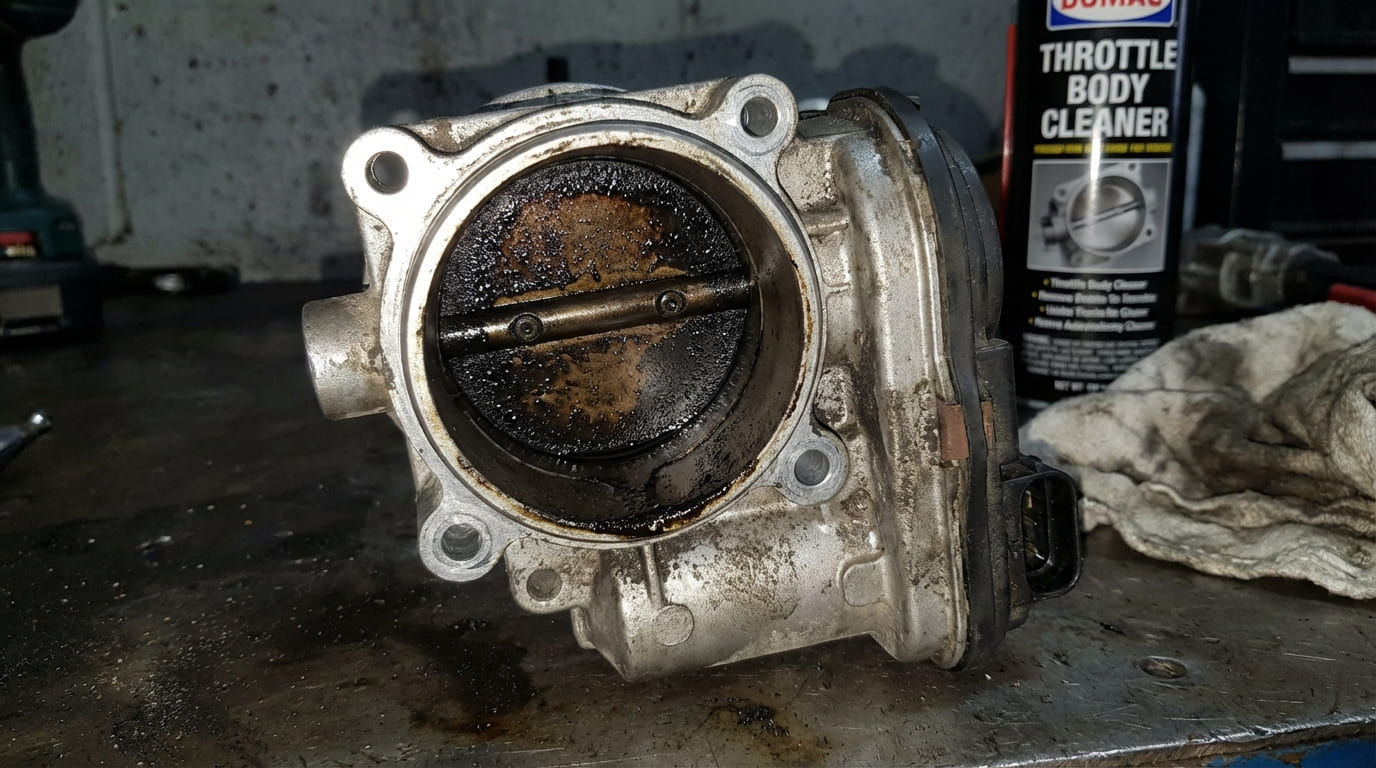
With the engine off and cooled, remove the intake tube after disconnecting the battery negative terminal. Use a borescope or smartphone camera to inspect the throttle bore and the leading edge of the throttle plate.
Light film? Likely doesn’t need cleaning. Thick, crusty deposits restricting airflow? Cleaning is justified. If the plate doesn’t close fully due to buildup, it will disrupt idle airflow control.
Check live data with a scan tool: monitor idle air control (IAC) counts and throttle position sensor (TPS) voltage. High IAC counts at idle often indicate restricted airflow from carbon.
In my shop, we never clean a throttle body without first checking IAC counts. If they’re above factory spec, we know airflow is restricted—cleaning usually brings them back to normal.
Safety Precautions and Preparation
This job seems simple, but risks include burns, sensor damage, and vacuum leaks if reassembly isn’t done right.
- Disconnect the negative battery terminal to prevent accidental throttle actuation
- Wait at least 30 minutes after engine shutdown—intake manifolds retain heat
- Wear safety glasses and nitrile gloves—throttle cleaners are corrosive
- Work in a well-ventilated area—fumes are toxic in enclosed spaces
Tools and Materials Required
Having the right tools prevents damage and ensures a complete job.
- Throttle body cleaner (non-chlorinated, sensor-safe—e.g., CRC Throttle Body Cleaner)
- Lint-free microfiber cloths (avoid paper towels—they leave fibers)
- Soft nylon brush (no metal—can scratch bore surfaces)
- Plastic pick or small flat-blade screwdriver (for gasket removal)
- Socket set and torque wrench (critical for reassembly)
- New throttle body gasket (typically $5–$15; don’t reuse old)
- Borescope (optional but highly recommended for inspection)
Cost to DIY: $30–$50 for tools and supplies. Shop cleaning typically costs $100–$180. If you own basic tools, DIY pays for itself in one job.
Cleaning Procedure: On-Vehicle (Recommended for Light to Moderate Deposits)
Most vehicles only need on-vehicle cleaning. This method saves time and avoids coolant line disconnection.
Access and Inspection
Remove the air intake tube from the throttle body. Unplug any sensors (like MAF) and set them aside. Do not force the throttle plate open—on electronic throttles, it’s spring-loaded closed.
Inspect the bore and plate edges. Focus on the area where the plate seals when closed—carbon here disrupts idle airflow.
Cleaning Steps
- Spray cleaner onto a microfiber cloth, not directly into the bore—prevents overspray on sensors
- Wipe the leading and trailing edges of the throttle plate
- Use a nylon brush on stubborn deposits, then wipe clean
- If an IAC passage is visible, lightly spray into the port—don’t flood it
- Never run the engine during cleaning—solvent can damage the catalytic converter or hydro-lock sensors
- Keep cleaner away from electrical connectors and TPS components
Let the area dry completely before reassembly—any residue can cause drivability issues.
Cleaning Procedure: Off-Vehicle (For Heavy Deposits or IAC Service)
Use this method when on-vehicle cleaning doesn’t resolve symptoms or when the IAC is integrated and inaccessible.
Removal Steps
- Disconnect all electrical connectors—label if multiple
- If coolant lines are present (common on heated throttle bodies), drain or capture coolant to avoid spills
- Remove mounting bolts in a crisscross pattern to prevent flange warping
- Peel off the old gasket completely—leftover pieces cause vacuum leaks
On BMWs and some Fords, the throttle body has coolant passages. Always cap or plug lines temporarily—coolant spillage can damage wiring or the alternator.
Deep Cleaning
Place the throttle body over a drip pan. Spray cleaner directly on carbon deposits, let it dwell 30 seconds, then scrub with a nylon brush. For cable-operated throttles, gently open the plate to clean both sides. For electronic units, avoid forcing the plate—clean around the edges carefully.
Use compressed air to blow out IAC and bypass passages—removes loosened debris that could clog upon reassembly.
Reinstallation
- Install a new gasket—never reuse the old one
- Align the throttle body carefully and tighten bolts in a crisscross pattern
- Torque to spec—typically 10–12 Nm, but consult the service manual
- Reconnect coolant lines and bleed the cooling system if needed
- Reattach all electrical connectors—ensure they click
| Part | Cost (DIY) | Repair vs Replace |
|---|---|---|
| Throttle Body Gasket | $5–$15 | Always replace—reusing risks vacuum leaks |
| Throttle Body Cleaner | $8–$12 | Cost-effective—cleaning takes 20–40 minutes |
| Full Throttle Body Assembly | $200–$600 | Replace only if motor, TPS, or bore is damaged |
Post-Cleaning Verification and Calibration
Cleaning without recalibration often causes more problems than it solves. The PCM must relearn the throttle’s closed position.
Throttle Body Relearn Procedure
Most modern vehicles require a relearn. Without it, you’ll get idle hunting, stalling, or poor response.
- Best method: Use an OEM-level scan tool (e.g., Techstream, wiTECH) to perform “Throttle Valve Closed Position Learning”
- Alternative: Some vehicles support a manual relearn—turn key to ON (not start), wait 10 seconds, turn off, wait 10 seconds, repeat 3x, then start and idle for 1 minute
Always verify the correct procedure for your make and model—what works on a Toyota may not work on a GM.
Engine Start and Idle Check
Start the engine and let it reach operating temperature. Monitor idle RPM—most vehicles idle between 650 and 800 RPM when warm.
Use a scan tool to check live data: throttle position should be stable, and IAC counts should normalize. If idle surges or drops, the relearn likely failed or a vacuum leak exists.
Road Test
Take a short drive. Focus on:
- Idle stability when stopping
- Tip-in response (smooth acceleration from idle)
- Deceleration behavior (no surge or stall)
If hesitation returns, the issue may be elsewhere—consider MAF, fuel pressure, or ignition system.
Causes of Contamination and Prevention
Cleaning is temporary if the root cause isn’t addressed. Here’s what leads to rapid recontamination:
Situation: 2014 Ford F-150 with recurring P2101 and rough idle after two cleanings.
Discovery: Collapsed PCV hose and gummed valve—oil vapors flooded the intake.
Lesson: Fix the PCV system first. Cleaning without addressing the source is a waste.
Situation: Turbocharged VW with rapid carbon buildup.
Discovery: No oil catch can—turbo seal blow-by was polymerizing in the throttle bore.
Lesson: Forced induction engines benefit from a properly plumbed catch can. Poor routing creates vacuum leaks.
Situation: Customer used a “miracle” fuel additive—idle worsened after cleaning.
Discovery: Additive left sticky residue and contaminated the MAF sensor.
Lesson: Avoid non-OEM fuel additives, especially on direct-injection engines.
Recommended / Avoid List
- ✅ Clean mounting threads with a thread chaser—ensures accurate torque and prevents galling
- ✅ Always use a new gasket—old ones lose sealing ability
- ✅ Perform relearn with a scan tool when possible—more reliable than manual methods
- ⚠️ Never reuse torque-to-yield bolts unless specified—these stretch and lose clamping force
- ⚠️ Avoid carb or brake cleaner—harsh solvents can damage electronic components
- ⚠️ Never force open an electronic throttle plate—can damage the motor or sensor
Diagnostic Scenarios and Probable Causes
| Symptom | Most Likely Cause | Less Common But Possible | Action |
|---|---|---|---|
| Rough idle, P0505 | Carbon blocking idle air passage | Faulty IAC motor, vacuum leak, bad TPS | Inspect bore, check for leaks, scan IAC operation |
| Hesitation on acceleration | Bore deposits disrupting airflow transition | Dirty MAF, fuel pump issue, timing problem | Verify with live data, clean throttle, monitor fuel trims |
| Stalling after cleaning | Failed relearn procedure | Solvent on MAF, vacuum leak from gasket | Perform relearn, inspect for leaks, check MAF voltage |
| White smoke after cleaning | Excess cleaner burning off | Coolant leak (if lines were disturbed) | Run engine briefly—smoke should clear in 30 seconds |
After 20 years in the bay, I’ve learned: a clean throttle body isn’t a cure-all. It’s one piece of a larger system. Always diagnose first, clean only when needed, and recalibrate every time. Refer to the factory service manual for torque specs, relearn procedures, and component layouts—what works on one brand may damage another.