In my shop, I’ve seen countless vibration complaints, rough idles, and engine swap issues traced back to the wrong or failed engine mounts. The shift from basic rubber to advanced hydraulic mounts has changed how we manage NVH—noise, vibration, and harshness. But mixing them up or misdiagnosing them leads to comebacks and frustrated customers. This guide cuts through the theory and gives you what matters: how to tell them apart, diagnose failures, and choose the right replacement.
How They Work and Where You’ll Find Them
Solid rubber and hydraulic mounts serve the same purpose—holding the engine in place while reducing vibrations—but they do it very differently. Knowing which your vehicle uses is step one. Using the wrong type kills ride quality or accelerates wear.
Solid Rubber (Elastomeric) Mounts
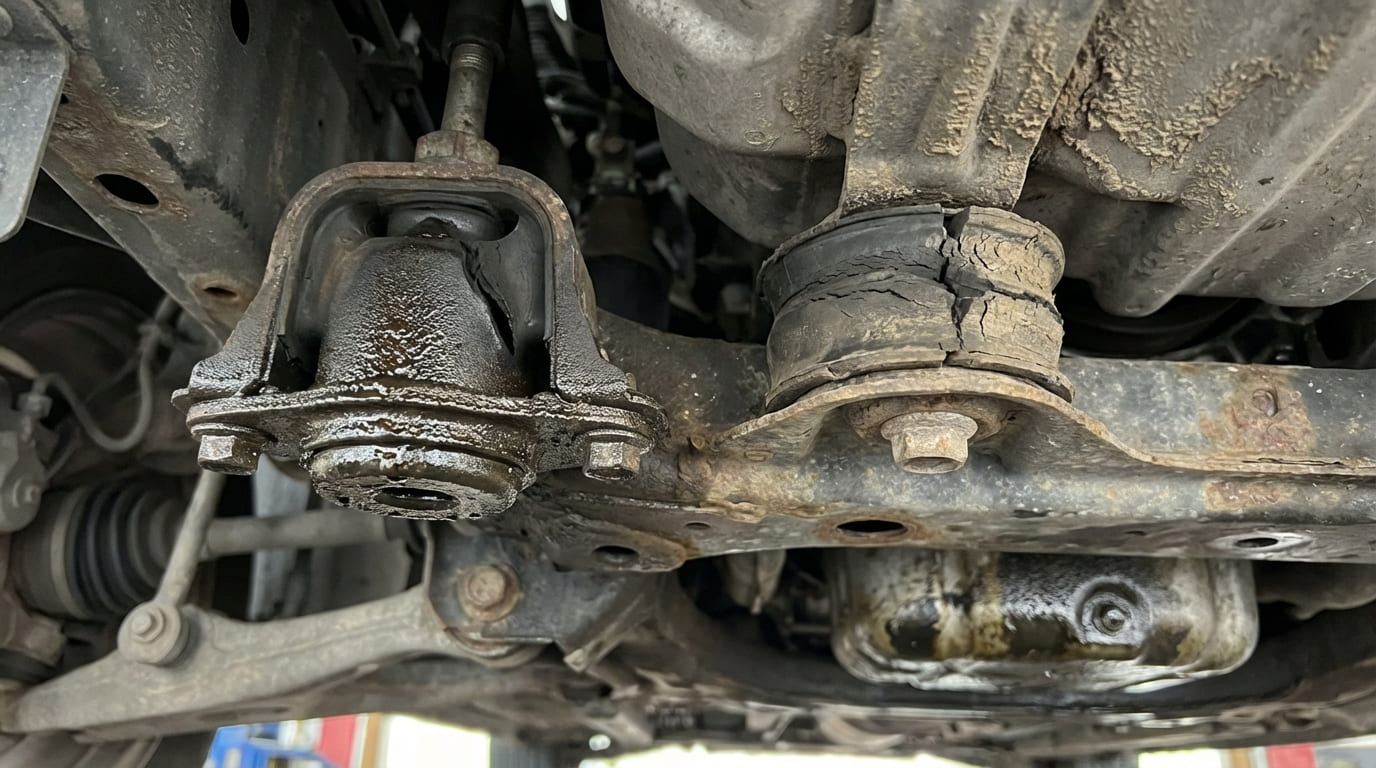
These are the most common on economy cars, older models, and performance builds where feedback is desired. They’re simple: a rubber block bonded between two steel plates. The rubber absorbs vibrations by flexing. Over time, heat, oil, and age cause cracking, hardening, or collapse.
They’re good at dampening high-frequency buzz—like injector pulses or valve train noise—but struggle with low-frequency shake at idle, especially in larger engines. As they wear, vibration increases and clunking appears during gear shifts.
Hydraulic (Fluid-Filled) Mounts
These go a step further by adding a sealed fluid chamber inside the rubber housing. The fluid moves through an orifice or inertia track, tuned to cancel out specific low-frequency vibrations—like diesel rumble or V6 shake at idle. This makes the cabin feel “dead” when stopped, a hallmark of luxury and comfort-oriented vehicles.
They’re heavier, more complex, and more expensive. But when they fail, the drop in comfort is dramatic. You’ll feel a deep, rhythmic throb at idle that wasn’t there before. Unlike rubber mounts, they can fail internally without visible sag—fluid leaks or diaphragm ruptures kill damping even if the mount looks intact.
In my shop, we always check for oily residue on mounts—even if they look fine. A dry mount isn’t always a healthy mount. Hydraulic units can leak slowly, losing damping long before they collapse.
How to Tell Them Apart
Don’t guess—verify. Replacing a hydraulic mount with a rubber one (or vice versa) creates NVH issues. Use these real-world ID tips:
| Feature | Solid Rubber Mount | Hydraulic Mount |
|---|---|---|
| Weight | Lighter | Noticeably heavier |
| Shape | Symmetrical, uniform rubber | Often asymmetrical with a bulge or chamber |
| Seams | Smooth or simple crimp | Visible crimp line or seam around the middle |
| Fluid Signs | Dry | Oily film, dark residue, or weeping |
If it’s a late-model sedan, minivan, or diesel, assume it has hydraulic mounts until proven otherwise. Quiet idle = fluid inside.
How to Diagnose a Failed Mount
Don’t rely on vibration alone—many issues mimic mount failure. Follow this shop-tested procedure:
- Visual Inspection: Look for cracks, separation, collapsed height, or oil stains. Check for contact marks between engine and chassis.
- Engine Torque Test: With the vehicle in gear and brakes applied, gently apply throttle. Watch engine movement—more than 1–2 inches indicates failure. Film it with your phone for slow-motion review.
- Pry Bar Test: On a lift, gently pry between engine and frame at each mount. Any internal movement (not just engine rocking) means the mount is shot. Be careful—don’t damage sensors or lines.
- Idle Vibration Check: If the vibration is a low-frequency throb (10–20 Hz), suspect hydraulic failure. High-frequency buzz points to solid mount wear or other issues.
I’ve diagnosed failed hydraulic mounts by feel alone—press your palm on the dash at idle. If it pulses like a heartbeat, the fluid chamber is gone.
Failure Symptoms and Likely Causes
| Symptom | Most Likely Cause | Less Common But Possible | Diagnostic Tip |
|---|---|---|---|
| Low-frequency vibration at idle | Failed hydraulic mount (fluid loss) | Worn solid mount, unbalanced engine | Check for oily residue; perform torque test |
| Clunking on gear engagement | Any failed mount (rubber or hydraulic) | Transmission issues, driveline play | Inspect all mounts; isolate with pry bar |
| Visible engine movement | Severely degraded or separated mount | Loose hardware, damaged subframe | Verify engine position under load |
| Sloshing sound from engine bay | Failed hydraulic mount (fluid sloshing) | Loose coolant reservoir, radiator surge | Rare—listen with hood open at idle |
Repair vs. Replace: Cost and Viability
Mounts aren’t usually repairable. Once the rubber fails or fluid leaks, replacement is the only fix. Here’s what to expect:
| Mount Type | Part Cost (Each) | Labor Time | Repair Viability |
|---|---|---|---|
| Solid Rubber | $30–$80 | 1–2 hours | Not repairable—replace |
| Hydraulic | $80–$200+ | 1.5–3 hours | Not repairable—replace |
Always replace mounts in pairs or sets if one has failed—the others are fatigued. Use OEM or high-quality aftermarket units. Cheap hydraulic mounts often use inferior fluid or seals and fail within a year.
On performance or modified engines, some go for solid polyurethane mounts for tighter control. But don’t do it on a daily driver. You’ll regret it when the dash buzzes at stoplights.
Best Practices for Replacement
- ✅ Replace mounts in pairs or sets—especially on transverse engines where load is shared.
- ✅ Support the engine properly with a jack and wood block before removal. Sagging damages exhaust manifolds and wiring.
- ✅ Clean and chase bolt threads. Dirty or damaged threads cause false torque readings and uneven clamping.
- ✅ Torque bolts to spec—in the correct sequence. Over-tightening crushes rubber or distorts hydraulic chambers.
- ⚠️ Never reuse torque-to-yield (TTY) bolts. They stretch and won’t hold torque. Replace them every time.
- ⚠️ Don’t swap hydraulic for solid mounts “to stiffen up” the engine. You’ll increase NVH and risk damaging interior trim.
I’ve seen dashboards crack and HVAC housings split from vibrations after someone installed poly mounts on a luxury sedan. OEM mounts aren’t weak—they’re engineered. Respect the design.
Real-World Lessons from the Shop
A 2012 luxury sedan came in with severe idle vibration. Mounts looked fine. No sag. But I spotted a greasy film on the front mount. Replaced the hydraulic unit—vibration gone. Lesson: Fluid loss kills damping even if the mount holds shape.
A customer installed poly mounts for “better performance.” Came back with cracked trim and buzzing vents. Swapped back to OEM hydraulic units—problem solved. Stiffer isn’t better when you’re shaking the cabin apart.
A diesel pickup had idle shake after a mount replacement. The new ones looked identical—but weren’t hydraulic. Swapped in correct fluid-filled units—silence returned. Lesson: Bolt-on fit doesn’t mean functional fit.
Hydraulic mounts aren’t overkill—they’re precision NVH tools. Rubber mounts are simple and durable but limited. Diagnose with eyes, hands, and ears. Replace with the right part, in the right way. And remember: the quietest engine isn’t the stiffest—it’s the one that’s properly isolated.