As a master technician, I see thermostat issues weekly. A failing thermostat doesn’t just affect temperature—it impacts fuel economy, emissions, heater performance, and can lead to catastrophic engine damage. This guide cuts through the noise and gives you actionable diagnostics, repair logic, and real-world insights from the shop floor.
How to Diagnose a Stuck Thermostat: Practical Field Tests
Don’t guess—test. Use these proven methods to confirm whether your thermostat is stuck open, closed, or operating normally. You’ll need an OBD2 scanner with live data and an infrared thermometer. Both are affordable and essential for any DIYer.
Test for a Stuck-Open Thermostat
A thermostat stuck open prevents the engine from reaching operating temperature, causing poor fuel economy, weak heater output, and failed emissions tests.
- Start the engine when cold. Monitor Engine Coolant Temperature (ECT) via OBD2 scanner.
- Point the infrared thermometer at the upper radiator hose near the thermostat housing.
- Observe for the first 10–15 minutes of warm-up.
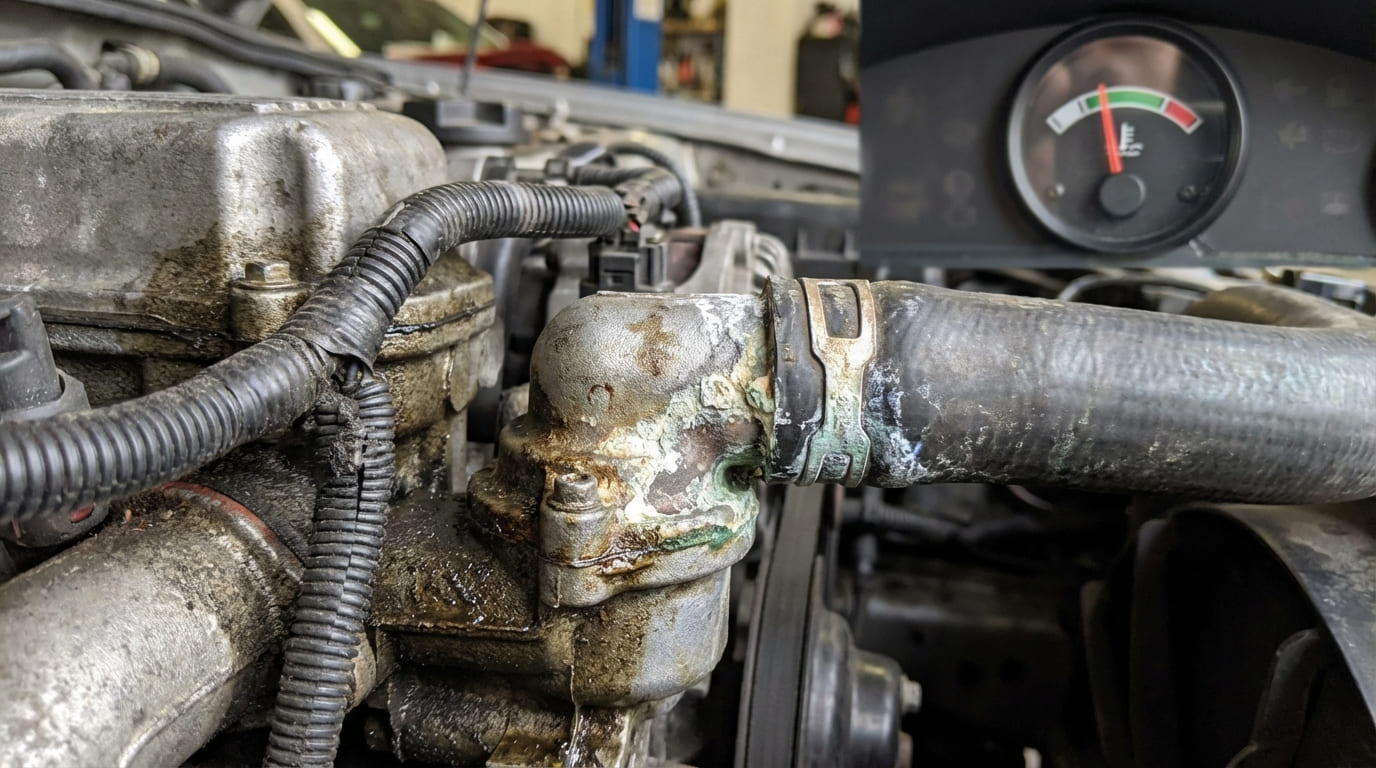
Pass/Fail: If the upper radiator hose heats up significantly (above 20°C / 36°F) before the ECT reaches the thermostat’s rated opening temperature (typically 82–95°C / 180–203°F), the thermostat is stuck open or leaking coolant flow prematurely.
In my shop, we always measure the metal neck of the thermostat housing, not the rubber hose. Hoses insulate and give false readings. A metal surface gives an accurate thermal reference.
Test for a Stuck-Closed Thermostat
A stuck-closed thermostat blocks coolant flow, causing rapid overheating, high-pressure buildup, and potential head gasket failure.
- Start the engine cold and let it idle while monitoring ECT.
- Once ECT reaches the thermostat’s rated opening temperature, check both upper and lower radiator hoses with the infrared thermometer.
- Feel for firmness: a hot, pressurized upper hose with a cold, soft lower hose indicates no flow.
Pass/Fail: If ECT exceeds the thermostat’s opening temp by 5–10°C (9–18°F) and the lower radiator hose is more than 20°C (36°F) cooler than the upper hose, the thermostat is stuck closed.
I’ve seen technicians replace a thermostat only to have the same overheating issue. Always rule out air pockets first. Burp the system before condemning the part. Most modern engines have a bleed valve—use it.
Symptoms and What They Mean
Thermostat Stuck Open: Key Signs
- Coolant temperature gauge reads low (below 80°C / 176°F) even after extended driving
- Slow or weak cabin heat, especially in cold weather
- Poor fuel economy due to prolonged open-loop fueling
- OBD2 trouble code P0128 (Coolant Temp Below Thermostat Regulating Temp)
These symptoms mimic a faulty ECT sensor or low coolant. Always verify system fill level and scan live data before replacing parts.
Thermostat Stuck Closed: Red Flags
- Temperature gauge climbs rapidly after startup
- Overheat warning lights illuminate, especially at idle
- Radiator fan runs continuously at high speed
- Hissing or boiling noises from the engine bay
- Coolant overflowing from the reservoir tank
If the lower radiator hose stays cold while the upper hose is hot and pressurized, flow is blocked. The thermostat is the most likely culprit—but not the only one.
Repair vs Replace: Cost and Viability
Thermostats are inexpensive but critical. Replacement is usually the best move when failure is confirmed.
| Component | Part Cost | Labor (DIY vs Shop) | Replace or Repair? |
|---|---|---|---|
| Thermostat | $20–$50 | DIY: 30–60 min | Shop: $120–$200 | Replace—never repair |
| Thermostat Housing Gasket | $5–$15 | Replace during thermostat job | Always replace |
| Coolant | $8–$15 per gallon | Top off or replace as needed | Use OEM-specified type |
In my shop, we replace the thermostat and housing gasket as a set every time. Reusing old gaskets leads to leaks 30% of the time. Spend $10 and save a comeback.
Common Mistakes and How to Avoid Them
Even experienced DIYers make errors during thermostat replacement. Avoid these pitfalls:
- Installing backwards: The spring-loaded portion goes into the engine. Reversing it blocks flow.
- Over-tightening bolts: Aluminum housings crack easily. Use a torque wrench—typically 9–12 ft-lbs.
- Skipping the bleed procedure: Air pockets cause false overheating and sensor errors. Follow the OEM bleed process.
- Reusing torque-to-yield bolts: These stretch during installation. Reuse them and you risk leaks or housing warpage.
- Using the wrong thermostat: Some engines require a 88°C unit; others need 102°C. Check your vehicle’s spec.
I once installed a new thermostat on a Subaru, torqued it down hard to “make sure it sealed,” and cracked the housing. Cost me a new housing and two hours. Now I use a torque wrench on every job—no exceptions.
What Else Could Cause These Symptoms?
A thermostat is often blamed when the real issue lies elsewhere. Use this differential diagnosis guide before replacing parts.
| Symptom | Most Likely Cause | Other Possible Causes |
|---|---|---|
| Engine runs cold | Stuck-open thermostat | Faulty ECT sensor, low coolant, wrong thermostat installed |
| Engine overheats quickly | Stuck-closed thermostat | Clogged radiator, failed water pump, air lock |
| Overheats at idle, cools while driving | Fan failure or clogged radiator | Low coolant, partially blocked thermostat |
| Erratic temperature swings | Air in system or failing water pump | Failing ECT sensor, thermostat fluttering |
A 2014 Honda Accord came in with P0128 and cold engine symptoms. I replaced the thermostat—no fix. Coolant was low. After a proper refill and bleed, it ran at 92°C and heater worked. Lesson: air pockets near the ECT sensor cause false readings. Always check coolant level first.
A 2008 Toyota Camry overheated with a hot upper hose and cold lower hose. I replaced the thermostat—overheated again. Pulled the radiator: core was clogged with sludge. Replaced radiator—fixed. Lesson: restriction isn’t always at the thermostat. Test flow before assuming failure.
A 2012 Ford Fusion had intermittent overheating. Replaced thermostat and water pump—still failed. Scoped the ECT sensor: erratic signal. Replaced sensor—problem gone. Lesson: electrical issues can mimic mechanical ones. Test the sensor before tearing into the cooling system.
Thermostats fail—but they’re rarely the root cause of systemic problems. They’re the canary in the coal mine. If yours fails, inspect the entire cooling system: radiator, water pump, hoses, and coolant condition. Flush old coolant every 5 years. Use the correct type. And always follow the factory torque and bleed procedures. The few extra minutes you spend now can prevent a blown head gasket later.