In my two decades turning wrenches in independent shops and dealerships, I’ve seen more than a few turbochargers come in on a tow truck—some with catastrophic failure, others just beginning to whisper warnings through a faint whine or a trace of blue smoke. More often than not, the root cause traces back not to the turbo itself, but to what’s flowing through it: the engine oil. While some say any quality oil will do, I’ve found that turbocharged engines place unique demands on lubricants, and cutting corners here can cost you big time down the road.
Why Turbocharged Engines Demand Better Oil
Turbochargers spin at over 200,000 RPM and operate in extreme heat—often exceeding 900°C on the exhaust side. This heat transfers into the bearing housing, where oil is the only thing preventing metal-to-metal contact. Unlike naturally aspirated engines, turbos rely entirely on oil for cooling and lubrication. If the oil breaks down, the turbo fails. The good news? Most turbo issues are preventable with the right oil and maintenance.
How to Check If Your Oil Is Suitable
Don’t guess—verify. Start by checking your owner’s manual for the OEM oil specification (e.g., BMW LL-04, GM dexos2, Ford WSS-M2C947-A1). These aren’t suggestions—they’re requirements. Then, look at the oil bottle for:
- API SP (or latest gasoline standard)
- ACEA C3 (common for European turbos)
- HTHS viscosity of at least 3.5 mPa·s
- NOACK volatility under 13%
If the oil doesn’t list these, it’s not optimized for turbo life.
Situation: A 2016 Subaru WRX came in with a whistling turbo and low boost. Owner had been using a conventional 10W-30 oil, claiming “it’s what the manual didn’t say not to use.”
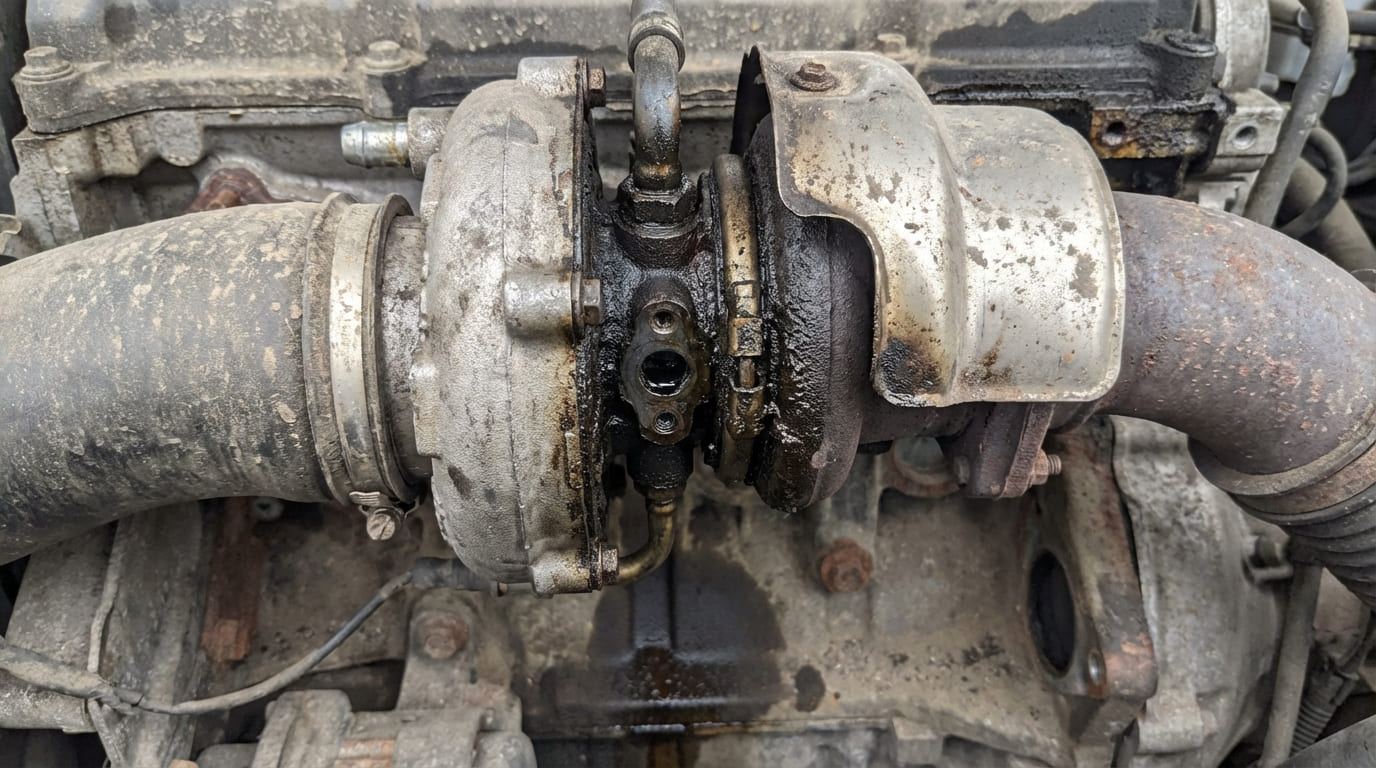
Discovery: We pulled the turbo and found the center cartridge packed with dark, crusty deposits. Oil analysis showed severe oxidation and a 30% drop in viscosity. The drain line was partially blocked.
Nuanced Lesson Learned: Just because an oil meets viscosity grade doesn’t mean it’s suitable. The real issue wasn’t the brand—it was the base stock. Conventional oils lack the thermal stability required for sustained turbo operation, especially in stop-and-go driving.
What Happens When You Use the Wrong Oil
Wrong oil leads to real-world failures. Here’s what I see most often:
| Scenario | Probable Cause(s) | Relative Likelihood | Diagnostic Next Step |
|---|---|---|---|
| Blue smoke on startup after shutdown | Failed turbo seal, coked oil drain, incorrect oil viscosity | High for seal/viscosity, Medium for coking | Inspect oil lines, check drain-back flow, verify oil spec |
| Whining turbo, low boost | Bearing wear, oil starvation, VGT vane sticking | High for oil-related wear, Medium for vane issue | Check shaft play, review oil history, inspect for coking |
| Excessive oil consumption, no leaks | High volatility oil, turbo seal failure, PCV issue | Medium across all three | Run UOA, check PCV flow, verify oil NOACK rating |
| Sludge under oil cap | Extended intervals, short trips, poor oxidation stability | High for driving pattern, Medium for oil quality | Review maintenance history, check TBN in UOA |
Situation: A 2018 Ford F-150 EcoBoost was towed in with zero boost and a grinding noise. Technician assumed the turbo was junk—common on these, right?
Discovery: Upon teardown, the turbo internals were surprisingly clean. But the oil feed line was kinked from a previous oil cooler install, and the oil was a non-synthetic blend with no API SP rating. Oil analysis showed TBN depletion at 5,000 miles.
Nuanced Lesson Learned: Don’t assume turbo noise means turbo failure. In this case, it was inadequate oil flow compounded by poor oil chemistry. The turbo was a victim, not the culprit.
Best Practices for Oil Selection and Maintenance
Protect your turbo with these field-tested rules:
- ✅ Use full synthetic oil only. It costs more—$70–$150/year extra—but prevents 80% of turbo oil-related failures I see. Conventional and blends can’t handle the heat.
- ✅ Follow OEM oil specs exactly. LL-04, dexos, WSS—these are non-negotiable. A $5 oil that doesn’t meet spec will cost you $1,500 in turbo replacement.
- ✅ Change oil every 5,000–7,500 miles under normal use; 3,000–5,000 under severe conditions. Short trips, towing, and idling are severe service. Your turbo doesn’t care what the sticker says—it cares what’s in the sump.
- ⚠️ Avoid mixing oil brands or types. Additive packages can interact under heat, leading to sludge or reduced protection. If you must top off, use the same spec and type.
- ⚠️ Don’t use “high-mileage” oil unless engine is burning oil. Seal swell additives can increase deposits in turbo oil passages. If your engine isn’t leaking, stick with standard full synthetic.
- ⚠️ Replace the oil filter with every change—use OEM or high-flow synthetic media filters. Cheap filters collapse under vacuum or restrict flow when hot, starving the turbo.
Situation: A Mercedes C300 with a 2.0L turbo came in with fluctuating oil pressure and a check engine light. Previous shop replaced the oil pump, but the issue returned.
Discovery: We ran a used oil analysis and found the viscosity had nearly doubled. The owner had been using a budget oil that passed API SN but had poor volatility control. Over time, oil evaporated, leaving behind thick, sludgy residue that restricted flow.
Nuanced Lesson Learned: Oil specs matter more than brand names. Just meeting API SN isn’t enough—European turbos often need ACEA C3 or OEM-specific approvals to control SAPS and volatility.
How to Monitor Oil and Turbo Health
Catch problems before they leave you stranded:
Run a used oil analysis (UOA) every 10,000 miles or annually. A $30 test from labs like Blackstone or Oil Analyzers Inc. shows:
- Viscosity shift (should be within ±15% of new oil)
- TBN (if below 50% of new oil’s value, change it)
- Iron and chromium (spikes indicate turbo bearing wear)
- Fuel dilution (over 3% means oil is thinning—common in GDI engines)
Perform visual checks: Peek under the oil cap. Sludge or varnish? That’s oil breakdown. Milky film? Moisture from short trips—let the engine fully warm up occasionally.
Check turbo shaft play during oil changes: Use a dial indicator if possible. More than 0.006″ radial or 0.002″ axial play means the bearings are worn. No play? Good sign—but keep monitoring oil quality.