In my two decades turning wrenches—from backyard garages to dealership bays—I’ve seen more than a few shortcuts taken with cooling systems. One that still raises my eyebrows: running straight water instead of proper coolant. It might seem harmless in the short term, especially if you’re topping off on the fly. But in my experience, doing this intentionally or for extended periods invites problems that go well beyond a simple fluid change. Let’s walk through what actually happens under the hood when water takes the place of formulated antifreeze.
Impaired Thermal Management
Temperature control is the cooling system’s primary job. Water alone struggles with both ends of the spectrum—boiling and freezing—because it lacks the chemical enhancements that modern coolants provide.
Overheating and Freezing Risks
Water boils at 100°C (212°F) at atmospheric pressure. Under a 15 psi radiator cap, that increases to about 121°C (250°F). But real-world engine hot spots—like around exhaust valves—can exceed this, causing localized boiling and steam pockets. Steam doesn’t transfer heat like liquid, so those areas can overheat even if the temperature gauge reads normal.
Antifreeze (ethylene glycol) in a 50/50 mix raises the boiling point to 129°C (265°F) under the same pressure and depresses the freezing point to -37°C (-34°F). Pure water freezes at 0°C (32°F), expanding by 9% and risking cracked blocks, heads, or radiators—even during brief cold snaps.
How to Check: Use a coolant hydrometer or refractometer to test freeze/boil protection. Every DIYer should own one. If you’re relying on water, assume zero protection.
In my shop, we always pressure-test the system after any coolant work. A 15 psi cap doesn’t mean the system holds it—weak hoses, old radiators, or a failing cap can drop effective pressure, lowering the boiling point and increasing overheating risk.
Corrosion, Erosion, and System Damage
Modern engines mix aluminum, cast iron, copper, brass, and plastic. Water acts as an electrolyte, especially tap water with dissolved minerals, accelerating corrosion between dissimilar metals.
Galvanic Corrosion and Electrolysis
When different metals are submerged in conductive fluid, voltage builds. Over 0.3V DC between coolant and engine ground indicates active electrolysis. This eats aluminum components—intake manifolds, heater cores, water pump impellers—faster than you’d expect.
How to Check: Set your multimeter to DC volts. Place the negative lead on the battery negative terminal and the positive lead in the coolant (radiator fill neck, cap off, engine cold). Readings above 0.3V signal a problem. Check ground straps first—missing or corroded engine grounds are the usual culprit.
I’ve seen a perfectly good cooling system destroyed by a missing $5 ground strap. Always inspect engine-to-frame and battery-to-body grounds before blaming the coolant.
Cavitation and Pump Damage
Water pumps create turbulence. Without cavitation inhibitors in coolant, vapor bubbles form and collapse violently near the impeller, eroding metal over time. This “cavitation erosion” looks like pitting or sandblasting and can destroy a pump in under 50,000 miles.
On engines with wet cylinder liners (some diesels and older designs), this can lead to liner perforation and coolant entering the crankcase—a repair that jumps from $200 to $3,000 fast.
How to Check: Inspect the impeller when replacing the water pump. Pitting or erosion suggests long-term use of improper fluid. Also check for coolant in the oil.
Seal and Hose Degradation
Coolant contains lubricants that protect water pump seals and condition rubber hoses. Water lacks these, leading to dry seals, early weep hole leakage, and swollen or brittle hoses.
How to Check: Look for coolant stains at the water pump weep hole. Any seepage means the seal is failing. Also inspect hoses for softness, bulging, or cracking—signs of material breakdown.
In my shop, we treat any sign of weep hole seepage as a pending pump failure. Don’t wait for a puddle—replace it now and inspect the fluid history.
Mineral Buildup and Flow Restrictions
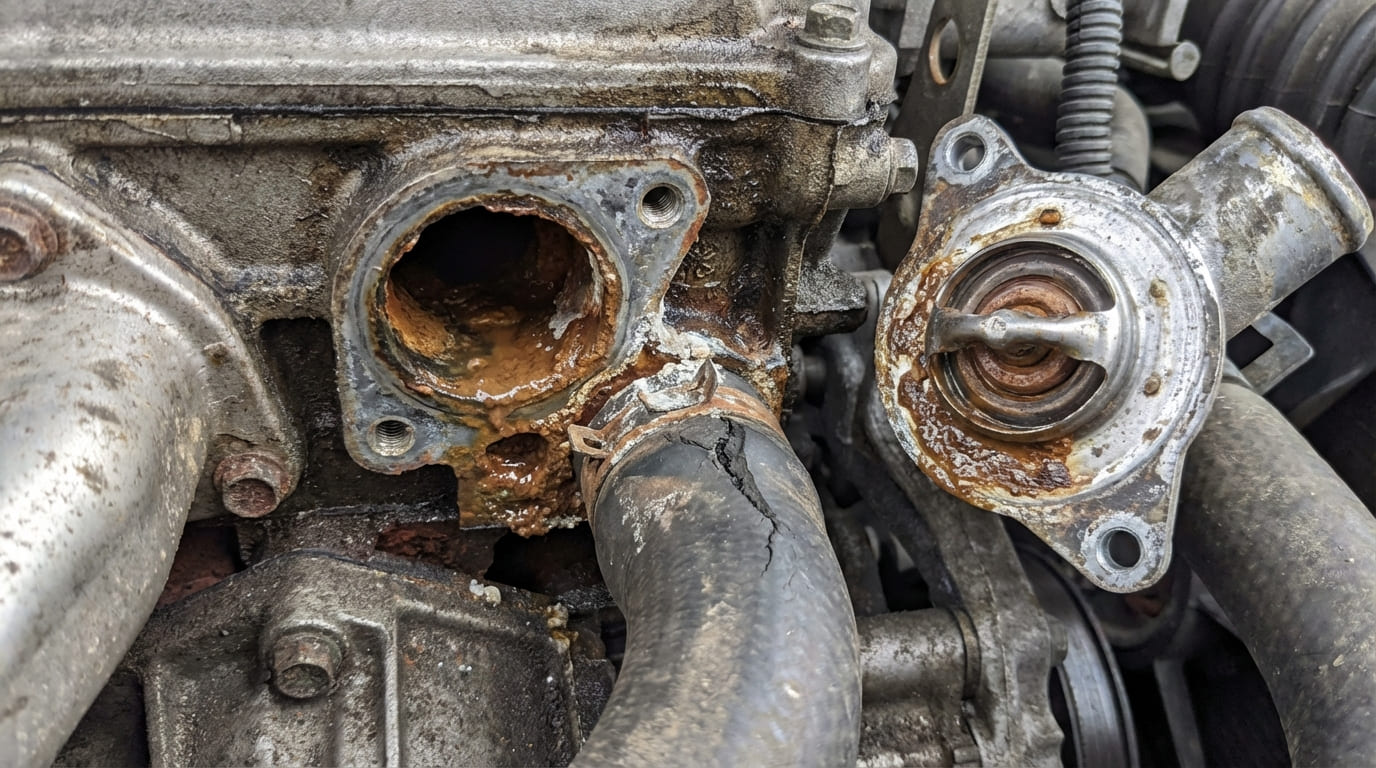
Tap water contains calcium, magnesium, and iron. When heated, these precipitate as scale—especially in cylinder heads and radiator tubes. Scale insulates metal from coolant and restricts flow, reducing cooling efficiency by up to 40% in severe cases.
Distilled water reduces this risk but still lacks corrosion inhibitors and freeze protection.
How to Check: Perform a radiator flow test. Remove upper and lower hoses and pour a gallon of water through. If it takes more than 10 seconds, you’ve got a restriction. Also inspect the thermostat housing and heater core inlet for sludge.
One flush isn’t always enough. If the system’s been run on tap water for years, use a citric acid–based cleaner and repeat until the flush water runs clear. Then refill with proper coolant—never reuse old fluid.
Emergency Use and Best Practices
Using distilled water to get home after a leak? That’s smart. Relying on it long-term? That’s a gamble.
After any water top-off, plan a full system flush and refill with OEM-specified coolant. Mixing coolant types can cause gel formation—always verify compatibility.
- ✅ Use distilled water only for emergency top-offs.
- ✅ Flush with a cooling system cleaner if water has been used.
- ✅ Refill with correct coolant type—check your owner’s manual.
- ✅ Use a vacuum filler on modern engines to prevent air pockets.
- ⚠️ Never use tap water long-term—even “soft” water conducts electricity and deposits minerals.
- ⚠️ Don’t skip the pressure test after refilling—15 minutes at 18 psi can catch small leaks before they cause overheating.
- ⚠️ Avoid mixing coolant types unless confirmed compatible—OAT, IAT, and HOAT formulas don’t always blend well.
Diagnostic Table: Symptoms and Likely Causes
| Symptom | Possible Causes | Relative Likelihood (Based on Field Experience) |
|---|---|---|
| Overheating with no external leak | Scale buildup, air pocket, boiling due to low coolant concentration, failed thermostat, water pump cavitation | Scale and air pockets common in water-cooled systems; boiling likely under load or high ambient temps |
| Coolant in oil (no oil in coolant) | Failed intake manifold gasket (common on aluminum V6/V8), cracked head, head gasket failure, casting porosity | Intake gasket issues frequent in certain models; head cracks often follow freeze events or pre-existing stress |
| Electrical potential >0.5V DC | Missing ground strap, stray voltage from alternator, dissimilar metals, degraded coolant | Missing ground strap is most common—check all engine and chassis grounds first |
| Water pump failure under 50k miles | Improper coolant, misaligned belt, contamination, cavitation, manufacturing defect | Improper fluid contributes to ~30% of premature failures I see |
Real-World Lessons from the Shop
Situation: 2012 F-150 with overheating and white smoke. Owner used tap water for two summers.
Assumption: Blown head gasket.
Truth: Flow test showed 60% restriction. Sludge in thermostat housing. No compression loss or hydrocarbons in coolant.
Fix: System flush and proper refill—no engine work needed. Always rule out flow issues before tearing down.
Situation: Subaru with cracked head after a 20°F night. Owner ran water “just for summer.”
Assumption: Pure freeze damage.
Truth: Metallurgy showed pre-existing thermal stress. The freeze was the final trigger.
Lesson: Water removes your safety margin. A slightly lean condition or poor cooling history can turn a minor freeze into a major failure.
Situation: Honda minivan—third water pump in three years.
Assumption: Bad parts.
Truth: Coolant had no inhibitor left. Owner topped off with distilled water for years.
Lesson: Coolant isn’t just antifreeze—it’s a system fluid. Missing lubricity and corrosion protection kill pumps fast.
Modern engines are less forgiving than older ones. Tighter tolerances, more aluminum, and emissions-sensitive tuning mean cooling system chemistry matters more than ever. The cost of proper coolant? $15–$30 per gallon. A full flush and refill? $150–$300. Compare that to a cracked head ($1,500–$3,000) or a full engine rebuild. The math is clear.
When in doubt, pull the service manual. It tells you the exact coolant spec, change interval, and fill procedure. That $20 PDF might save you a $3,000 mistake.