Recommended Replacement Intervals
Timing belts should be replaced based on both mileage and time, not just one or the other. Most manufacturers recommend replacement between 60,000 and 105,000 miles (96,000–169,000 km), or every 5 to 10 years—whichever comes first. Even low-mileage vehicles are at risk if the belt has aged beyond 7–10 years. Rubber degrades over time due to heat cycles, ozone exposure, and moisture, regardless of use. I’ve replaced belts on cars with under 40,000 miles that were severely cracked and delaminating simply because they were over 9 years old.
The exact interval depends on your vehicle’s make, model, and engine. For example:
- Honda K-series: 105,000 miles or 7 years
- Subaru EJ-series: 105,000 miles or 105 months (~8.75 years)
- Toyota 2AZ-FE (4-cylinder): 90,000 miles or 72 months
- Volkswagen 1.8T: 75,000 miles or 7 years
Always consult your factory service manual or dealership maintenance schedule. Don’t rely on generic advice—OEM specifications are your best guide.
In my shop, we always check the VIN-specific maintenance plan before quoting any timing belt job. One missed specification can mean the difference between a smooth repair and catastrophic engine damage.
How to Determine If Your Car Has a Timing Belt
Many drivers don’t know whether their engine uses a belt or chain. Here’s how to tell:
- Timing belts are typically hidden behind a plastic or thin metal cover on the front or side of the engine.
- Timing chains are enclosed in heavy cast aluminum or iron covers bolted directly to the engine block.
- Check your owner’s manual or search by VIN using a repair database like Alldata or Mitchell.
If in doubt, a quick visual inspection after removing the engine cover can confirm. Never assume—especially on newer models where both systems may exist in the same lineup.
Interference vs. Non-Interference Engines: Why It Matters
This is the single most important factor in assessing the risk of belt failure.
In an interference engine, the pistons and valves occupy the same space in the combustion chamber at different times. If the timing belt fails, the valves can collide with the pistons, causing bent valves, damaged pistons, or destroyed cylinder heads. Repair costs typically range from $1,500 to $4,000+—often more than the value of the car.
In a non-interference engine, there’s enough clearance to prevent contact. The engine will stop running, but internal parts usually survive. A new belt and re-timing get it back on the road.
Ask this question first: “Is my engine interference?” If yes, treat the timing belt like a ticking time bomb. Delaying service is gambling with your engine.
How to Check Timing Belt Condition (And Why It’s Not Enough)
While you can inspect the belt through an access window or after partial disassembly, visual checks have serious limitations.
What you can see:
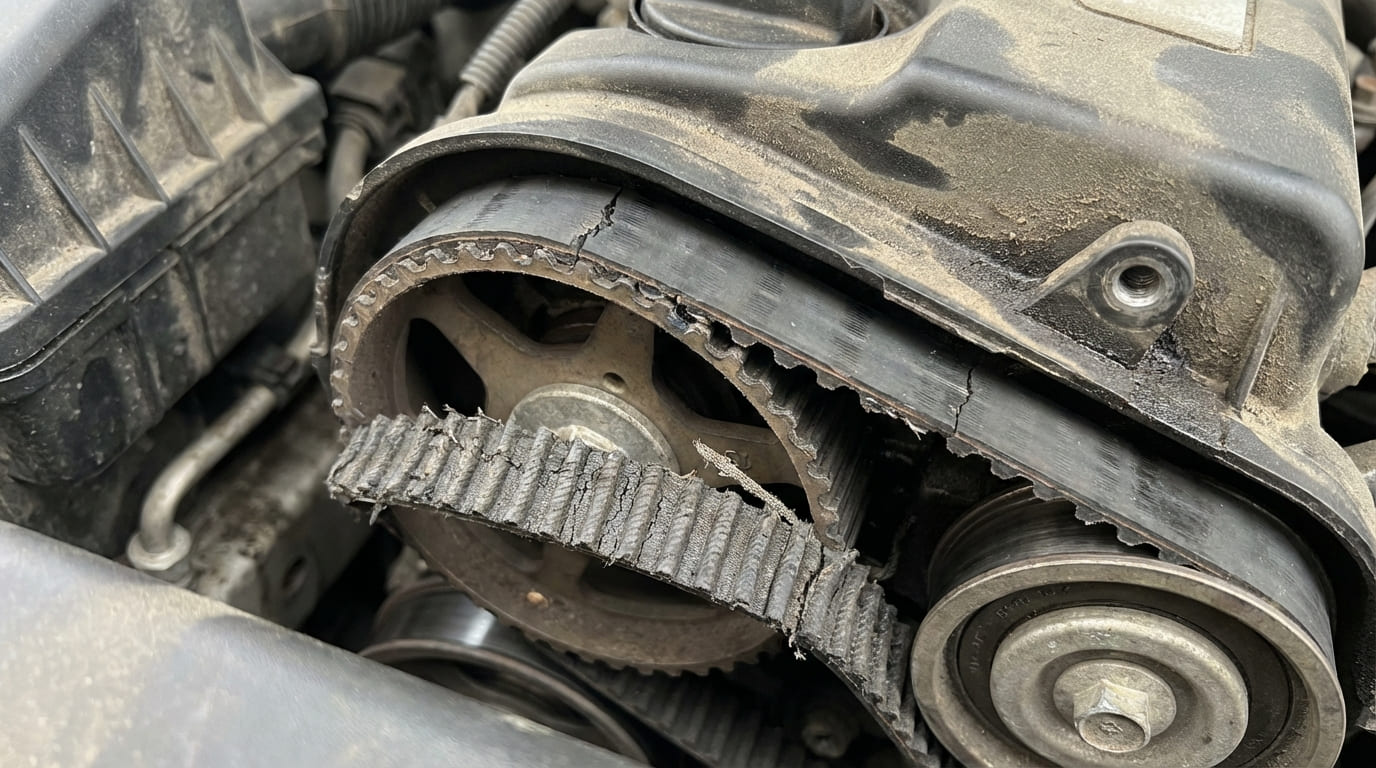
- Cracks on the belt teeth or backing
- Missing or sheared teeth
- Fraying or delamination
- Oil contamination (indicates seal leaks)
What you can’t see:
- Internal fiber degradation (aramid or carbon cords breaking down)
- Micro-tears in the rubber matrix
- Tensioner spring fatigue
Even a belt that looks perfect can fail days later due to age or internal wear. That’s why I never recommend relying on inspection alone. If the car is near or past the OEM interval, replace it—no exceptions.
Components to Replace Alongside the Timing Belt
Replacing only the belt is a false economy. The following components are exposed during the same labor-intensive disassembly and share similar failure timelines.
| Component | Failure Risk | Replacement Cost (Part Only) |
|---|---|---|
| Tensioner | High – hydraulic units lose pressure; mechanical ones bind | $40–$120 |
| Idler Pulleys | High – bearings seize or wear out | $20–$60 each |
| Water Pump | Medium–High – if belt-driven, it’s behind the cover | $60–$180 |
| Cam/Crankshaft Seals | Medium – prone to seepage after disassembly | $10–$25 each |
| Serpentine Belt(s) | Low – but easy to replace during access | $20–$50 |
I always replace the water pump on any timing-belt-driven model unless it was done recently. The labor to remove the cover is 80% of the job—skipping the pump to save $100 now could cost $800 later.
Consequences of Failure by Engine Type
The outcome of a broken timing belt depends entirely on engine design.
| Engine Type | Failure Consequence | Typical Repair Cost | Repair vs. Replace Decision |
|---|---|---|---|
| Interference | Bent valves, damaged pistons, broken rocker arms, cracked head | $1,800–$4,500+ | Often not worth fixing on older/high-mileage cars |
| Non-Interference | Engine stops; no internal damage | $400–$800 (belt + labor) | Always repairable |
Diagnostic Scenarios and Root Causes
Use these common symptoms to guide diagnosis—but verify with physical inspection.
| Symptom | Most Likely Cause | Action Steps |
|---|---|---|
| Engine won’t start, no compression | Timing belt broken or jumped teeth | Remove cover, check alignment of cam and crank timing marks |
| Check Engine Light with P0011, P0016, P0008 codes | Belt stretched or jumped; failed tensioner | Verify timing marks; inspect tensioner operation |
| Rough idle, misfires after belt service | Improper re-timing, loose cam bolt | Recheck all timing marks and fastener torque specs |
| Engine died suddenly at speed | Belt failure (interference engine likely damaged) | Do not crank engine. Tow to shop. Perform compression and leak-down test. |
Situation: 2008 Honda Accord with 68,000 miles, P0011 code, running rough. Belt looked fine through inspection hole.
Discovery: Tensioner had lost all hydraulic pressure. Belt jumped three teeth. Replaced belt, tensioner, and idlers. Verified cam/crank alignment with factory tools.
Lesson: Never skip tensioner replacement. And never trust a partial inspection—timing drift can happen without visible belt damage.
Situation: 2012 Subaru Outback, engine died on highway. Belt intact.
Discovery: Cam sprocket key sheared. Belt turned sprocket, but camshaft didn’t rotate.
Lesson: Lost timing isn’t always a belt issue. Check cam and crankshaft rotation independently when diagnosing.
Situation: 2005 Toyota Camry, 45,000 miles, 9 years old. Owner delayed service due to low mileage.
Discovery: Belt dry, cracked, cords separating. Tensioner seized.
Lesson: Time kills timing belts as much as mileage. Age-based intervals exist for a reason—follow them.
Best Practices: Do and Don’t
- ✅ Replace the belt, tensioner, and idlers as a set. They’ve endured the same stress.
- ✅ Use OEM or high-grade aftermarket parts (Gates, Aisin, INA). Cheap belts fail early.
- ✅ Replace the water pump if it’s belt-driven. Labor is the big cost—not the part.
- ✅ Clean and lubricate TTY (torque-to-yield) bolts with engine oil before installation. Dry threads cause inaccurate torque and bolt failure.
- ⚠️ Don’t reuse TTY bolts unless the service manual explicitly allows it. They stretch permanently.
- ⚠️ Don’t assume the belt is good because it “looks okay.” Internal failure is invisible.
- ⚠️ Don’t skip timing mark verification after reassembly. One tooth off can cause misfires or damage.
Timing belt service isn’t just maintenance—it’s insurance. For most cars, the total cost (belt, tensioner, idlers, water pump, labor) runs $500–$900. Compare that to $3,000 in engine repairs, and the decision is clear. Replace it on schedule, use quality parts, and verify every step. Your engine’s life depends on it.