In my shop over the last two decades, few issues have caused more misdiagnoses than boost pressure problems. Turbocharged and supercharged engines rely on precise airflow, and when boost drops, power suffers. The instinct is often to blame the turbo—but in most cases, the culprit is simpler and cheaper. I’ve seen turbos replaced unnecessarily when the real issue was a cracked hose or failed gasket. Let me show you how to diagnose and fix boost leaks and pressure loss like a pro.
Symptoms of Boost Leaks and Pressure Loss
Recognizing the signs early can save time and money. These symptoms often overlap, so use them as clues—not final diagnoses.
Performance and Drivability Issues
Reduced acceleration, turbo lag, and rough idle are common. With significant leaks, the engine may stall or hesitate under load. The ECU tries to compensate by adding fuel, leading to rich conditions and poor efficiency. If the car feels down on power but the turbo sounds fine, suspect a leak.
Audible Hissing or Whistling
Listen under boost. A hiss or whistle near the intake, intercooler, or valve cover often points to a leak. Use a mechanic’s stethoscope or a length of hose to isolate the sound. Note: fluttering after throttle lift is often normal diverter valve operation, not a leak.
Check Engine Light and DTCs
Common codes include:
- P0299 – Underboost Condition
- P0171/P0174 – System Too Lean (Bank 1/2)
- P0101 – MAF Sensor Performance
- P0507 – Idle Control RPM High
Always check freeze frame data. If P0299 sets under high load, it’s likely mechanical. If it occurs at idle, suspect vacuum lines or sensor issues.
Fuel Economy Drop
Unmetered air from a leak forces the ECU to add fuel. Long-term fuel trims above +10% are a red flag. After repair, trims should normalize and MPG often improves noticeably.
Causes of Boost Leaks (Air Escaping the System)
These are physical leaks in the pressurized intake path, from turbo outlet to intake manifold.
Charge Air Cooler and Couplers
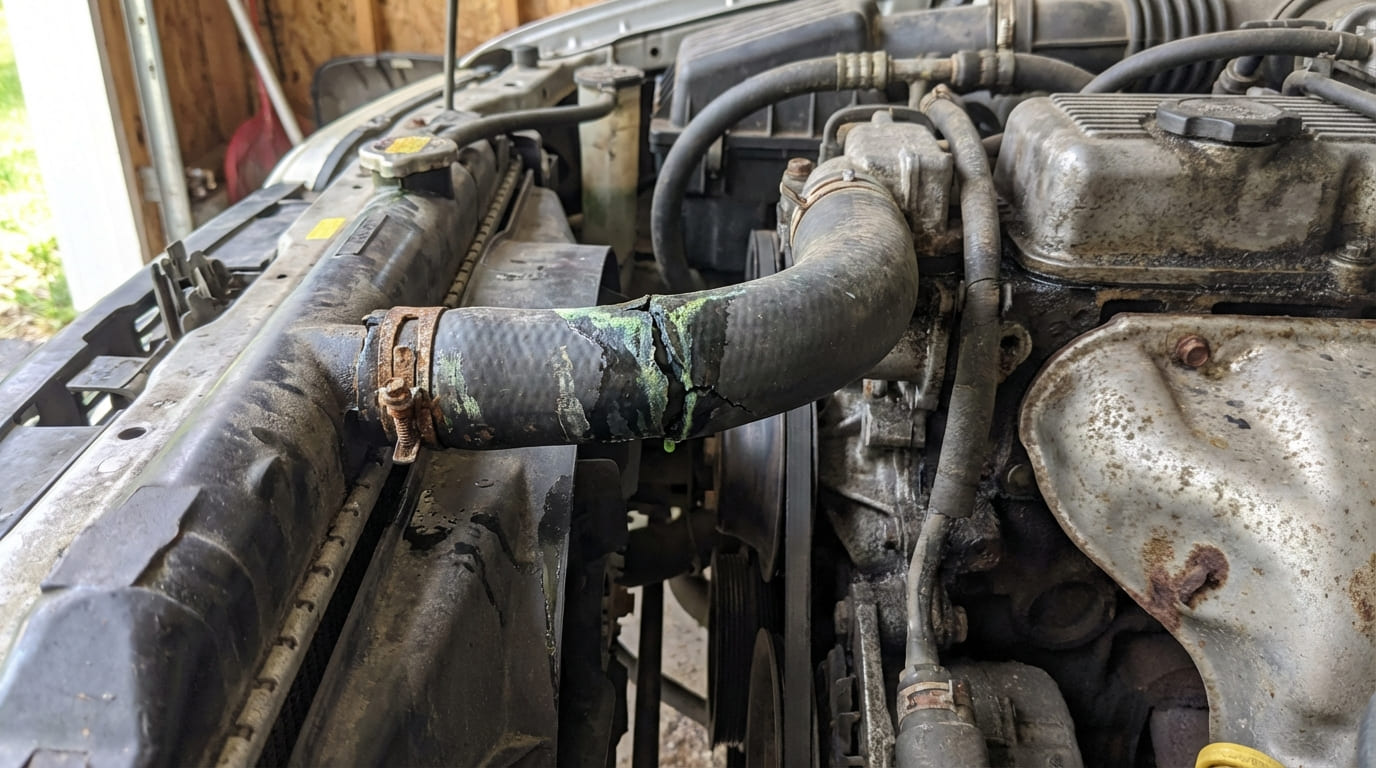
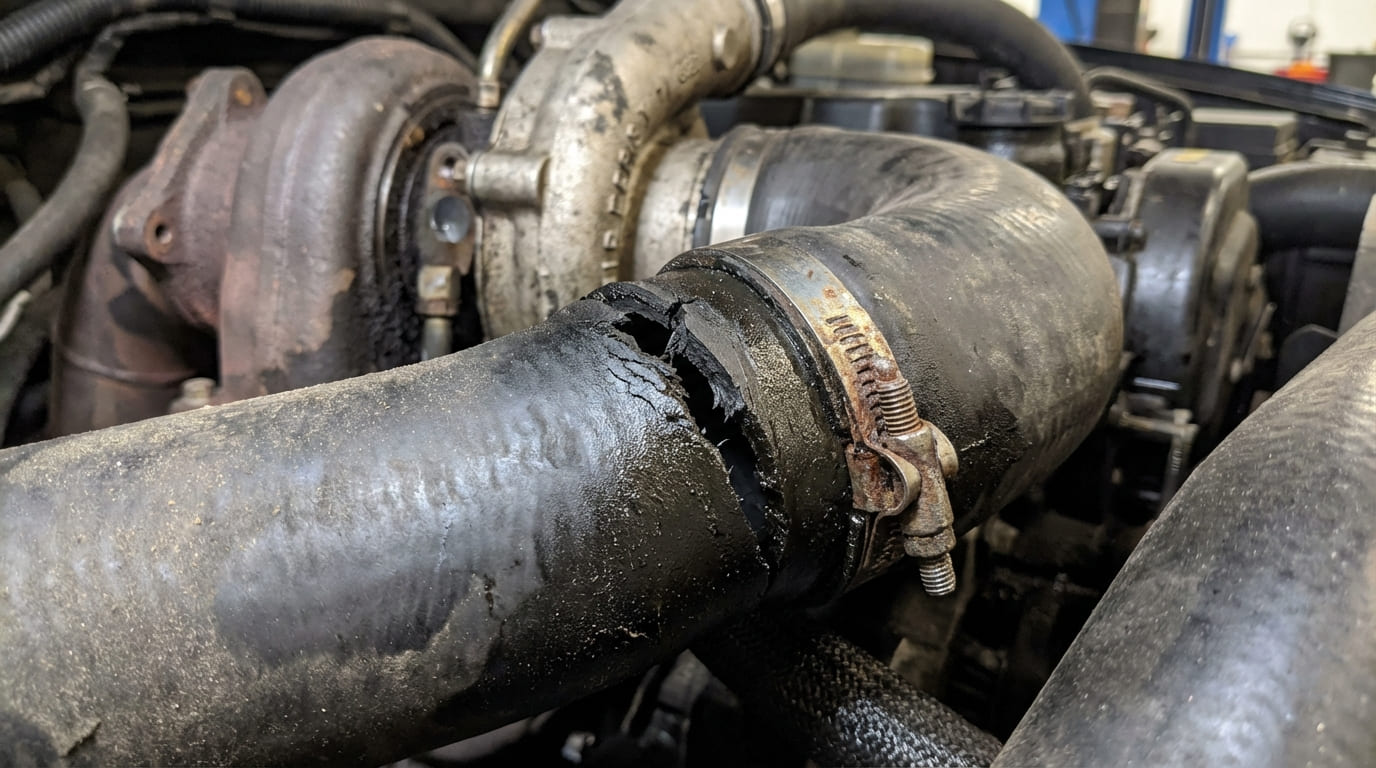
Intercoolers crack from impact or thermal stress. Couplers (especially OEM rubber) split or loosen over time. Clamps can corrode or loosen. A failed coupler at the intercooler inlet is one of the most common leak points.
How to Check: Perform a smoke test. Soapy water works for large leaks, but smoke reveals even pinholes. Look for oil residue—pressurized air escaping can carry oil mist.
Intake Manifold and Gaskets
Plastic or composite manifolds crack, especially near mounting points or coolant passages. Gaskets degrade from heat cycling. On some engines, a cracked manifold can leak boost into the cooling system—no coolant loss, but major performance drop.
How to Check: Smoke test with the system pressurized. Inspect for hairline cracks. Check freeze frame data—if underboost happens at high load, it’s likely not a manifold gasket (those usually affect idle).
Vacuum and Boost Control Lines
Small-diameter hoses control the wastegate and diverter valves. They’re prone to cracking, especially in cold climates or from rodent damage. A split line won’t leak at idle but fails under boost.
How to Check: Pressurize the system to 3–5 psi for smoke testing. Higher pressure can swell a cracked hose shut, hiding the leak. Replace all rubber control lines every 5–7 years as preventive maintenance.
Diverter and Bypass Valves
These valves can fail internally—torn diaphragm, weak spring, or worn O-ring. A valve may hold vacuum but leak under actual boost pressure.
How to Check: Remove and test with a hand vacuum pump and pressure source. Apply 15 psi and check for leakage. If suspect, replace with OEM-spec part. Aftermarket “high-flow” valves often have incorrect spring rates.
| Part | Typical Cost (USD) | Repair vs Replace |
|---|---|---|
| Intercooler Coupler | $15–$40 | Replace |
| Diverter Valve | $80–$250 | Replace |
| Boost Control Solenoid | $60–$150 | Replace or clean |
| PCV Valve | $20–$50 | Replace |
PCV and Crankcase Ventilation System
On turbocharged engines, the PCV system is part of the intake tract. A ruptured PCV valve or split hose can draw unmetered air into the intake post-MAF, causing lean codes and reduced boost.
How to Check: Block the crankcase vent during a smoke test. If smoke appears, the leak is in the PCV system. Replace the PCV valve and inspect hoses—especially on direct-injection engines prone to oil sludge.
EGR System (If in Boost Path)
Some diesels and modern gasoline engines route EGR through the high-pressure intake. A leaking EGR valve or failed gasket can allow boost to escape.
How to Check: Monitor EGR position via live data. If the valve shows “closed” but boost leaks, the seal is compromised. Remove and inspect for carbon buildup or warpage.
Causes of Loss of Boost Pressure (Compressor or Control Issues)
These are not leaks—but failures in the system’s ability to generate or control boost.
Turbocharger or Supercharger Damage
Foreign object damage (FOD) is more common than bearing failure. A dropped clamp or torn air filter can nick the compressor wheel, reducing efficiency. Shaft play is a clue—but not definitive. Internal seal wear can cause recirculation without noticeable play.
How to Check: Remove intake pipe and inspect compressor wheel for damage. Spin by hand—should be smooth with minimal play. Axial play over 0.004″ or radial over 0.015″ is usually excessive. But even a smooth-spinning turbo can fail internally.
Wastegate Malfunction
A stuck-open wastegate prevents boost buildup. Carbon buildup, corroded linkage, or failed actuator diaphragm are common causes. On electronic systems, the actuator motor or position sensor can fail.
How to Check: Command wastegate movement via scan tool and observe rod movement. If ECU commands 50% but no movement, the actuator is likely bad. Clean carbon from flapper and hinge if accessible.
Boost Control Solenoid Failure
This solenoid modulates pressure to the wastegate actuator. A clogged filter or stuck internal valve disrupts control. Many solenoids can be cleaned instead of replaced.
How to Check: Remove and blow through ports while applying 12V. Should switch flow paths cleanly. Clean with electronic parts cleaner and compressed air. If unresponsive, replace.
MAP and MAF Sensor Issues
A dirty or failing MAF sensor can underreport airflow, making the ECU think there’s a boost leak. MAP sensor drift can cause incorrect boost control.
How to Check: Compare MAF readings to known-good values at 2500–3000 RPM under load. Clean with MAF-safe cleaner. For MAP, compare to manifold vacuum at idle—should read ~14.7 psi at sea level. Replace if out of spec.
Diagnostic Procedure: Step-by-Step
Follow this sequence to avoid unnecessary parts replacement.
Step 1: Scan for Codes and Live Data
Check for DTCs and freeze frame data. Log:
- Commanded vs Actual Boost
- Long-Term Fuel Trims
- MAF g/s reading at 2500 RPM
- Wastegate Duty Cycle
If actual boost is low but fuel trims are normal, suspect sensor or control issue. If trims are high, suspect air leak.
Step 2: Visual and Auditory Inspection
Inspect all hoses, clamps, and connections. Look for:
- Cracked or swollen hoses
- Loose or corroded clamps
- Oil residue on couplers
- Disconnected vacuum lines
Listen with a hose to your ear while someone revs the engine. Hissing at a joint is a telltale sign.
Step 3: Pressure and Smoke Testing
Use a boost leak tester to pressurize the system to 15 psi. Watch for pressure drop:
- Drop >2 psi/min = leak present
- Soapy water on joints can reveal large leaks
For pinpoint accuracy, use a smoke machine. Seal the turbo inlet, introduce smoke, and look for escaping smoke. Works best at low pressure (3–5 psi) for small leaks.
Step 4: Component Testing
Test suspect parts:
- Diverter valve: Apply vacuum and pressure
- Boost solenoid: Check operation with 12V and airflow
- Wastegate: Verify movement under ECU command
In my shop, we always test the diverter valve under actual boost pressure, not just vacuum. I’ve seen valves pass vacuum tests but leak at 10+ psi.
Best Practices: What to Do and Avoid
- ✅ Recommended: Use OEM-spec hoses and clamps. Aftermarket silicone is fine, but ensure durometer matches OEM—too soft blows off, too hard won’t seal.
- ✅ Recommended: Torque fasteners in sequence and stages. Uneven force warps intercooler tanks or manifold gaskets.
- ✅ Recommended: Clean threaded holes with a tap. Debris or oil affects torque and can cause leaks.
- ⚠️ Avoid: Reusing torque-to-yield (TTY) bolts. They stretch during installation and lose clamping force when reused.
- ⚠️ Avoid: Spraying soapy water on electrical connectors. Use smoke or dry inspection near sensors.
- ⚠️ Avoid: Assuming a new part is good. I’ve installed brand-new diverter valves that leaked. Test if symptoms persist.
Common Scenarios and Likely Causes
| Symptom | Most Likely Causes | Less Common But Possible |
|---|---|---|
| Underboost (P0299), high fuel trims | Charge pipe leak, failed diverter valve, loose clamp | MAF sensor contamination, boost solenoid clog |
| Whistling under boost | Intercooler coupler leak, cracked hose | Wastegate actuator leak, PCV system leak |
| Boost builds slowly | Restricted intake, turbo bearing wear | Sticking wastegate, collapsed intake hose |
| Boost spikes then drops | Blow-off valve failing to reseat, solenoid issue | ECU software glitch, sensor intermittency |
| No boost, turbo spools loudly | Large charge air leak, intercooler burst | Compressor wheel damage, inlet obstruction |
Situation: A 2014 WRX came in with P0299 and sluggish performance. The owner had replaced the turbo and intercooler with used parts.
Initial Assumption: Bad turbo or poor installation.
Deep Dive: Smoke test showed a large leak at the intake manifold—seemed obvious. But after replacing the gasket, the problem returned. Further investigation revealed the used intercooler had a hairline crack in the inlet pipe, only visible under pressure when the rubber coupler expanded slightly.
Nuanced Lesson Learned: Even if one leak is found, don’t assume it’s the only one. Used parts can have hidden damage, and symptoms can be cumulative.
Situation: A 3.5L EcoBoost truck had intermittent underboost. No visible leaks, turbo spun freely.
Initial Assumption: Faulty boost control solenoid.
Deep Dive: Live data showed erratic wastegate duty cycle. Replaced the solenoid—no change. Then I noticed the vacuum line to the solenoid was soft and collapsing under suction. It wasn’t leaking air in, but restricting signal to the actuator.
Nuanced Lesson Learned: Not all boost control issues are about air escaping. Restrictions in control lines can be just as damaging as leaks.
Situation: A customer reported a fluttering noise after installing a “high-flow” diverter valve.
Initial Assumption: Cheap aftermarket part.
Deep Dive: The valve was sealing fine, but the spring rate was too light. It opened too early during deceleration, causing compressor surge. The OEM valve used a dual-spring design to manage pressure gradients more smoothly.
Nuanced Lesson Learned: Performance modifications can disrupt factory control logic. Sometimes, OEM is better engineered for daily driving conditions.
Boost issues are rarely about the turbo itself. Focus on the entire system—from intake to manifold. Use live data, smoke testing, and physical inspection together. Never assume a repair is complete until fuel trims normalize and boost tracks command. And remember: the cheapest part can cause the biggest problem. Always verify, don’t guess.