Yes, faulty spark plugs are one of the most common causes of engine misfires. After two decades as a master mechanic in both independent shops and dealerships, I’ve seen countless misfires traced back to worn, fouled, or improperly installed spark plugs. But here’s the catch: replacing the plugs without diagnosing *why* they failed often leads to the same problem returning. This guide cuts through the noise with real-world diagnostics, repair tips, and cost insights so you can fix the issue for good — not just mask it.
How Faulty Spark Plugs Cause Misfires
Spark plugs ignite the air-fuel mixture in each cylinder. When they fail, combustion becomes unstable or doesn’t happen at all. The result? A misfire — felt as hesitation, rough idle, or a flashing check engine light. Modern engines detect misfires via crankshaft position sensors and log codes like P030X (where X is the affected cylinder).
The key is understanding *how* a plug fails and whether it’s the root cause or a symptom.
Common Failure Modes That Lead to Misfires
These are the top spark plug issues I see in the shop — and how they disrupt combustion.
- Fouling: Carbon, oil, or ash buildup can short-circuit the spark. Carbon fouling (black, dry) usually means rich fuel mixture or short trips. Oil fouling (wet, glossy black) points to internal engine leaks — common in high-mileage engines or turbos with seal failures. Ash fouling (light tan or white) often comes from oil additives or coolant leaks.
- Incorrect or Worn Gap: Too wide, and the coil may not generate enough voltage to jump the gap, especially under load. Too narrow, and the spark can be too weak to ignite the mixture properly. Always check gap with a wire gauge — even pre-gapped plugs can be off.
- Electrode Erosion: Normal wear thins the center electrode. Once it drops below 0.020″ in diameter, spark efficiency drops. Iridium plugs resist this better, but they’re not immune.
- Cracked Insulator: Often caused by thermal shock or over-torquing. The crack creates a path to ground, so the spark bypasses the gap. These misfires may only show up when the engine is hot or under load.
- Melted Electrodes: A red flag. This usually means pre-ignition from a lean air-fuel ratio, incorrect timing, or a plug that’s too hot for the application — not just old age.
- Wrong Heat Range: Too cold, and the plug fouls at idle. Too hot, and it can cause pre-ignition under load. Stick to OEM specs unless you’ve modified the engine.
In my shop, we always inspect the old plug like a crime scene. The deposits tell the story — oil, carbon, or melting aren’t random. They’re clues to deeper issues.
How to Diagnose a Spark Plug Misfire
Don’t guess. Follow these steps to confirm if the spark plug is the culprit — or if something else is to blame.
Step 1: Confirm the Misfire and Identify the Cylinder
Use an OBD2 scanner to pull codes. A P0302 means cylinder 2 is misfiring. But go further — check Mode 6 data if available. It shows misfire counts per 1,000 cycles, helping distinguish chronic issues from occasional stumbles.
Also review fuel trims:
- High positive long-term trim (+10% or more)? Could be a lean condition — maybe a vacuum leak or clogged injector, not the plug.
- Negative trim? Might be a rich condition or leaking injector.
Step 2: Remove and Inspect the Spark Plug
Focus on the misfiring cylinder. Compare it to a known good plug. Look for:
- Color: Tan = healthy. Black = rich or oil. White = lean or overheating.
- Gaps: Measure with a wire gauge. Compare to factory spec — usually 0.028″ to 0.060″, depending on engine.
- Damage: Cracks, melting, or bridged gaps mean replacement is needed.
Caution: Oil on a plug in a 150,000-mile engine might be normal. In a 60,000-mile engine, it’s a red flag.
Step 3: Perform a Spark Test Under Load
Grounding a plug to the valve cover isn’t enough. Use a spark tester that simulates cylinder pressure (20–30kV load). I prefer adjustable gap testers — if the spark fails at 0.5″ but works at 0.3″, the coil or plug can’t deliver full voltage.
Color matters: Blue = strong. Yellow or orange = weak. But even a good spark doesn’t rule out a coil that breaks down when hot.
Step 4: Check Plug Resistance (If Applicable)
For resistor-type plugs, use a multimeter. Test between the center electrode and the metal shell. Normal range: 3,000–10,000 ohms. Infinite resistance? Resistor is open. Near zero? It’s shorted — may not cause misfire but can increase EMI.
Step 5: Rule Out Mechanical Issues
If the plug looks fine but the misfire persists, do a compression test. Low compression (below 100 psi) or more than 15% variation between cylinders points to valves, rings, or head gasket issues — not ignition.
I once spent hours on coils and plugs only to find a bent valve via compression test. Save time: test compression early if the ignition parts look okay.
Other Common Misfire Causes (Don’t Blame the Plugs Too Soon)
Spark plugs are an easy target, but other issues mimic the same symptoms. Use this table to differentiate.
| Symptom / Test | Spark Plug Issue | Ignition Coil Issue | Fuel Injector Issue | Mechanical Issue |
|---|---|---|---|---|
| Visual Plug Condition | Fouled, eroded, cracked | Often normal | Normal | Normal or oil-fouled |
| Misfire Follows Coil Swap? | No | Yes | No | No |
| Fuel Trim Behavior | Varies (rich if fouled) | Often normal | High if clogged, low if leaking | High if coolant leak |
| Compression Test | Normal | Normal | Normal | Low or inconsistent |
| Common in 100K Mile Engine? | High | High | Moderate | Low to moderate |
Repair vs. Replace: Cost and Practical Advice
Spark plugs are cheap — usually $5–$15 each for copper, $10–$25 for iridium. Labor, if you’re not DIYing, runs $100–$250 depending on engine complexity (V6/V8 with coils on plugs takes longer).
But here’s the reality: if you’re doing the work, replace all plugs at once. Even if only one looks bad, the others are likely near the end of life. And always replace ignition coils if they show signs of arcing or cracking — they cost $80–$150 each, but a failing coil will kill new plugs fast.
When to just replace plugs:
- Misfire on multiple cylinders with worn/fouled plugs
- Vehicle is past recommended interval (60K for copper, 100K for iridium)
- No other mechanical or fuel system issues found
When to dig deeper:
- Plugs keep fouling after replacement
- Electrodes are melting
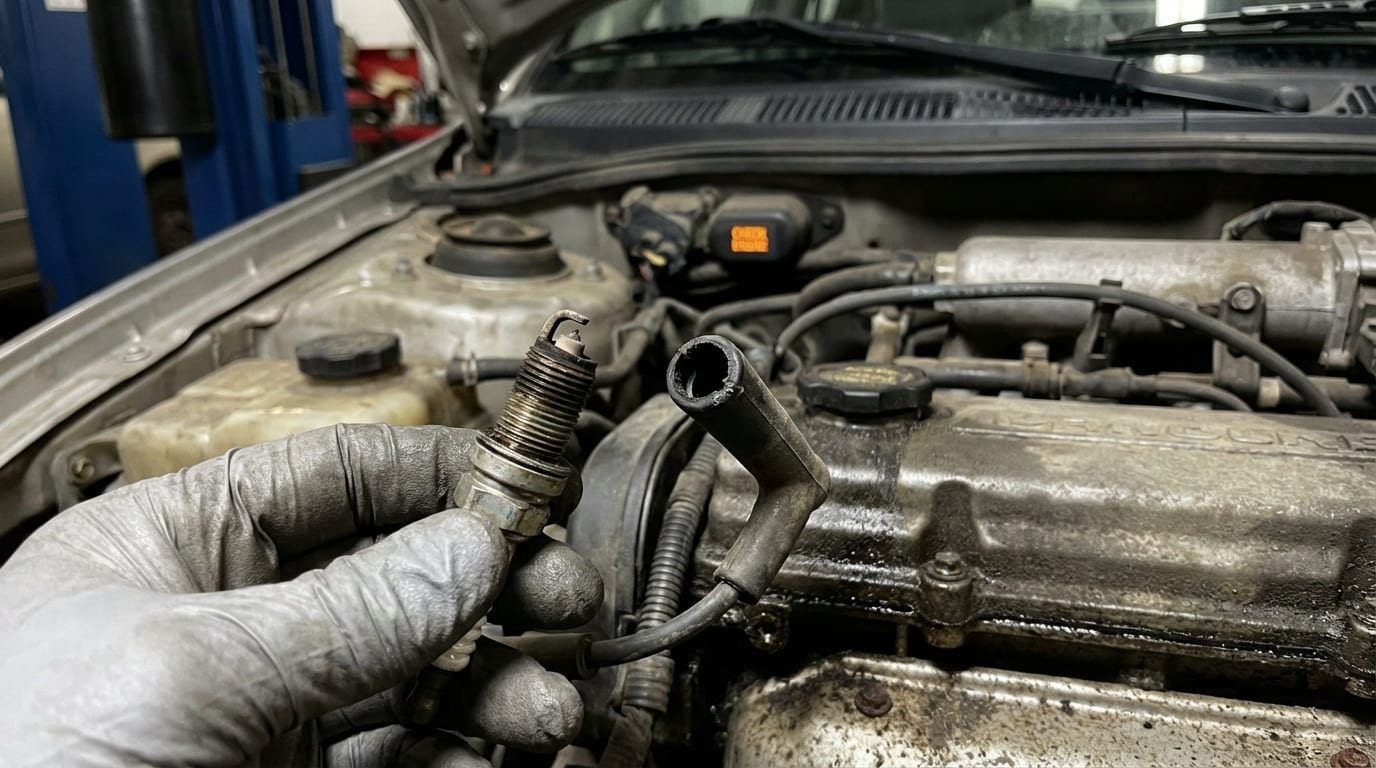
- Oil is present in the spark well
Situation: A 2015 Honda Accord with P0302. Owner replaced coil and plug twice. I found oil in the well — a leaking valve cover gasket. Fixed the gasket, new plug, no more misfire. Lesson: the plug was the messenger, not the problem.
Situation: Turbo VW misfiring under boost. Plugs had melted electrodes. Replaced both — misfire returned. Fuel trims showed lean condition. Failed fuel pump couldn’t keep up. Lesson: melted plugs can be a symptom of fuel starvation, not bad plugs.
Situation: V8 truck with stumble under light load. No codes. Plugs and coils looked fine. Smoke test revealed small vacuum leak. Fixed leak — problem gone. Lesson: not every misfire triggers a code. Air leaks can mimic ignition faults.
Best Practices for Spark Plug Replacement
Get it right the first time with these field-tested tips.
- ✅ Clean spark plug wells with compressed air or a shop vac before removal. Dirt can fall into the cylinder.
- ✅ Use a thread chaser or tap to clean cylinder head threads. Debris increases torque and risks damage.
- ✅ Torque plugs to spec — never “eyeball it.” Over-tightening cracks porcelain or strips aluminum heads. Under-tightening reduces heat transfer and can cause pre-ignition.
- ✅ Gap plugs with a wire gauge, not a flat feeler. Even pre-gapped plugs can be off.
- ⚠️ Don’t reuse torque-to-yield coil boots or fasteners. They lose clamping force and can cause arcing.
- ⚠️ Avoid anti-seize on nickel-plated or factory-coated plugs unless specified. It reduces friction, leading to over-torquing.
- ⚠️ Never touch the insulator with bare fingers. Skin oils can create conductive paths in humid conditions.
Prevention and Maintenance
Stick to OEM-specified plugs and replacement intervals. Iridium plugs last 80,000–100,000 miles in most street-driven vehicles. Harsh conditions — towing, stop-and-go traffic, extreme temps — may require earlier service.
If you’re seeing repeated issues, look beyond the plug. Check oil consumption, coolant levels, and fuel trims. A plug that keeps fouling is telling you something — listen to it.
Every engine has its own personality. What works on a Toyota might not work on a BMW. When in doubt, consult the factory service manual — it’s still the most accurate source you’ve got.