Ignition coils fail for reasons beyond simple age or wear. As a master technician, I’ve found that most failures stem from avoidable stressors—heat, contamination, electrical overload, or improper maintenance. This guide cuts through the noise to give you actionable diagnostics, repair logic, and proven prevention strategies.
How Ignition Coils Fail: The Real-World Causes
Coils transform 12 volts into 15,000–45,000 volts to fire the spark plug. When any part of this system is compromised, the coil bears the brunt. Below are the primary failure causes, ranked by frequency and repair priority.
Heat and Electrical Overload
Repeated thermal cycling degrades internal insulation. Short trips, towing, and stop-and-go driving accelerate this. Over time, windings short internally, increasing current draw and heat—a vicious cycle.
External electrical issues often mimic or cause coil failure:
- Excessive dwell time from a failing PCM driver circuit
- High resistance in spark plug wires (on coil-pack systems)
- Low-resistance or incorrect spark plugs drawing more current
A coil that tests “good” but keeps failing? Suspect the control side.
In my shop, we always check the primary ignition waveform with a scope before replacing a repeatedly failed coil. If dwell exceeds spec, the PCM is likely at fault—not the coil.
Contamination: Oil, Coolant, and Moisture
Fluid in the spark plug well is a leading cause of repeat coil failure. It creates a conductive path, causing misfires and carbon tracking.
Common sources:
- Leaking valve cover gasket (oil)
- Failing spark plug tube seals (oil)
- Cracked or warped intake manifold (coolant, especially on V6 engines)
- Poorly sealed plug wells (water, after washing or rain)
Dielectric grease on the coil boot helps, but won’t fix a flooded well.
I once replaced three coils on a 4-cylinder that kept misfiring. Found oil pooling in every well. Replaced the valve cover gasket and tube seals—no more issues. Always inspect the well before replacing the coil.
Mechanical Stress and Vibration
Coil-on-plug (COP) designs sit directly on the cylinder head, exposed to engine vibration and expansion. Over time, internal wires fatigue and break—especially on high-mileage 4-cylinder engines.
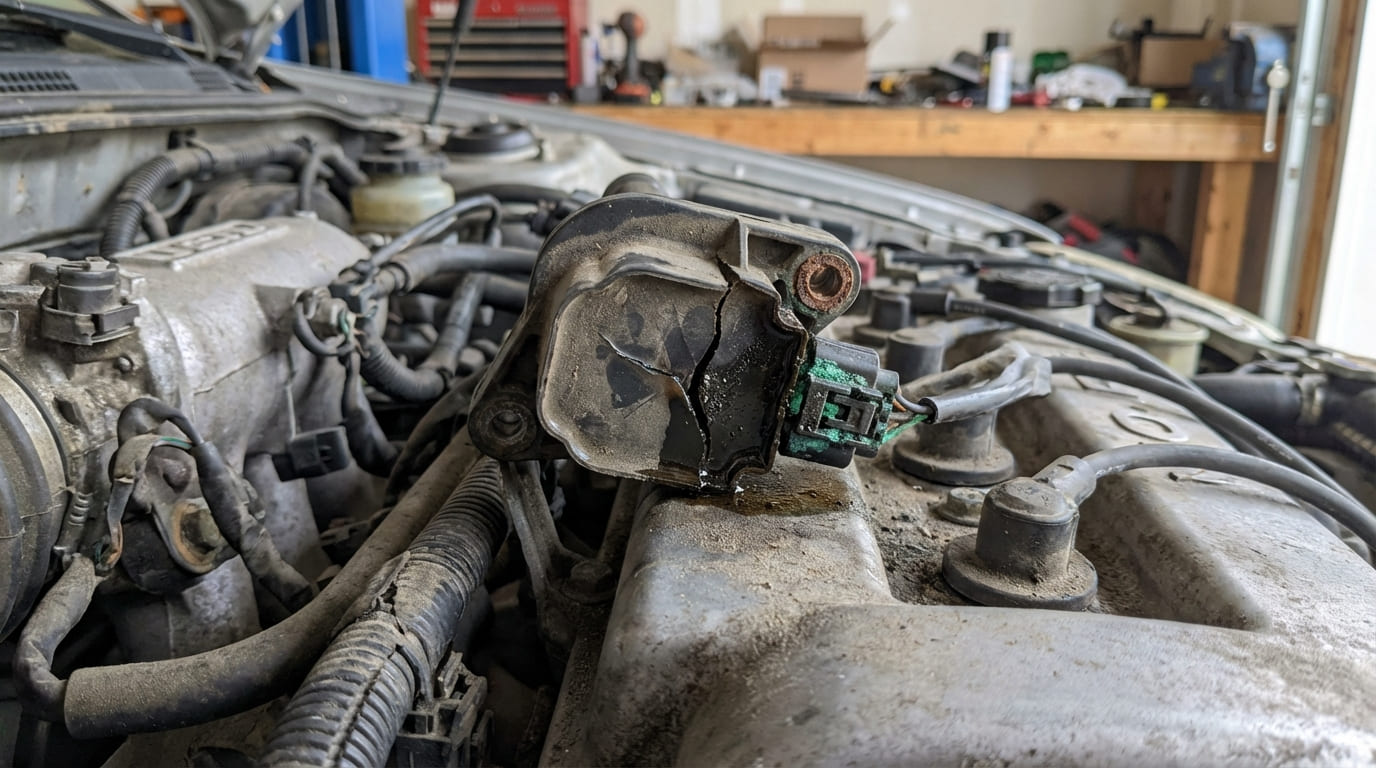
Cracks in the housing or failed seals allow moisture and debris in, leading to carbon tracking. These may not be visible without removing the coil.
Worn or Incorrect Spark Plugs
A spark plug with a gap beyond spec forces the coil to generate higher voltage. Over time, this overstresses the coil. Fouled or carbon-tracked plugs waste energy as heat.
Always check plug condition and gap before blaming the coil. Use only OEM-specified plugs—some aftermarket copper-core plugs look identical but draw more current.
On turbocharged engines, I only use OEM or OE-equivalent plugs. Budget plugs may save $5, but they’ve cost customers $200 in repeated coil replacements.
How to Diagnose Ignition Coil Failure
Don’t assume a misfire code means a bad coil. Follow this sequence to avoid costly mistakes.
Step 1: Confirm the Misfire Cylinder
Use an OBD2 scanner to read live misfire data. A P030X code (e.g., P0302) identifies the cylinder. Check Mode 6 data for misfire counts—this shows severity and pattern.
Step 2: Perform a Coil Swap Test
On COP systems:
- Swap the suspect coil with one from a known good cylinder.
- Clear codes and test drive.
- Rescan: If the misfire moves, the coil is faulty. If it stays, investigate spark plug, fuel injector, or compression.
Step 3: Visual Inspection
Remove the coil and check for:
- Cracks or carbon tracking on the housing
- Oil, coolant, or water in the spark plug well
- Swollen or cracked coil boot
- Corrosion or bent pins in the connector
Step 4: Electrical Testing
Use a digital multimeter (DMM) to check resistance:
| Circuit | Typical Range | Notes |
|---|---|---|
| Primary Winding | 0.3–1.0 ohms | Varies by manufacturer—consult service manual |
| Secondary Winding | 5,000–20,000 ohms | Open or shorted windings indicate failure |
Note: A coil can test “in spec” but still fail under load. For definitive testing, use a spark tester with a 12mm gap or an ignition scope.
I’ve seen coils pass resistance tests but produce weak yellow sparks under load. A spark tester or scope reveals what a multimeter misses. Never skip this step on high-mileage or turbocharged engines.
Repair vs Replace: Cost and Viability
Ignition coils vary in price and labor cost:
| Coil Type | Part Cost | Labors Ease |
|---|---|---|
| Coil-on-Plug (COP) | $40–$120 each | Easy (10–20 mins per coil) |
| Coil Pack (Waste Spark) | $80–$200 | Medium (may require intake removal) |
| Distributor Coil | $50–$150 | Easy |
Replace coils one at a time unless multiple failures suggest a systemic issue (e.g., contamination or incorrect plugs).
On high-mileage vehicles (100k+ miles), consider replacing all COPs if one fails—others are likely near end-of-life.
Prevention: Pro Tips to Extend Coil Life
- Replace spark plugs at OEM intervals with correct type and gap. Even 0.005″ over-gap increases coil stress.
- Apply dielectric grease to coil boots during installation—keeps moisture out and prevents boot bonding.
- Inspect spark plug wells during oil changes. Catch oil or coolant early.
- Never reuse old coil mounting bolts or grommets—they lose tension, increasing vibration.
- Avoid cheap aftermarket coils on performance or turbocharged engines. Inferior potting material cracks under heat.
- Inspect wiring harnesses for chafing or corrosion near connectors.
On vehicles prone to oil leaks (e.g., older BMWs, Hondas, Fords), I recommend replacing valve cover gaskets and tube seals at 80k–100k miles—before they kill the coils.
Symptoms of Ignition Coil Failure
Common signs include:
- Engine misfire (under load or at idle)
- Rough or fluctuating idle
- Power loss or hesitation during acceleration
- Check Engine Light with P030X (misfire) or P035X (coil circuit) codes
- Increased fuel consumption
- Stalling or hard starting
Failure Mode Probabilities and Diagnostic Priority
| Symptom | Most Likely Cause | Less Common But Possible | Diagnostic Priority |
|---|---|---|---|
| P030X + P035X on one cylinder | Faulty coil or spark plug | Wiring issue, PCM driver fault | Swap test first, then resistance and visual |
| Misfire worsens when wet | Moisture in spark plug well | Cracked coil housing, failed boot seal | Inspect well and boot, apply dielectric grease |
| Coil visibly damaged or melted | Excessive dwell (PCM issue) | High resistance in secondary circuit | Check control signal with scope |
| Multiple coil failures over time | Fluid contamination or incorrect plugs | Systemic voltage issue, poor grounding | Inspect for oil/coolant, verify plug spec |
Situation: A 2012 4-cylinder sedan had P0301 and rough idle. Owner replaced coil and plug twice.
Deep Dive: Found carbon tracking and oil in the well. Valve cover gasket and tube seal were failed.
Lesson: Fix the environment, not just the part. Otherwise, you’re just wasting money.
Situation: Turbo 6-cylinder misfiring under boost. New coil didn’t help.
Deep Dive: Scope showed dwell time double spec. PCM driver circuit was failing.
Lesson: A melted coil is often a symptom, not the cause. Test the control side.
Ignition coil failure is rarely random. Most are caused by preventable factors: contamination, incorrect parts, or electrical issues. Always inspect the entire ignition system—coil, plug, well, wiring, and control signal—before replacing parts. When in doubt, consult the service manual. Specifications vary widely, and guessing can cost you time and money.