Yes—a severely clogged oil filter can cause low oil pressure, but it’s not always the root cause. The filter sits in the main oil flow path, and when it becomes blocked with sludge, metal particles, or degraded oil byproducts, it restricts oil movement. While most filters have a bypass valve to prevent total oil starvation, that valve opens at the cost of oil pressure and filtration. You may still have flow, but not enough pressure to properly lubricate lifters, camshafts, or bearings. The good news? This is one of the easiest and cheapest issues to test and fix.
How a Clogged Filter Affects Oil Pressure
As the filter media loads up with contaminants, oil flow resistance increases. The oil pump must work harder to push oil through. If the restriction is severe, downstream pressure drops—especially at idle when pump speed is lowest. The bypass valve kicks in around 8–12 psi differential pressure, letting unfiltered oil into the engine. This prevents catastrophic failure but results in lower system pressure and dirty oil circulation.
Many drivers mistake this for a failing oil pump. But unlike a worn pump, a clogged filter often responds to a simple oil and filter change. If pressure returns to normal afterward, the filter was the culprit.
How to Check for a Clogged Oil Filter
Never rely on the dashboard oil light or factory gauge. They’re prone to false readings. Use a mechanical oil pressure gauge for accuracy.
- Locate the oil pressure test port—usually near the oil filter housing or on the engine block.
- Screw in a calibrated mechanical gauge.
- Run the engine to full operating temperature (180–200°F oil temp).
- Record pressure at idle (typically 600–800 RPM) and at 2,000 RPM.
- Compare readings to factory specs—common values are 10–15 psi at hot idle and 40–60 psi at 2,000 RPM, but always check your manual.
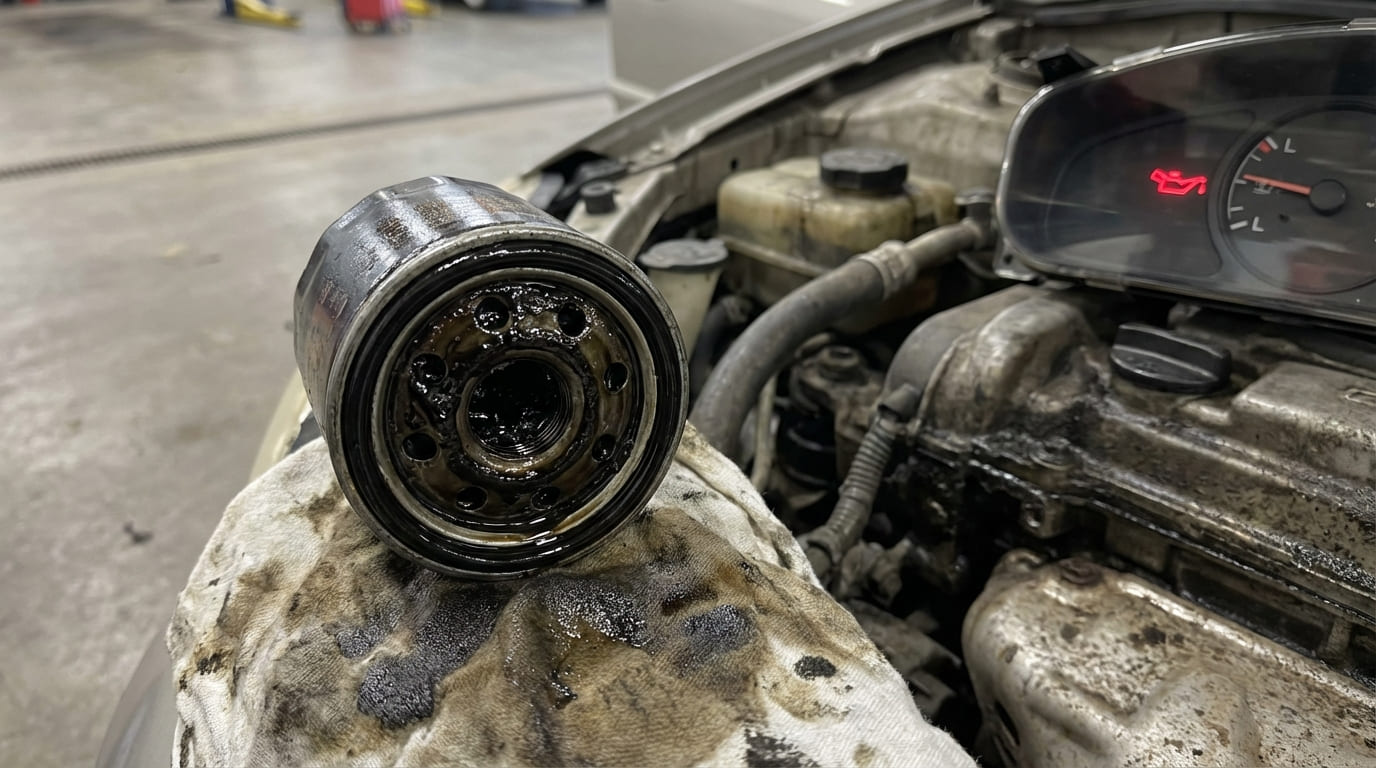
If pressure is low, drain the oil and remove the filter. Inspect it:
- Is the filter crushed, bulging, or leaking?
- Does the center tube look collapsed?
- When cut open, is the media packed solid with sludge or metal flakes?
If yes, the filter was restricting flow. Replace it with a high-quality unit and retest.
In my shop, we always install a new OEM-spec filter and fresh oil of the correct viscosity before deeper diagnosis. If pressure doesn’t improve, we know the problem is internal. But more than once, a $15 filter and oil change has solved a “mystery” low-pressure issue.
Symptoms of Low Oil Pressure from a Clogged Filter
- Oil pressure warning light flickers or stays on at idle
- Ticking or tapping noise from the valvetrain, even with correct oil level
- Pressure readings improve after engine warms up or RPM increases
- Dark, sludgy oil with visible particles during drain
- Symptoms appear shortly after an oil change—especially with low-quality filters
What Else Could Be Causing Low Oil Pressure?
A clogged filter is just one possibility. If pressure remains low after a fresh filter and oil change, investigate these common issues:
| Condition | Typical Impact on Pressure | Diagnostic Clue | Repair Complexity |
|---|---|---|---|
| Clogged oil filter | Moderate to severe drop at idle | Pressure improves after filter/oil change | Low |
| Worn main or rod bearings | Gradual drop across all RPMs | Knocking noise under load, high-mileage engine | High |
| Failing oil pump | Low pressure at all temps, worse when hot | Whining noise, visible wear on gears or housing | Medium to High |
| Stuck-open pressure relief valve | Consistently low pressure, no rise with RPM | Pressure flatlines regardless of engine speed | Medium |
| Blocked oil pickup tube | Sudden drop in pressure, especially under hard cornering | Sludge or debris visible when pan is removed | Medium |
| Incorrect oil viscosity | Low when hot, normal when cold | Oil too thin for engine; check owner’s manual | Low |
A 2012 Toyota Camry came in with a low oil pressure light at idle. The owner had just changed the oil at a quick-lube. Mechanical gauge confirmed low pressure. After replacing the filter with a known OEM unit and fresh oil, pressure returned to spec. The original filter had a collapsed center tube—likely a manufacturing defect. Lesson: A new filter isn’t always a good filter. Stick to reputable brands.
A high-mileage Ford 5.4L had low pressure and valvetrain noise. Two filters already replaced—no fix. We dropped the pan and found the oil pickup screen clogged with sludge. The filter wasn’t blocked, but the oil had broken down due to blow-by from worn rings. The clogged pickup starved the pump. Lesson: A clogged filter is often a symptom. Check oil condition and engine health, especially on high-mileage engines.
An older BMW with oil pressure swings had a high-flow pump and performance filter installed. Pressure was still low at idle. We found the aftermarket filter’s bypass valve opened at just 6 psi—too low for the engine’s needs. Switched back to OEM-spec filter, and pressure stabilized. Lesson: Modifications must match system specs. A bigger pump won’t help if the filter bypasses too early.
Costs and Repair vs Replace Decisions
Replacing an oil filter and oil costs $30–$70 if done yourself, $100–$180 at a shop. If pressure returns to normal, you’ve solved the issue cheaply.
If not, deeper problems are likely. A new oil pump costs $150–$400 in parts, with 3–6 hours of labor. Bearing replacement requires engine disassembly—$1,500 to $4,000. In high-mileage engines, consider whether repair is worth it versus engine replacement or vehicle retirement.
My rule: If oil pressure doesn’t improve after a correct oil and filter change, stop driving the vehicle. Continued operation risks spun bearings, cam lobe collapse, or complete engine failure. Diagnose with a mechanical gauge before investing in major repairs.
Best Practices for Oil Filter Installation
- ✅ Always use a high-quality filter—avoid cheap no-name brands. Stick to OEM or reputable aftermarket (e.g., WIX, Purolator, Bosch, OEM).
- ✅ Hand-tighten the filter—spin it until the gasket contacts the mount, then one full turn more. Over-tightening can warp the case or disable the bypass valve.
- ✅ Lubricate the rubber gasket with clean oil before installation. Prevents leaks and ensures smooth removal next time.
- ✅ Clean the filter mounting surface. Old gasket remnants or debris can cause leaks or flow restrictions.
- ⚠️ Never reuse an oil filter. Once the media is loaded, flow is compromised—even if it looks fine.
- ⚠️ Don’t assume a new filter is good. Inspect for dents, leaks, or damaged threads before installing.
A clogged oil filter can cause low oil pressure—but it’s usually the first and easiest thing to rule out. Always verify with a mechanical gauge, change oil and filter with quality parts, and retest. If pressure doesn’t improve, the issue is likely internal wear or another component in the oiling system. Don’t guess—test, compare, and repair based on data, not assumptions.