Hybrid engines combine internal combustion and electric propulsion, creating unique reliability challenges. As a master technician, I’ve seen countless owners misdiagnose symptoms and rush into expensive repairs. This guide cuts through the noise, focusing on real-world problems, how to check them, and whether repair or replacement makes financial sense.
High Voltage (HV) Battery System Degradation
HV battery issues are the most feared—and often misunderstood—problems in hybrids. Reduced fuel economy or poor EV mode performance doesn’t automatically mean a dead battery. Cooling system faults or sensor errors can mimic full pack failure and are far cheaper to fix.
Symptoms and How to Check
- Reduced fuel economy or electric-only range
- Erratic state-of-charge (SOC) readings on the dashboard
- Warning lights: HV Battery Warning, Check Engine Light (CEL), or Master Warning Light
- Engine running more frequently than usual
To diagnose: Use an OEM-level scanner (e.g., Toyota Techstream, Honda HDS) to read block-by-block voltages and internal resistance. A voltage difference over 0.2V between cells under load indicates imbalance. Internal resistance above 20 milliohms in NiMH packs suggests aging. Lithium-ion packs vary by model—consult service manuals.
Always inspect the battery cooling system first. Check the air filter (often behind the rear wheel well) for clogs and command the cooling fan via scanner. A failed fan or blocked duct causes thermal throttling, triggering performance loss.
Root Causes and Repair Logic
- Age: Most packs last 10–15 years. Beyond that, capacity drops naturally.
- Heat exposure: Desert climates accelerate degradation.
- Cooling system failure: Clogged filters, failed fans, or faulty sensors.
- Manufacturing defects: Rare, but possible in early model years.
Replacement costs $1,500–$4,500 depending on model. Before replacing, consider reconditioned packs with balanced cells—many last 3–5 more years. Individual cell replacement is possible but requires high-voltage safety training and specialized tools. Not a DIY job.
Situation: A 2012 Toyota Prius came in with poor EV performance and constant engine use.
Initial Assumption: Dead HV battery.
Deep Dive: Scanning showed acceptable voltages but high deviation under load. Inspection revealed a clogged air filter and blown fuse in the cooling fan circuit.
Nuanced Lesson Learned: Always verify cooling function before condemning the battery. This fix cost $75 in parts and prevented a $2,800 pack replacement.
Motor Generator (MG) Unit Failures
MG1 and MG2 are highly reliable, but when they fail, symptoms are dramatic: loss of propulsion, grinding noises, or limp mode. However, wiring faults or resolver sensor issues are often mistaken for motor failure.
Symptoms and How to Check
- Loss of electric drive or regenerative braking
- Whining or grinding from the transaxle
- Check Engine Light with codes like P0A80 (battery voltage) or P2A00 (MG performance)
- Vehicle won’t move under electric power
Use an OEM scanner to monitor resolver position data. Erratic jumps suggest a sensor or wiring fault. Test winding insulation with a Megohmmeter (500V DC): readings below 1 Megohm to ground indicate breakdown. Check phase current waveforms with an oscilloscope—imbalance often points to inverter issues, not the motor.
Root Causes and Cost Outlook
- Bearing wear: Common in older units due to dried grease.
- Insulation breakdown: From moisture or thermal stress.
- Overheating: Linked to cooling system problems.
- Resolver faults: Often just a loose connector or chafed wire.
MG replacement ranges from $1,200 to $2,800. Rebuilds exist but require precision balancing. In my shop, we test all harnesses and connectors before disassembly—saves hours and avoids unnecessary teardowns.
Situation: A 2015 Ford Fusion Hybrid had no electric drive and a P0A80 code.
Initial Assumption: MG2 or HV battery failure.
Discovery: Battery tested fine. Resolver signal wire was chafed near the transaxle harness.
Nuanced Lesson Learned: Intermittent electrical faults mimic major failures. Inspect wiring first—repair takes 30 minutes and costs $20 in tape.
Inverter/Converter Module Failures
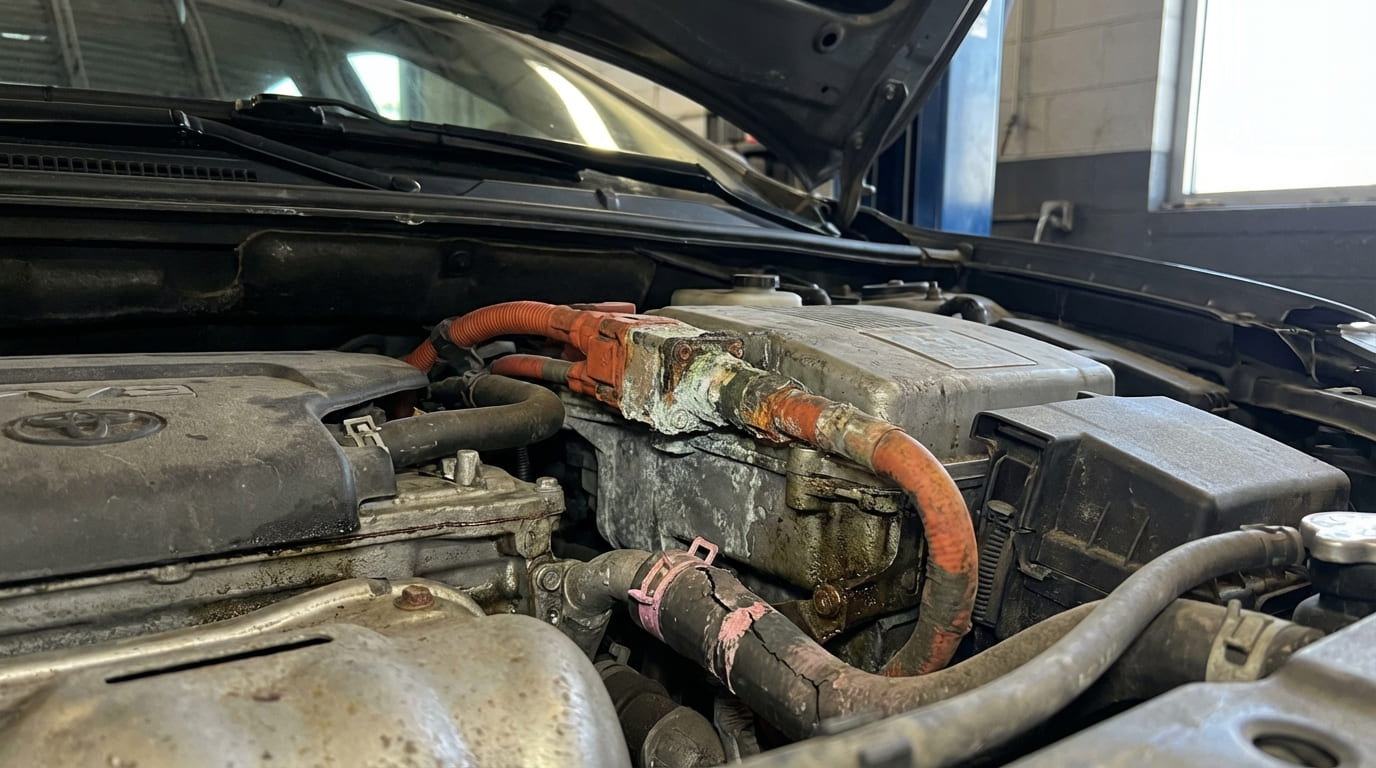
The inverter converts DC battery power to AC for the motors. It’s sensitive to heat and coolant issues. Liquid-cooled units are prone to corrosion if leaks go unnoticed.
Symptoms and How to Check
- Vehicle won’t “ready” or shuts down unexpectedly
- High-pitched whine from the inverter compartment
- Limp mode or no propulsion
- Inverter temperature warning
Scan DC bus voltage and inverter temperature. If temperature reads high but the housing is cool, suspect a faulty sensor. Use a Megohmmeter to check for internal shorts to ground. Visually inspect for coolant leaks—look for white crust or staining on terminals.
Root Causes and Viability
- IGBT failure: From blocked coolant passages or pump failure.
- Cooling system issues: Low coolant, air pockets, or clogged radiator.
- Capacitor aging: Electrolytic types dry out over time.
- Software glitches: Some intermittent faults clear after reflashing.
Replacement costs $1,800–$3,500. Used units are available but may have hidden wear. Inverter rebuilds are cost-effective if cooling issues are fixed first. Always replace coolant and bleed the system properly.
Situation: A 2013 Honda Accord Hybrid wouldn’t enter “ready” mode. Inverter fan ran nonstop.
Initial Assumption: Failed inverter control board.
Discovery: Loose ground strap at the inverter housing. Tightening restored full operation.
Nuanced Lesson Learned: Ground connections are critical in high-voltage systems. Always check grounds before replacing electronics.
Hybrid Transaxle and Power Split Device Issues
These units are durable but not immune to wear. Constant switching between electric and engine drive stresses internal components.
Symptoms and How to Check
- Unusual noises during acceleration or deceleration
- Hesitation during mode transitions
- Check Engine Light with transmission codes
- Reduced power or slippage
Scan input/output shaft speeds. A variance over 200 RPM under load suggests slippage. Check fluid condition—burnt smell or metal particles indicate internal damage. Use only OEM-specified fluid; incorrect types cause poor lubrication and accelerated wear.
Root Causes and Repair Strategy
- Bearing wear: Especially in MG rotors or planetary carriers.
- Lubrication breakdown: From wrong fluid or extended drain intervals.
- Mechanical wear: Gears or clutches in some designs.
- Speed sensor faults: Often due to wiring or contamination.
Fluid change: $150–$250. Transaxle replacement: $2,500–$4,000. Rebuilds are rare outside specialty shops. If noise or slip is present, replacement is usually the only viable option.
Internal Combustion Engine (ICE) Hybrid-Specific Issues
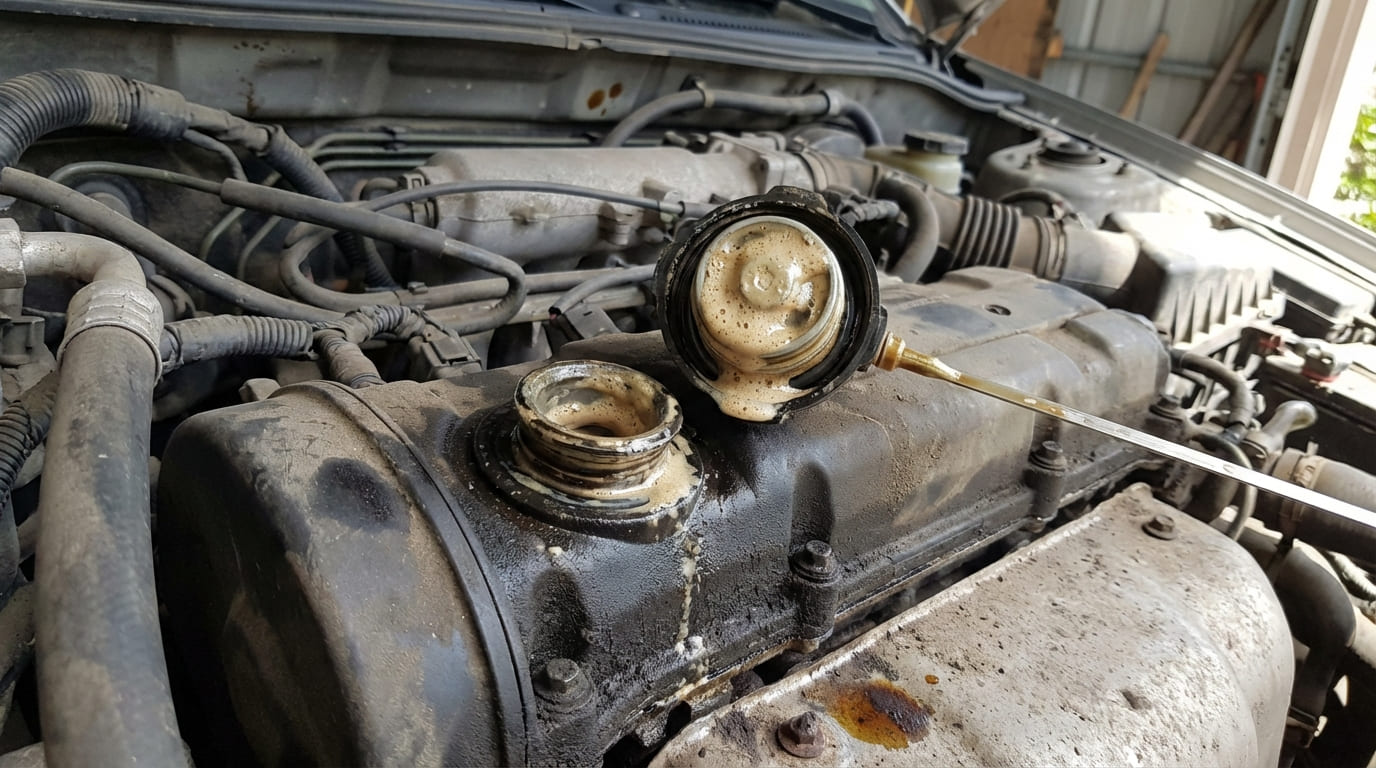
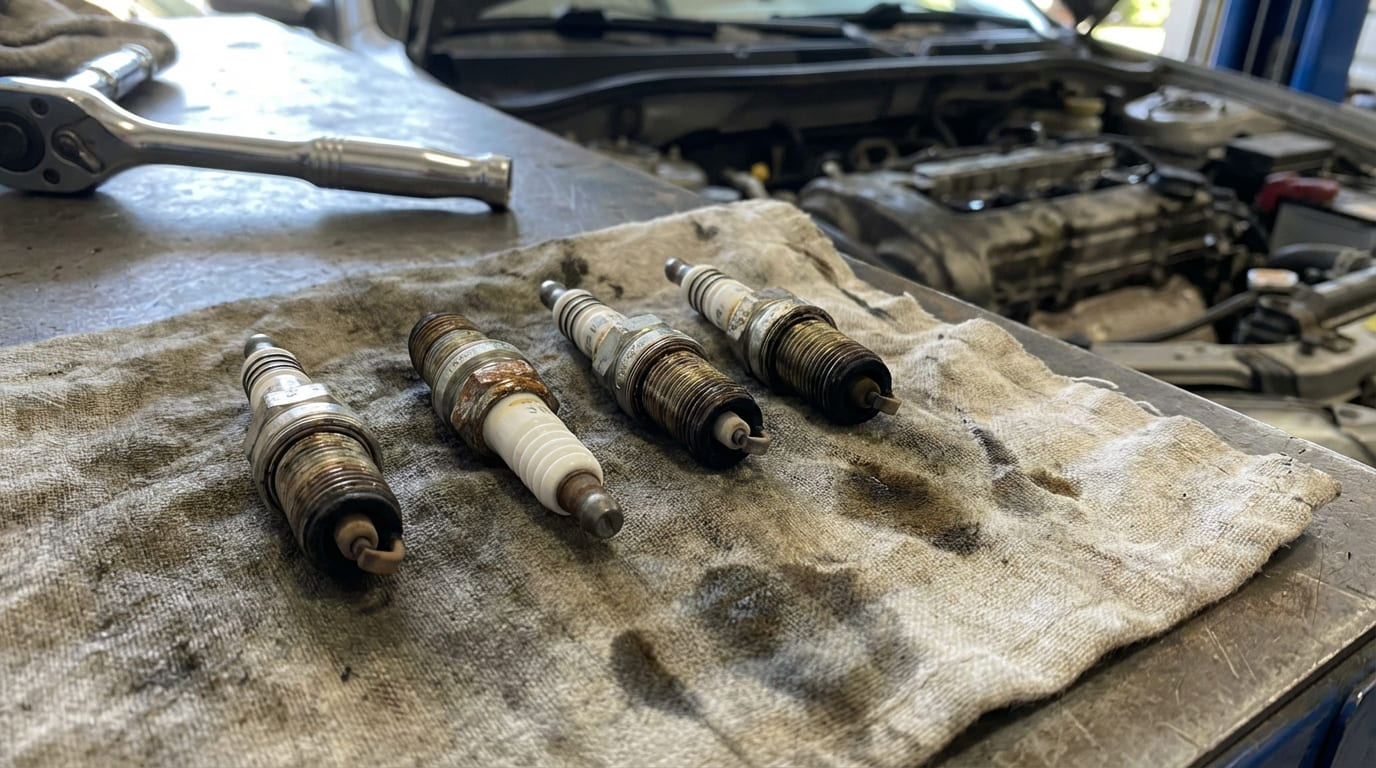
The ICE in hybrids cycles on and off frequently, leading to unique wear patterns. Short trips prevent full warm-up, increasing carbon buildup and oil contamination.
EGR and PCV System Clogging
EGR valves clog faster due to cooler exhaust temps. PCV systems sludge up from incomplete combustion. Symptoms include rough idle, poor fuel economy, and CEL with P0401 (EGR flow).
How to check: Remove and inspect EGR valve for carbon. Use a scan tool to monitor EGR position vs. commanded value. Clean with carb cleaner if clogged. Replace if stuck or damaged.
Oil Consumption
Stuck piston rings from carbon buildup cause oil burning. Some engines respond to chemical soak treatments (e.g., Sea Foam, BG EPR), but results vary. Severe cases need ring replacement—major engine work.
Coolant Leaks
Hybrids have multiple cooling circuits: engine, inverter, and battery. More hoses, pumps, and connections mean more failure points. Pressure test each circuit separately to isolate leaks.
Startup/Shutdown Cycle Wear
Engines may start thousands of times over 100k miles. This wears mounts, timing components, and starters. Inspect mounts regularly. Use OEM-rated oil to reduce wear.
12V Auxiliary Battery Issues
The 12V battery powers the computers that enable the high-voltage system. If it’s weak, the car won’t “ready.”
Symptoms and How to Check
- Vehicle won’t “ready”—no dashboard lights
- Clicking relays when pressing start
- Intermittent accessories
Test resting voltage after one hour of sleep: below 12.4V indicates failure. Use a conductance tester to check CCA—most hybrids require AGM batteries with 325+ CCA. Check parasitic draw: over 50mA after sleep suggests a module not powering down.
Root Causes and Replacement Tips
- Age: 3–5 years typical lifespan.
- Parasitic drain: Aftermarket devices, faulty infotainment, or TPMS modules.
- DC-DC converter failure: If the 12V battery isn’t charging when HV system is active.
AGM battery cost: $150–$250. If a new battery dies quickly, test DC-DC output: should be 13.8–14.4V when “ready.” Converter replacement: $600–$1,200.
Best Practices: Do and Don’t
- ✅ Recommended: Use OEM diagnostic tools—generic scanners miss HV system data.
- ✅ Recommended: Inspect battery cooling filters every 12 months—prevents thermal issues.
- ✅ Recommended: Test 12V battery and parasitic draw annually on hybrids over 5 years old.
- ⚠️ Avoid: Assuming HV battery failure based on symptoms—always scan block data first.
- ⚠️ Avoid: Reusing torque-to-yield bolts on inverter or transaxle mounts—can cause leaks or vibration damage.
- ⚠️ Avoid: Mixing coolant types in dual-circuit systems—can form gel and block cooling paths.
Diagnostic Decision Table: Common Hybrid Symptoms and Likely Causes
| Symptom | Most Likely Causes | Less Common but Possible | Diagnostic Priority |
|---|---|---|---|
| Reduced EV range | HV battery degradation, cooling fan failure | DC-DC converter fault, sensor error | Scan block voltages, inspect cooling |
| Vehicle won’t “ready” | 12V battery failure, DC-DC converter issue | Interlock circuit fault, HV contactor | Test 12V battery and charging voltage |
| Grinding noise from transaxle | Bearing wear, low fluid | MG rotor contact, gear damage | Inspect fluid, scan RPM correlation |
| High coolant temp (inverter) | Coolant leak, pump failure, air pocket | Thermostat fault, clogged radiator | Pressure test, check flow and bleed |
| Check Engine Light with P0401 | EGR clogging, pressure sensor fault | Wiring issue, vacuum leak | Inspect EGR valve, test sensor readings |
Hybrid systems are complex, but methodical diagnostics prevent costly mistakes. Always start with the simplest, cheapest possibilities—cooling, wiring, grounds, and 12V battery—before assuming major component failure. In my 20 years as a master tech, that approach has saved owners thousands.