In my experience across two decades of heavy-duty and light-duty diesel work, the injection pump remains one of the most critical—and often misunderstood—components in the fuel system. When problems arise, it’s tempting to blame the pump outright, but the reality is rarely that simple. More often than not, what appears to be a failed pump is actually a symptom of upstream issues: contaminated fuel, neglected maintenance, or electrical faults. This article walks through the diagnostic logic I use in my shop, based on real-world cases and systematic troubleshooting.
Symptoms of Diesel Injection Pump Failure
Engine Cranks, No Start or Hard Start
If the engine turns over but won’t fire, especially in cold conditions, fuel delivery is a logical place to look. On most engines I see, this points to either insufficient fuel volume reaching the pump or a failure in high-pressure generation.
- Diagnostic: Fuel pressure at pump inlet – Use a low-pressure fuel gauge to verify inlet pressure. Many inline and rotary pumps require a minimum of 3–5 psi during cranking. Modern common rail systems may need up to 70 psi from an electric lift pump. If pressure is low, inspect fuel filters, pickup tube, and return lines for restrictions or air leaks.
- Diagnostic: Injection timing synchronization – Use a scan tool to compare Crankshaft Position Sensor (CKP) and Camshaft Position Sensor (CMP) signals. On VE-type and Bosch pumps, timing drift beyond 2–3 degrees BTDC can prevent starting. Some systems allow ECU re-synchronization; others require mechanical adjustment with a timing pin or gauge.
- Diagnostic: Fuel rail pressure (common rail) – Monitor live data during cranking. If rail pressure doesn’t reach manufacturer thresholds (typically 3,000–5,000 psi), no injection occurs. Confirm the ECU is commanding the pump and that the fuel quantity control valve is responding.
Reduced Engine Power and Acceleration
Drivers often describe this as “flat” performance under load. While turbo issues are common suspects, inconsistent fuel delivery due to pump problems can mimic the same symptoms.
- Diagnostic: Fuel pressure drop under load – Use a high-pressure gauge or scan tool to monitor rail pressure. A drop exceeding 500 psi from idle to full load may indicate internal pump leakage or a failing metering valve.
- Diagnostic: Cylinder contribution test – On electronically controlled systems, check injection quantity deviation. Differences over 2–3 mg/stroke between cylinders suggest uneven fueling, possibly from a worn pump section or clogged injector.
- Diagnostic: Verify boost pressure – Rule out intake restrictions first. If boost is within spec (e.g., 20–25 psi at 2,500 RPM on a 6.7L Cummins), focus shifts to fuel delivery.
Rough Idling or Misfires
This symptom can mimic ignition or compression issues, but in diesels, it often traces back to fuel metering inconsistencies.
- Diagnostic: Cylinder balance test – Monitor RPM correction factors via scan tool. Deviations beyond 8–10% on modern common rail systems suggest uneven fueling.
- Diagnostic: Fuel return flow from pump – Measure return volume at idle. More than 40 ml/min on a Bosch VP44, for example, usually indicates internal leakage in plungers or control valves.
- Diagnostic: Injector leak-off test – Isolate the pump by testing injectors individually. High return flow at injectors shifts suspicion away from the pump.
Increased Fuel Consumption
When fuel economy drops noticeably, start by ruling out driver behavior and aerodynamic drag. Then assess fuel trim and system efficiency.
- Diagnostic: Monitor fuel trims – On diesels with closed-loop control, long-term trims above +10% may indicate under-delivery, forcing the ECU to command more fuel to compensate.
- Diagnostic: EGR function – A stuck-open EGR valve can cause rich running. Verify EGR position via live data before assuming pump over-fueling.
Excessive Exhaust Smoke
Smoke color offers a clue but isn’t definitive. Always confirm with diagnostics.
- Black Smoke – Typically caused by over-fueling or insufficient air. Check commanded vs. actual injection quantity via scan tool. Deviations over 15% warrant inspection. Also verify air filter condition and turbo boost.
- White Smoke – Common in cold starts; persistent white smoke suggests retarded timing or poor compression. Verify injection timing (e.g., 4–6° BTDC on IDI engines) and perform a compression test. Wet testing can rule out head gasket or cracked block issues.
- Blue Smoke – Rarely related to the injection pump. Points to oil consumption—worn turbo seals, valve guides, or piston rings. Avoid fuel system repairs when the real issue is mechanical.
Fuel Leaks from Pump Body
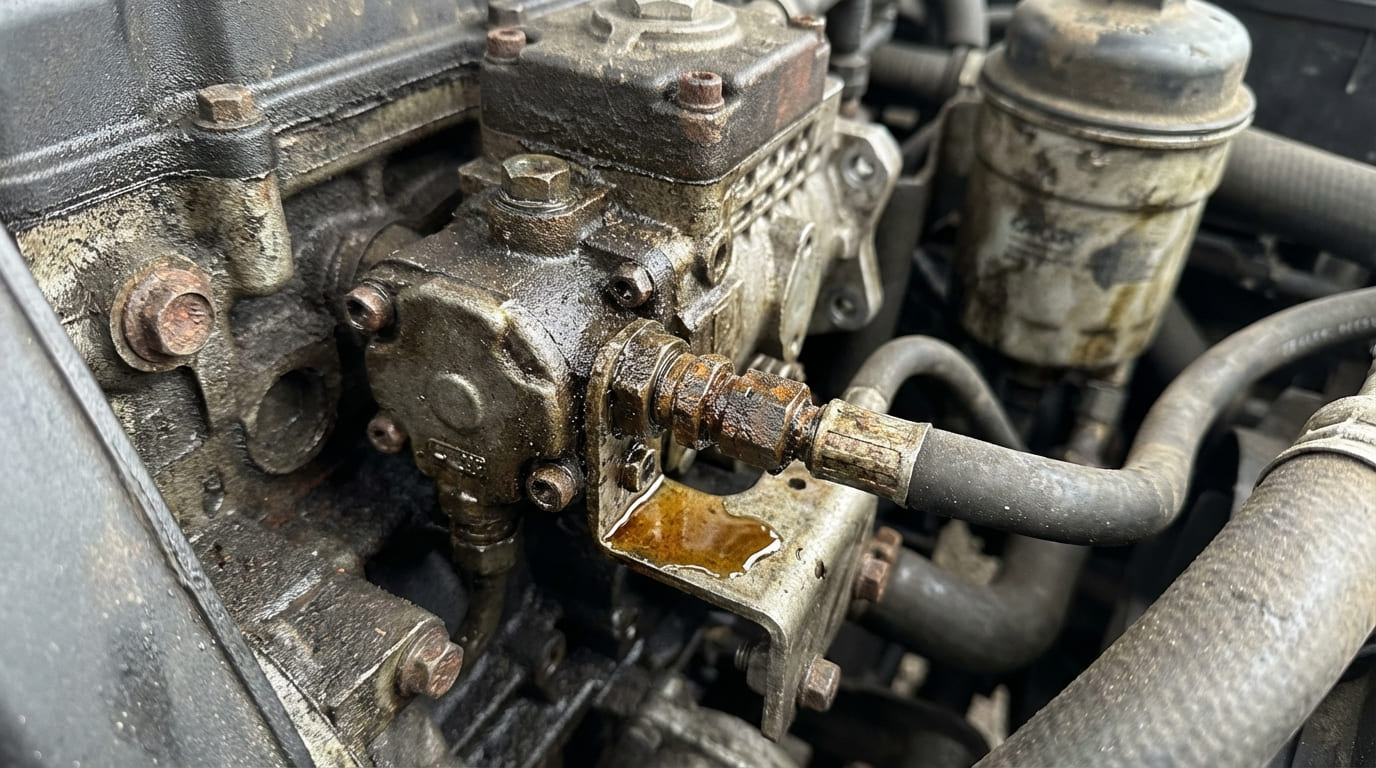
External leaks are often the first visible sign of trouble. But UV dye testing often reveals the leak source is a cracked line, not the pump.
- Diagnostic: Visual inspection – Check for weeping at seal points, especially on older rotary pumps.
- Diagnostic: UV dye and pressure test – Pressurize the low-pressure side to ~15 psi and scan with UV light. Some leaks only appear under operating temperature.
Causes of Diesel Injection Pump Failure
Fuel Contamination
Dirty or wet fuel is the number one killer of injection pumps. Precision tolerances (often under 2 microns) mean even small contaminants cause rapid wear.
- Water ingress – Can cause rust on plungers and barrels. Check fuel filter bowl for water. In high-moisture environments, consider periodic Karl Fischer testing. Cost: $15–$50 per test.
- Particulate contamination – Silica or rust particles act like sandpaper. Inspect used filters under magnification. Metallic shavings suggest internal pump damage.
- Biodiesel issues – Older seals may swell or harden with high biodiesel blends. Oxidized biodiesel left sitting can form varnish. Use B20 or lower unless pump is rated for higher blends.
Insufficient Lubrication
Diesel fuel lubricates the pump. Anything reducing lubricity increases wear risk.
- Low fuel levels – Running near empty heats fuel and introduces air. Can lead to cavitation and overheating. Keep tank above 1/4 full during long hauls.
- Fuel dilution – Gasoline contamination (even 5%) can drop lubricity by 50%. Always confirm fuel type if misfire or hard start follows a fill-up.
- Extended filter intervals – Clogged filters increase inlet vacuum, stressing the pump. Replace filters at OEM intervals—or more often in dirty conditions. Cost: $15–$50 per filter.
Electrical and Electronic Component Failure
Modern common rail pumps rely on solenoids and sensors that can fail independently of mechanical wear.
- Fuel quantity control valve – Test resistance; typical range is 3–5 ohms on Bosch units. Use a lab scope to verify response to ECU commands.
- Pressure regulator (PCV/DRV) – A sticking valve causes rail pressure to spike or drop. Compare commanded vs. actual pressure—if they don’t track, suspect the regulator.
- Internal sensors – A failed pump speed sensor may mimic mechanical fault. Check live data for erratic readings before condemning the pump.
Mechanical Wear and Fatigue
Even with perfect fuel, components wear over time. Plungers, rollers, and drive shafts have a finite life.
- Internal wear – As a rule of thumb, return flow exceeding 50 ml/min at 1,500 RPM on a rotary pump suggests internal leakage. Confirm with bench test if possible.
- Seal degradation – O-rings and shaft seals harden with heat and age. Replace them during any pump removal—even if they look intact. Cost: $20–$50 for seal kit.
- Drive system issues – Worn couplings or timing gears cause timing drift. Inspect drive mechanism when replacing a pump—otherwise, the new unit may fail prematurely.
Overheating
Pumps rely on fuel flow for cooling. Restrictions or high loads can push temperatures beyond safe limits.
- Restricted return line – Return pressure over 5 psi (spec is usually <5 psi) can deform seals and cause seizure. Inspect return line for kinks or blockages.
- Prolonged high-load operation – In towing or agricultural use, monitor fuel temperature via scan tool. Sustained temps above 70°C (158°F) accelerate wear and varnish formation.
Diagnostic Decision Table: Common Scenarios and Probable Causes
| Symptom | Most Likely Causes | Less Common but Possible | Diagnostic Priority |
|---|---|---|---|
| Hard start, no fuel pressure | Fuel starvation, air in system, lift pump failure | Timing drift, seized control valve | Check inlet pressure first |
| Power loss with black smoke | Over-fueling due to faulty metering valve | Turbo wastegate stuck, clogged EGR cooler | Verify boost before assuming pump fault |
| Rough idle, high return flow | Internal pump leakage (worn plungers) | Sticking injectors, air ingress | Perform return flow test at pump and injectors |
| No start, correct rail pressure | Timing sync issue, ECU fault | Defective injectors, sensor drift | Check CKP/CMP correlation via scan tool |
Best Practices: Do and Don’t
- ✅ Recommended: Clean fuel system threads with a tap before installing fittings. Debris in threads can compromise seals and introduce contaminants.
- ✅ Recommended: Replace fuel filters at OEM intervals and bleed the system properly. Air ingestion stresses the pump and delays startup.
- ✅ Recommended: Use OEM-spec or equivalent fuel—especially with biodiesel blends. Off-brand fuels may lack proper lubricity additives.
- ⚠️ Avoid: Reusing torque-to-yield fasteners on pump mounts or timing covers. These bolts lose clamping force after first use and can lead to misalignment.
- ⚠️ Avoid: Skipping a fuel sample analysis when contamination is suspected. A $20 test can save a $2,000 pump.
- ⚠️ Avoid: Assuming the pump is bad without checking electrical signals. I’ve replaced ECUs and sensors that were mimicking pump failure.
Situation: A 2005 Ford 6.0L Power Stroke came in with hard starting and white smoke. The owner had already replaced the injectors twice.
Initial Assumption: We suspected a failed head gasket—common on that engine.
Deep Dive: Compression test showed even pressures. Coolant analysis found no hydrocarbons. Then I checked injection timing via scan tool and found it was 8 degrees retarded.
Nuanced Lesson Learned: The high-pressure oil pump was weak, failing to build enough pressure to actuate the injectors properly. The symptom mimicked both head gasket and injection pump issues, but the root cause was mechanical oil pressure loss. Always validate timing and actuation pressure before tearing into fuel or cooling systems.
Situation: A 12-valve Cummins with a P7100 pump lost power and produced black smoke under load.
Initial Assumption: Pump over-fueling due to internal wear.
Deep Dive: Rail pressure was stable, but boost pressure was low. I found a split in the intake boot after the turbo. The ECU was commanding more fuel, but there wasn’t enough air.
Nuanced Lesson Learned: The pump wasn’t failing—it was responding to incorrect load calculations. Turbo and intake integrity must be ruled out before condemning a pump, even when smoke suggests over-fueling.
Situation: A delivery van with a Bosch VP44 pump had intermittent no-starts. No DTCs were present.
Initial Assumption: Intermittent electrical fault in the fuel shutoff solenoid.
Deep Dive: After hours of testing, I discovered a cracked fuel return line letting air into the system when the engine heated up. The pump would lose prime as temperatures rose.
Nuanced Lesson Learned: Air ingress can be temperature-dependent and hard to catch. Pressure testing cold systems may miss leaks that only open under thermal expansion. Always test under operating conditions when possible.
In my shop, we always treat the injection pump as a symptom, not a diagnosis. Before replacing a $1,500–$3,000 pump, verify fuel quality, electrical signals, and mechanical timing. A systematic approach saves time, money, and comebacks. And remember: the service manual is your best tool—specs vary widely between engines.