In my two decades turning wrenches in heavy-duty shops and independent bays, I’ve seen more than a few engines come in with misdiagnosed fuel system issues—especially when it comes to injectors. The confusion often starts with assuming all injectors are created equal. They’re not. While both diesel and gasoline injectors deliver fuel, the way they do it, how they’re built, and how they’re controlled stem from entirely different combustion philosophies. Let me walk you through the key differences, not just in specs, but in real-world behavior and service considerations.
Fuel and Combustion Fundamentals
Understanding the combustion process is essential to diagnosing injector problems. Gasoline engines use spark ignition (Otto cycle), where a precise air-fuel mixture is ignited by a spark plug. This requires consistent fuel atomization and timing, but operates at lower compression and pressure. Diesel engines rely on compression ignition—air is compressed until it’s extremely hot, then fuel is injected directly into this high-heat environment, causing auto-ignition. This demands injectors that can handle extreme pressure and deliver fuel with microsecond precision.
Operating Pressure and Injector Design
The most critical difference between diesel and gasoline injectors is operating pressure. Gasoline port fuel injectors (PFI) run at 30–80 PSI. Gasoline direct injection (GDI) systems push that to 500–3,000 PSI—high, but still far below diesel systems. Diesel common rail injectors operate between 5,000 and 40,000 PSI. Older unit injector systems can reach up to 30,000 PSI. This extreme pressure shapes every aspect of diesel injector design.
Gasoline injectors typically use solenoid actuators and spray fuel in a cone pattern through multiple small orifices or a pintle tip. In PFI, fuel mixes in the intake port; in GDI, it sprays directly into the cylinder, requiring precise targeting to avoid oil dilution and knock.
Diesel injectors use solenoid or piezoelectric actuators. Piezo types allow multiple injection events—pilot, main, and post-injection—which reduce noise, control NOx, and aid DPF regeneration. Nozzles have 5–9 microscopic holes engineered to penetrate dense, hot air and atomize fuel under extreme conditions.
Construction and Durability
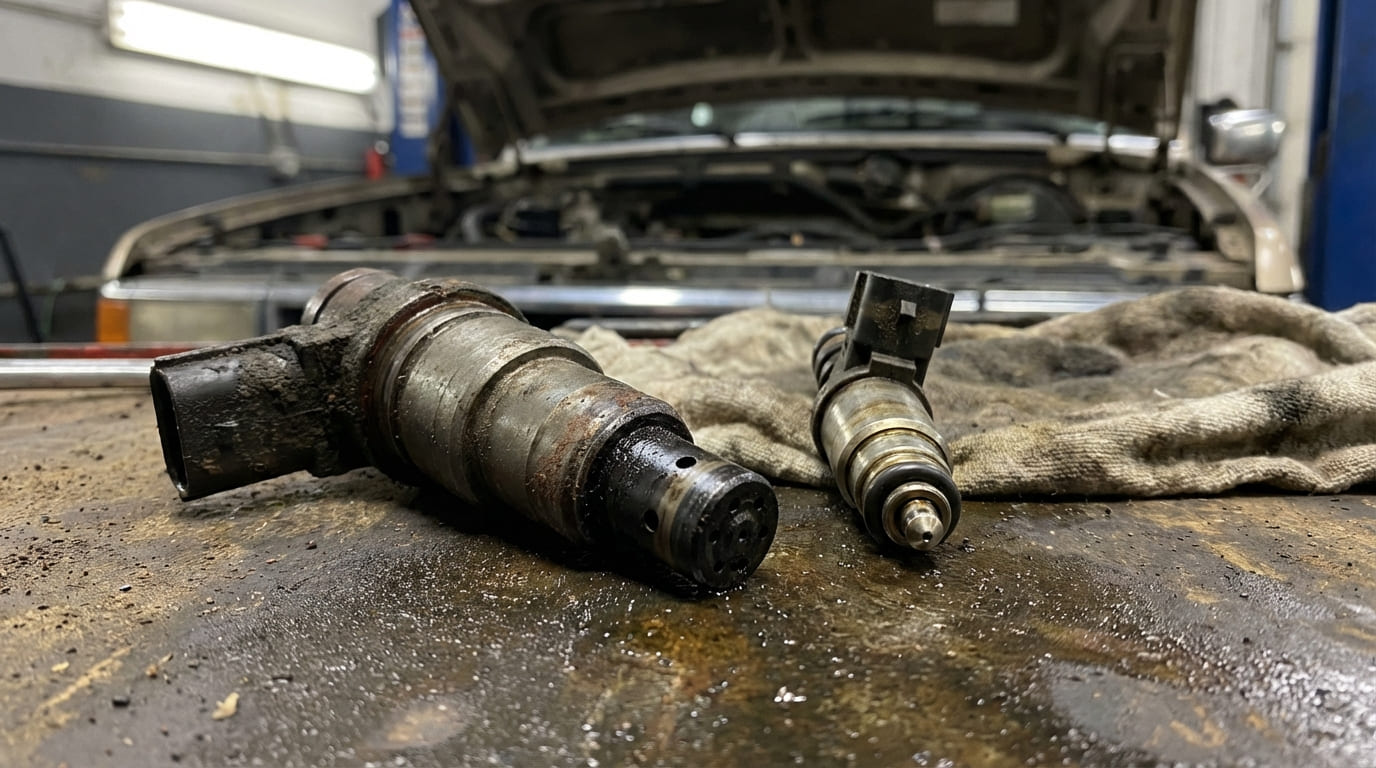
Gasoline injectors are made with stainless steel bodies, plastic connectors, and rubber O-rings. They’re susceptible to clogging from varnish, debris, or ethanol-related deposits. Flow inconsistencies due to buildup affect performance and emissions, especially in GDI engines.
Diesel injectors are forged from high-strength steel alloys, often with wear-resistant coatings. Internal clearances are measured in microns—so tight that even microscopic contamination from dirty fuel can cause scoring or needle seizure. Water in diesel fuel is a major killer, leading to corrosion, microbial growth, and cavitation damage. Carbon buildup on nozzle tips is common in engines with frequent short trips or low exhaust temps.
In my shop, we always drain a sample from the fuel filter housing when diagnosing diesel injector issues. If you see water, sediment, or cloudiness, address the fuel system before touching injectors. A $15 fuel filter change can save you a $1,200 injector job.
Control Systems and Calibration
Gasoline injectors are controlled by pulse width—how long the injector stays open. The ECM adjusts based on oxygen sensor feedback to maintain a stoichiometric ratio (14.7:1) for optimal catalytic converter efficiency. Timing is less critical, though GDI systems inject during compression to cool the chamber and prevent knock.
Diesel control is far more complex. The DECU manages multiple injection events, rail pressure, and timing down to the microsecond. It uses feedback from rail pressure sensors, exhaust gas readings, and fuel quantity adaptations to balance performance, noise, and emissions. Modern diesel injectors often require coding or calibration after replacement—plug-and-play isn’t an option.
Never skip the adaptation step after replacing a diesel injector. I’ve seen engines run “fine” but fail emissions or enter limp mode weeks later because the ECU was compensating for unlearned flow characteristics. Always use OEM-level scan tools to perform injector coding.
Diagnostic Steps and Tools
Diagnosing injector issues starts with the right tools and methodology. Don’t guess—test.
How to Check Gasoline Injectors
- Scan for trouble codes and review long-term/short-term fuel trims. Consistently high positive trims suggest lean conditions—possibly clogged injectors.
- Check misfire counters to isolate faulty cylinders.
- Perform injector resistance test (typically 12–16 ohms for high-impedance types).
- Use an injector balance test or buzz test to assess mechanical function.
- Monitor fuel pressure and regulator operation.
- For GDI, consider ultrasonic cleaning if flow tests show restriction—though replacement is often more reliable.
How to Check Diesel Injectors
- Scan for fuel quantity adaptations. Values near maximum on one or more cylinders suggest injector wear or leakage.
- Monitor rail pressure stability under load. Slow rise or drop indicates supply issues (pump, filter, regulator).
- Perform contribution test to identify weak cylinders.
- Check return fuel volume—if one injector returns significantly more fuel, it may have internal leakage.
- Use oscilloscope to analyze solenoid waveform and needle lift timing.
- Inspect for external leaks, especially at the connector or nozzle.
High adaptations on multiple injectors almost always point upstream. I once diagnosed a 2014 Ram 2500 with white smoke and poor economy—owner had replaced two injectors already. Adaptations were maxed. Rail pressure test revealed a failing CP4 pump. Replaced the pump, cleared adaptations, and the problem vanished. Always rule out fuel supply first.
Repair vs Replace: Cost and Viability
Gasoline injectors rarely justify rebuilding. Ultrasonic cleaning can restore flow in mildly clogged units, especially GDI, but internal wear or leakage means replacement. New OEM injectors: $80–$180 each. Aftermarket: $40–$100. Always replace top O-rings and fuel rail seals.
Diesel injectors are more complex. Reconditioned units from reputable shops cost $200–$400, while new OEM: $400–$900+. Given the precision and calibration needs, I recommend OEM or high-tier remanufactured only. Avoid cheap aftermarket—poor spray patterns or incorrect flow rates can trigger DPF issues or limp mode.
Labor: 2–4 hours depending on engine. On modern diesels, coding and adaptation add 30–60 minutes with proper scan tool.
Best Practices for Service and Longevity
- ✅ Always replace O-rings, seals, and copper washers—reusing them risks leaks under high pressure. On GDI and diesel, this is non-negotiable.
- ✅ Clean injector bores and fuel rails before installation. Use a thread chaser or tap to remove debris. A single metal shaving can destroy a new injector.
- ✅ Use OEM-spec fuel filters and change them on schedule. On diesel, this is the single best way to extend injector life.
- ⚠️ Never reuse injector mounting hardware—especially torque-to-yield bolts or sealing washers.
- ⚠️ Avoid aftermarket injectors on CRDI engines unless they’re programmable and proven compatible. Many lack proper calibration data.
- ⚠️ Don’t assume noise means failure. Diesel injectors tick—some louder than others. Correlate sound with data, not hearsay.
Common Failure Symptoms and Likely Causes
| Symptom | Gasoline Likely Causes | Diesel Likely Causes |
|---|---|---|
| Rough idle, misfire | Clogged nozzle, leaking pintle, electrical fault, vacuum leak | Sticking needle, carboned nozzle, high return flow, low rail pressure, calibration error |
| Hard starting (cold) | Leaking injector, weak pump, faulty regulator | Worn nozzle, low injection pressure, glow plug issue, fuel contamination |
| Excessive smoke | Rich condition, leaking injector, PCV issue | Over-fueling, distorted spray, timing error, EGR fault, DPF saturation |
| Loss of power | Fouled injectors, clogged filter, restricted exhaust | Fuel adaptation limits, pump failure, rail sensor fault, mechanical wear |
A 2008 VW TDI came in with intermittent rough running—no codes. Customer said it only happened after highway driving. Live data showed brief rail pressure drops. Injectors tested fine cold. One had a hairline crack that opened under heat, bypassing fuel internally. Lesson: some failures are thermal. Static tests miss them. Always test under load and temperature.
A tech replaced a GDI injector on a 2016 Mustang and reused the top O-ring. Two weeks later, fuel smell and misfires. The O-ring had extruded into the spark plug well, creating a leak path. Not catastrophic—yet—but a fire risk. Replace all seals. Every time.
In the end, diesel and gasoline injectors may look similar, but they’re engineered for entirely different worlds. Diesel injectors face higher pressures, tighter tolerances, and more complex control strategies. Gasoline injectors deal with deposit formation and precise mixture control. Treating them the same leads to misdiagnosis, comebacks, and costly mistakes. Always respect the system. Use the right tools. Follow OEM procedures. And when in doubt, consult the service manual—not a forum.