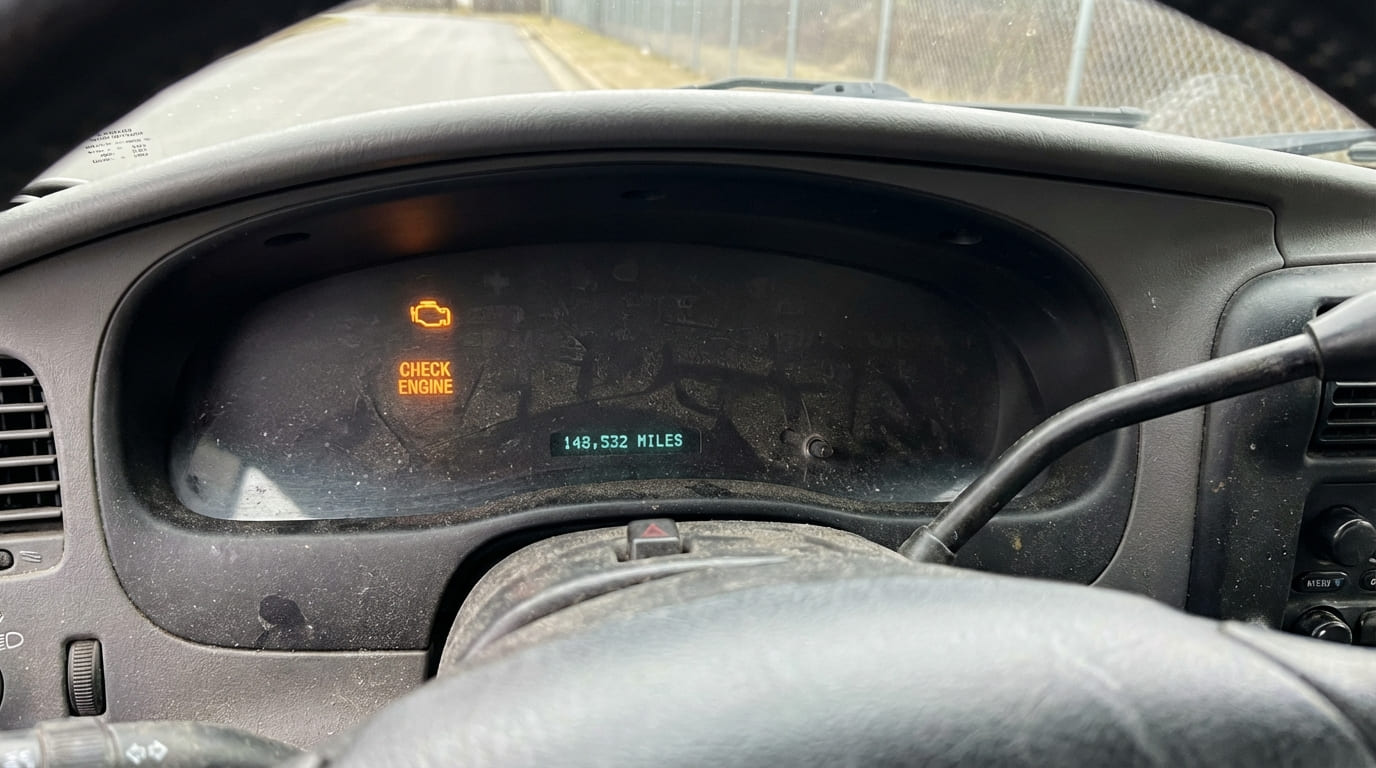
A flashing Check Engine Light (CEL) means your engine is actively misfiring, and unburned fuel is entering the exhaust system. This can overheat and destroy the catalytic converter—fast. Unlike a steady CEL, a flashing one demands immediate action. In my shop, ignoring it has led to $4,000 exhaust repairs when a $300 fix would’ve sufficed.
Immediate Action: What to Do When the Light Flashes
Treat a flashing CEL like an engine fire: stop driving as soon as safe. Even a few minutes of driving under load can ruin the catalytic converter. I’ve seen too many customers “push it” to save a tow, only to pay ten times more.
- Shut the engine off in a safe location.
- Do not restart or drive the vehicle.
- Arrange for a tow to a repair shop—don’t risk further damage.
In my 20 years as a master tech, I’ve never seen a catalytic converter save itself after a sustained misfire. If the light is flashing, assume the converter is at risk until proven otherwise.
Diagnostic Workflow for a Flashing CEL
Once the vehicle is in the shop, start with an OBD2 scan tool that shows live data. Codes are just clues—live data reveals the real story.
Step 1: Retrieve and Interpret DTCs
Look for P030x codes—P0300 (random misfire) or specific ones like P0301 (cylinder 1). But don’t stop there. A P0171 (System Too Lean) might be the root cause behind a misfire code. Also check for fuel trim, MAF, or O2 sensor codes—they often point to the real issue.
Crucially: record freeze frame data before clearing codes. It shows engine load, RPM, temperature, and speed when the misfire occurred. This tells you if it happened at idle, under acceleration, or during warm-up—critical for diagnosis.
Step 2: Monitor Live Data Trends
Use live data to separate symptoms from root causes. Focus on these parameters:
- Misfire counters: More than 2% misfires at idle or light load on any cylinder is a red flag. Transient spikes at cold start? Usually normal.
- Fuel trims (STFT/LTFT): If long-term fuel trim (LTFT) is above +10%, suspect a vacuum leak or fuel delivery issue. Below -10%? Possible fuel pressure or injector problem.
- O2 sensor response: If the downstream O2 sensor is switching rapidly like the upstream one, the catalytic converter is likely damaged or overwhelmed.
- MAF/MAP readings: Compare airflow to expected values at given RPM and load. A dirty MAF or failing MAP sensor can cause lean conditions and misfires.
Common Root Causes and How to Investigate
While many issues can trigger a misfire, five causes cover 90% of cases. Always verify—never assume.
| Potential Cause | Likelihood | Key Diagnostic Method | Cost & Notes |
|---|---|---|---|
| Failed ignition coil | High | Swap test, secondary resistance check | $80–$150 per coil. Swap with a known-good cylinder—if misfire follows, replace. Common on COP systems. |
| Fouled spark plug | High | Visual inspection, gap check | $10–$30 per plug. Oil fouling? Check valve seals. Ash deposits? Possible coolant leak or oil consumption. |
| Vacuum leak | Moderate to High | Smoke test, fuel trim analysis | $100–$300 repair. Common on intake gaskets, PCV lines, brake booster. Can mimic ignition faults. |
| Clogged fuel injector | Moderate | Injector balance test, resistance check | $150–$300 per injector. Flow testing is best but requires special tools. Ethanol fuels increase risk. |
| Low compression / mechanical fault | Low to Moderate | Compression test, leak-down test | $150–$500 diagnostic. If leak-down shows air escaping through intake, suspect burned valve. Expensive fix. |
Always perform a swap test before replacing coils or injectors. If the misfire moves to the new cylinder, you’ve confirmed the faulty part. If not, keep looking—don’t throw parts at it.
Best Practices: What to Do (and Not Do)
- ✅ Do: Clean spark plug threads with a tap before reinstalling. Prevents thread damage and ensures proper heat dissipation.
- ✅ Do: Use factory service manuals for torque specs and test procedures. Aftermarket guides often lack critical details.
- ✅ Do: Test under real-world conditions. Some faults (like heat-sensitive wiring) only appear under load or at operating temperature.
- ⚠️ Don’t: Replace parts based on DTCs alone. A P0302 doesn’t prove the coil or plug is bad—it could be fuel, vacuum, or mechanical.
- ⚠️ Don’t: Clear codes before recording freeze frame data. That snapshot is often the key to solving intermittent issues.
- ⚠️ Don’t: Use non-OEM spark plugs on turbocharged or direct-injection engines. Inconsistent gaps or materials can trigger misfires.
Real-World Diagnostic Scenarios
Situation: 2014 F-150 with P0303 and flashing CEL. Previous shop replaced coil and plug. Light returned in two days.
Discovery: Live data showed misfires only under load. Leak-down test revealed 18% leakage on cylinder 3, with air escaping through the throttle body.
Lesson: Even with normal compression, a burned intake valve can cause load-specific misfires. Always test under realistic conditions.
Situation: 2008 Camry with P0300 (random misfire). Technician replaced all plugs and coils. Misfires continued.
Discovery: Smoke test revealed a cracked PCV hose. Vacuum fluctuated at idle, destabilizing fuel trim across all cylinders.
Lesson: Random misfires aren’t always ignition-related. Small vacuum leaks can affect the entire engine’s air/fuel balance.
Situation: Turbocharged VW with P0301. Fresh plugs and coils. Light returned after highway driving.
Discovery: Injector connector was slightly melted. Resistance out of spec. Injector failed under high load.
Lesson: Electrical issues can be heat-sensitive. Test components under real operating conditions, not just at idle.
Verification: Don’t Call It Fixed Too Soon
After repairs, clear codes and test drive under varied conditions—idle, acceleration, cruise, deceleration. Keep the scan tool connected to monitor misfire counters in real time.
If the misfire counter stays at zero for 5–10 minutes of mixed driving and fuel trims stabilize within ±5%, the repair likely succeeded. But check the downstream O2 sensor—if it’s still switching rapidly, the catalytic converter may already be damaged.
Finally, consult the factory service manual for your specific engine. What works on one model may not apply to another. That manual isn’t optional—it’s your best tool for avoiding comebacks and costly mistakes.