In my experience, a broken valve spring is one of those failures that starts quietly but can spiral into a catastrophic engine event faster than most people realize. While some engines might idle for a few minutes with a fractured spring, the risks far outweigh any temporary mobility. I’ve seen more than a few cases where a driver tried to “make it home” and ended up needing a full engine replacement — a repair that could have been avoided with a tow and timely diagnosis.
Risks of Driving with a Broken Valve Spring
When a valve spring fails, the valve loses its controlled return motion. This leads to a cascade of potential secondary damage. On most engines I’ve worked on, the following risks become real possibilities:
- Valve-to-piston contact: If the valve isn’t closing in time, the rising piston can strike it, especially at higher RPM. This is more common in interference engines, which make up the majority of modern designs.
- Valve-to-valve contact: In tight multi-valve heads, an unseated valve may collide with a neighboring valve during overlap.
- Bent or broken pushrods: In OHV engines, uncontrolled valve motion can overstress the pushrod, leading to bending or snapping.
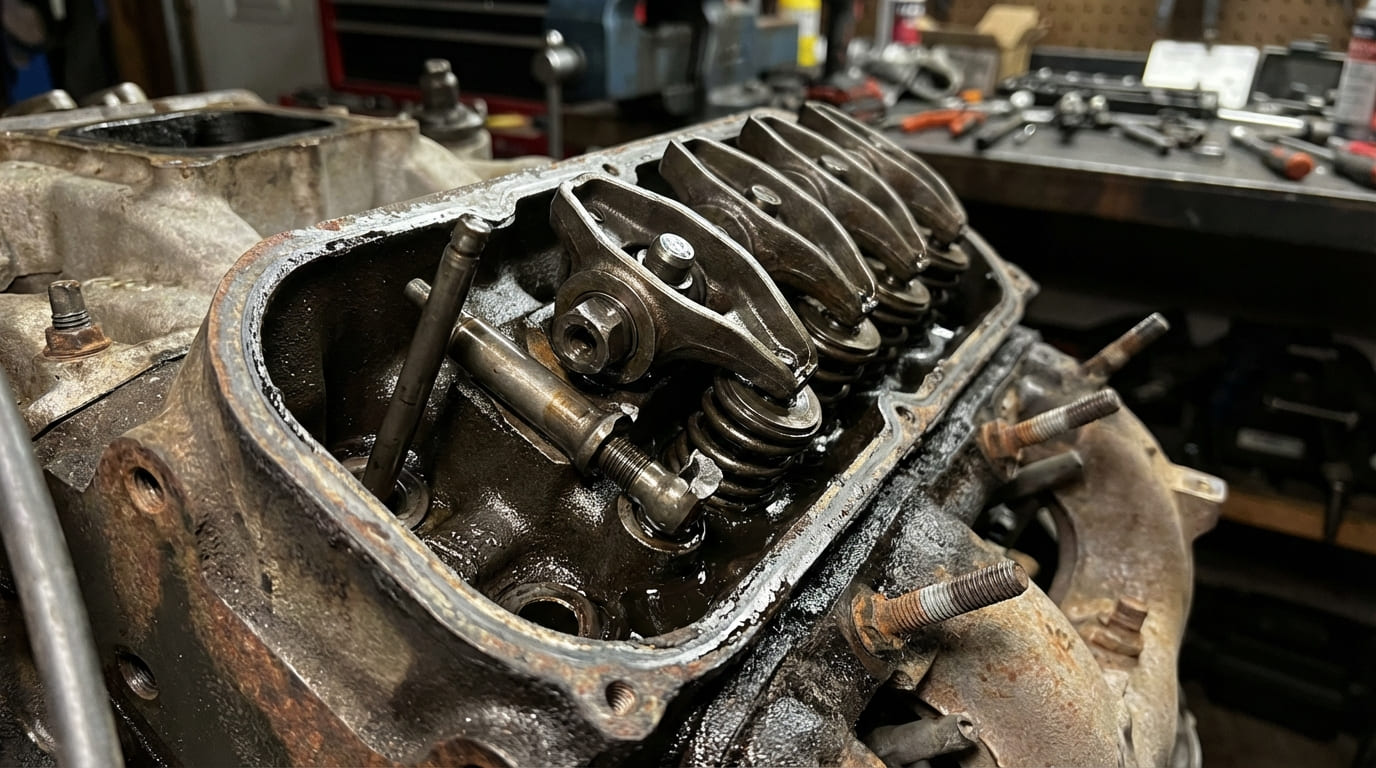
- Damaged rocker arms: A loose or bouncing valve train can hammer the rocker, leading to cracks or broken pedestals.
- Cylinder head damage: Repeated impacts may damage valve seats or even crack the head casting around the guide or bridge.
- Camshaft lobe wear: A lifter or rocker arm that isn’t seated properly due to spring failure can cause rapid cam lobe spalling or flattening.
- Metal debris in oil: Fragments from broken springs or bent components circulate through the oil, risking bearing damage.
- Catalytic converter damage: Unburned fuel from a misfiring cylinder can overheat and melt the catalyst substrate.
In my shop, we never advise driving more than a few hundred feet with confirmed or suspected valve spring failure. The cost of a tow is minor compared to a $3,000 engine rebuild.
Symptoms and How to Check
Recognizing the signs early can save thousands in repairs. In my shop, we typically see a combination of the following symptoms. Here’s how to check each one:
- Single-cylinder misfire (P030X code): Use a scan tool to read live misfire counts. Focus on the cylinder with the highest misfire rate. Swap coils or injectors to rule out ignition/fuel issues.
- Rough idle and power loss: Perform a cylinder balance test if your scan tool supports it. A dead or weak cylinder will show significant power drop when disabled.
- Rhythmic ticking or tapping noise: Use a mechanic’s stethoscope on the valve cover near each cylinder. A broken spring often produces an irregular or sharp tap that changes with RPM.
- Backfiring: Intake backfire suggests a leaking intake valve; exhaust backfire points to an exhaust valve issue. Both can stem from improper valve seating due to spring failure.
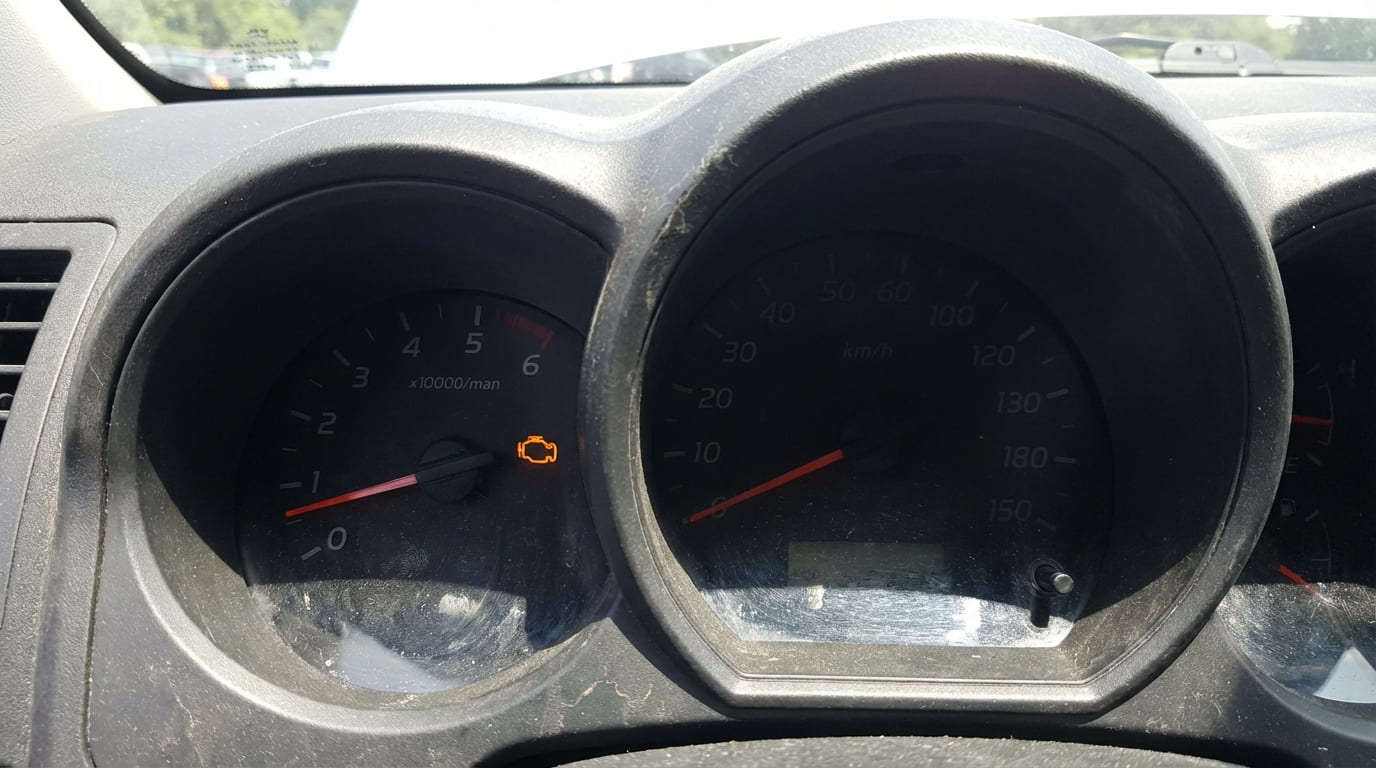
- Check Engine Light: Always pull freeze frame data. Note engine load, RPM, and coolant temp when the misfire occurred — this helps determine if it’s load- or heat-related.
How to Diagnose a Broken Valve Spring
Compression and Leak-Down Testing
Start with a cylinder compression test. Compare all cylinders. As a rule of thumb, if one cylinder reads more than 15% lower than the highest, investigate further. But compression alone isn’t conclusive.
Follow up with a leak-down test. With the piston at TDC on compression, apply 100 psi of air. Listen for air escaping:
- From the intake — likely a bent or unseated intake valve
- From the exhaust — possible exhaust valve issue
- From the oil cap — suggests piston or ring damage, but could also mean the valve isn’t sealing due to spring failure
In my shop, we always do a leak-down test before removing any covers. It’s faster, cleaner, and often confirms whether the issue is valvetrain or bottom-end related.
Visual and Internal Inspection
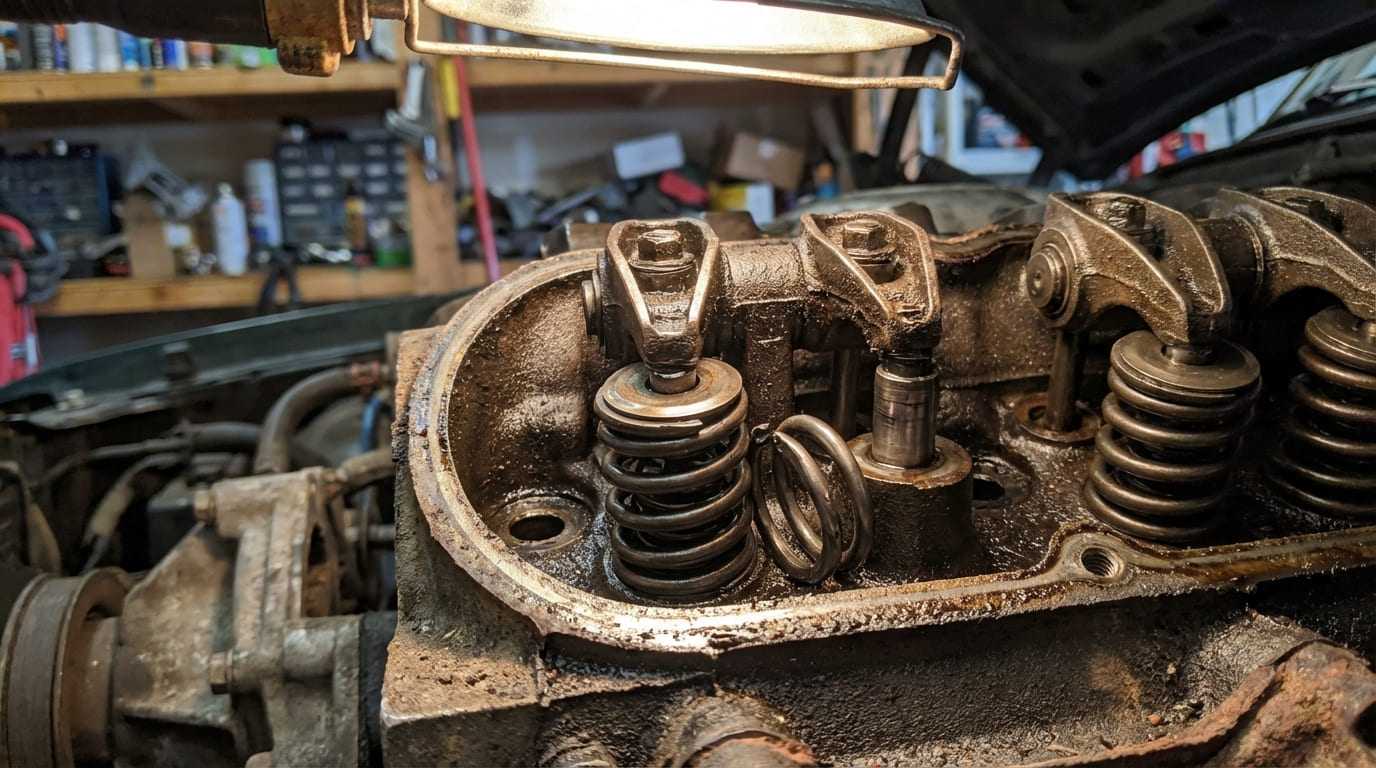
Remove the valve cover to inspect springs, retainers, and rocker arms. Look for:
- Cracks or gaps in the spring coil
- Missing or dislodged valve keepers
- Loose or broken rocker arms
- Oil contamination or metal shavings around the valve stem
Use a borescope through the spark plug hole to inspect the combustion chamber. Look for:
- Denting on the piston crown
- Bent or recessed valves
- Carbon buildup patterns indicating poor sealing
A $100 borescope pays for itself in avoided misdiagnoses. I’ve caught valve contact issues before disassembly — saving hours of labor.
Recommended and Avoid Practices
- ✅ Recommended: Use a quality on-engine spring compressor. Cheap tools can slip and damage the valve stem or guide.
- ✅ Recommended: Replace valve stem seals when replacing springs. They’re inexpensive and degrade with heat and age.
- ✅ Recommended: Clean spark plug hole threads with a thread chaser before reinstalling plugs. Prevents galling and ensures proper seating.
- ⚠️ Avoid: Reusing old retainers or locks. They’re precision parts and can crack under stress.
- ⚠️ Avoid: Skipping the leak-down test. Compression alone doesn’t tell the full story.
- ⚠️ Avoid: Assuming only one spring failed. In high-mileage engines, I often replace all springs on that head if labor is already invested.
Repair Options and Cost Considerations
The repair path depends heavily on whether secondary damage occurred. The table below outlines common scenarios I’ve encountered, including typical costs and repair viability.
| Scenario | Likely Cause | Repair Approach | Cost Range (Labor + Parts) | Repair vs Replace Logic |
|---|---|---|---|---|
| Single broken spring, no valve contact | Spring fatigue, overheating, poor material | On-engine spring replacement with seal update | $300–$600 | Worth repairing. Minimal labor if no head removal. |
| Broken spring with bent valve | Valve not closing in time, interference engine | Head removal, valve replacement, spring & seal renewal | $1,200–$2,000 | Repair if engine is otherwise healthy. Consider upgraded springs. |
| Broken spring with piston damage | Severe valve-to-piston contact | Head repair + piston/cylinder inspection, possible short block | $2,500–$4,500 | Evaluate vehicle value. A used long block may be more cost-effective. |
| Multiple spring failures | Over-revving, incorrect spring pressure, tuning issues | Full valve job, possibly upgraded springs | $1,800–$3,000 | Common in modified engines. Address root cause (e.g., rev limit, harmonics). |
In my shop, we always discuss repair cost vs. vehicle value with the customer. If the fix exceeds 50% of the car’s worth, we recommend a used long block or engine replacement.
Case Studies from the Shop
Situation: A 2012 V6 truck came in with a P0304 code and a tapping noise. Owner drove it 30 miles after symptoms started.
Initial Assumption: Broken spring or lifter issue on cylinder 4.
Discovery: Valve cover off revealed a shattered inner spring. Leak-down test showed 80% loss to exhaust. Bore scope showed a dented exhaust valve and piston crown.
Nuanced Lesson Learned: Even if the engine runs, continued operation with a broken spring can cause valve-to-piston impact — and once metal is deformed, a simple spring swap won’t fix it.
Situation: A high-mileage inline-4 had intermittent misfires. Compression was borderline, but leak-down was normal.
Initial Assumption: Ignition or fuel issue.
Discovery: After ruling out coils and injectors, we pulled the valve cover. One spring was fractured but still partially coiled — it would intermittently lose tension under load.
Nuanced Lesson Learned: Not all broken springs fail completely. Partial fractures can cause on-again, off-again symptoms that mimic other faults.
Situation: A performance engine with aftermarket springs developed a knock. Owner had recently tuned for higher RPM.
Initial Assumption: Rod knock or bearing failure.
Discovery: Noise traced to valvetrain. Spring had failed due to harmonic resonance at 6,500 RPM — a frequency not seen in stock tune.
Nuanced Lesson Learned: Upgraded components don’t always mean improved reliability. Spring harmonics and valve float need to be considered in modified applications.
Final Advice: What to Do Now
If you suspect a broken valve spring:
- Stop driving the vehicle immediately.
- Tow it to a shop for diagnosis.
- Perform a leak-down test and visual inspection before committing to repairs.
- Consider replacing all valve springs on the affected head if the engine has over 100,000 miles.
Time and temperature are your enemies. A spring that’s cracked today may fail completely tomorrow. Diagnose early, act fast, and avoid turning a $50 part into a $3,000 problem.