Rocker arms are a critical part of the valvetrain in overhead valve (OHV) and some overhead cam (OHC) engines. Their main job is to transfer motion and force from the camshaft to the intake and exhaust valves, opening them at the right time. If they fail, engine performance drops fast—expect noise, misfires, or even serious internal damage. This guide cuts through the theory and gives you exactly what you need to know: how they work, how to spot problems, how to fix them, and when to walk away.
How Rocker Arms Work: The Basics
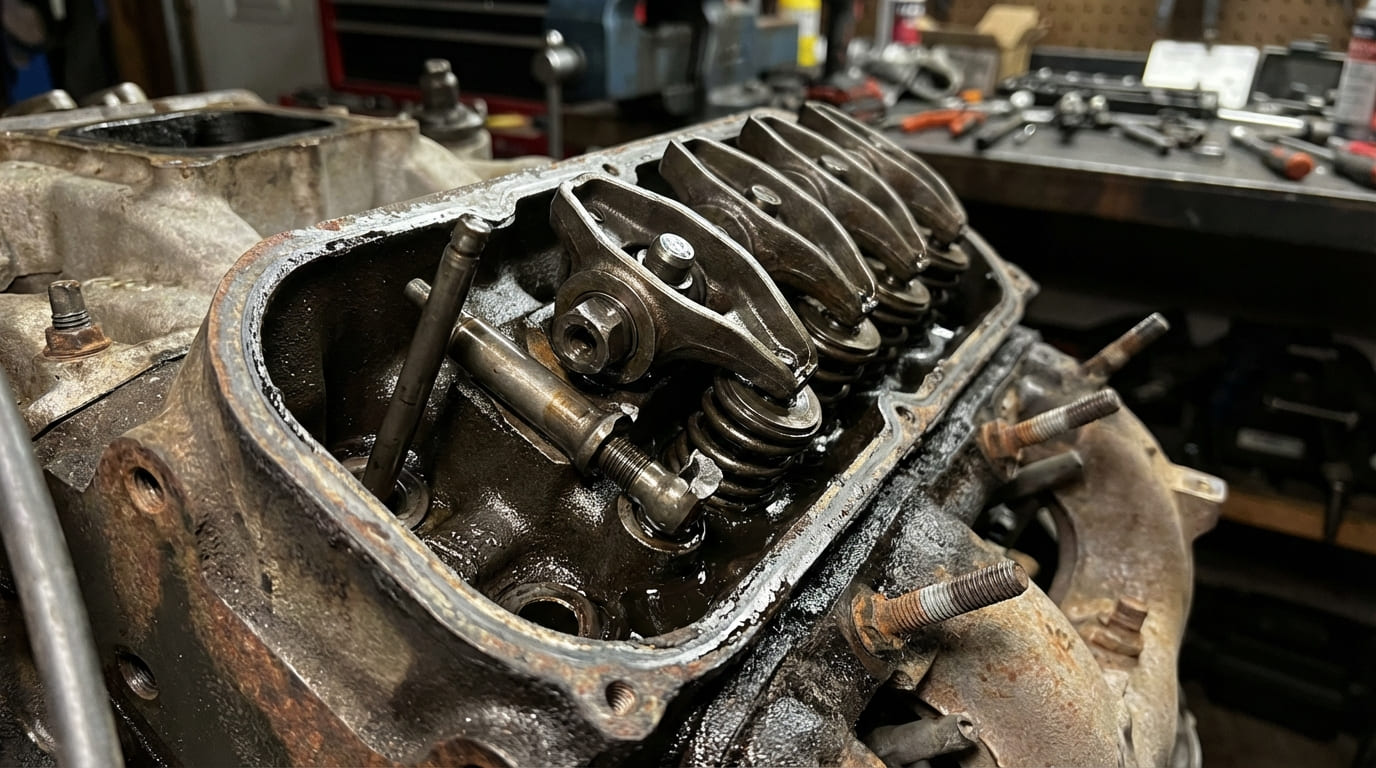
In OHV engines, the camshaft sits in the engine block. It pushes a lifter, which moves a pushrod upward. That pushrod hits one end of the rocker arm. The rocker pivots on a fulcrum and pushes the other end down onto the valve stem, opening the valve against spring pressure. When the cam lobe rotates away, the valve spring closes the valve. The rocker arm is the last mechanical link in this chain—small, but vital.
Even in OHC engines, rocker arms are often used, though the camshaft acts on them directly instead of via a pushrod. The function remains the same: translate rotational cam motion into linear valve movement.
Key Functions of Rocker Arms
Convert Motion and Transmit Force
The rocker arm turns the upward push from the pushrod (or direct cam lobe contact) into downward force on the valve stem. This pivoting action is what allows the camshaft—located lower in the engine—to control valves up in the cylinder head. It’s a simple lever system, but it must handle high loads, especially at high RPM.
Provide Mechanical Advantage
Most rocker arms have a ratio—typically 1.5:1 to 1.8:1. This means a 0.300” lift at the pushrod end becomes 0.450” to 0.540” at the valve. That amplification improves airflow without needing a more aggressive (and wear-prone) cam profile. Higher ratios are popular in performance builds, but they increase stress on the entire valvetrain.
Always verify actual valve lift if tuning performance. Not all rockers labeled “1.5:1” deliver exactly that—pivot point placement affects ratio.
Types of Rocker Arms and Where They’re Used
Different designs serve different needs. Choosing the right type matters for durability, performance, and cost.
| Type | Common Applications | Pros | Cons |
|---|---|---|---|
| Stamped Steel | Economy OHV engines (e.g., older V6s, 4-cylinders) | Inexpensive, durable for daily driving | Heavy, flexes under high RPM, wears faster |
| Roller Tip | Performance and late-model OHV engines | Reduces friction at valve stem, less wear | Roller bearings can fail if oil-starved |
| Full Roller | Race engines, high-performance builds | Low friction at pivot and tip, better longevity | Expensive, requires precise setup |
| Pedestal-Mounted | Older OHV engines (e.g., small-block Chevy) | Easy to replace individually | Alignment varies, more flex than shaft systems |
| Shaft-Mounted | Modern OHC, performance OHV (e.g., LS engines) | Rigid, maintains alignment, less deflection | More expensive, harder to service |
In my shop, we always upgrade to shaft-mounted rockers on performance builds—even if the engine came with pedestals. The reduced flex pays off in valve control above 5,500 RPM. It’s worth the extra labor.
Common Materials and Their Real-World Use
Material affects weight, strength, and cost. Here’s what you’ll see and when to use it:
- Stamped steel: Stock applications only. Don’t use in high-RPM builds.
- Cast iron: Older industrial engines. Heavy and outdated.
- Forged aluminum: Popular aftermarket choice. Lightweight, strong, affordable.
- Billet aluminum: Top-tier for racing. Holds geometry under load, but costs 2–3x more than forged.
Billet rockers aren’t just for show. On a turbocharged LS with 80+ psi of boost, I’ve seen forged arms deflect enough to cause valve float. Billet fixed it. Spend the money if you’re pushing limits.
How to Diagnose Rocker Arm Problems
Valvetrain noise is the most common clue—but don’t assume it’s the rocker. Follow a system.
How to Check for Rocker Arm Issues
- Listen for noise: A rhythmic ticking or tapping, especially at idle, often points to rocker wear. Noise that worsens with RPM is a red flag.
- Inspect with valve cover off: Look for:
- Cracked or broken arms
- Seized roller tips (don’t spin freely)
- Loose mounting bolts (pedestal or shaft)
- Shiny spots on valve stems (sign of misalignment)
- Check for play: Use a pry bar gently on each rocker. Excessive movement at the pivot or tip indicates wear.
- Verify oil flow: On shaft-mounted systems, remove a rocker and blow compressed air through the oil gallery. If it’s clogged, clean it or replace the shaft.
- Measure wear: Use a micrometer on the trunnion. Compare to spec—most wear limits are around 0.002” diameter loss. Roller bearings should have zero grit or wobble.
If you find wear, don’t just replace the bad rocker. Inspect pushrods, lifters, and cam lobes. A failed rocker may be a symptom, not the cause.
Symptoms and What They Really Mean
| Symptom | Most Likely Cause | What Else to Check |
|---|---|---|
| Ticking noise at startup, goes away when warm | Clogged oil passage in rocker shaft | Oil viscosity, filter, pump pressure |
| Constant tapping, worse at high RPM | Worn trunnion or roller bearing | Pushrod condition, lifter bleed-down |
| Misfire under load | Cracked/broken rocker or flexing arm | Valve spring pressure, cam lobe wear |
| Reduced power, poor idle | Wear reducing effective valve lift | Aftermarket cam or head work affecting geometry |
| Intermittent noise | Loose mounting bolt or worn shaft bushing | Torque specs, thread condition in head |
A 5.7L Hemi came in with tapping noise. Owner replaced lifters and pushrods. I found one roller tip seized solid—causing metal grind and incomplete valve opening. The cam lobe was fine. Lesson: Always spin every roller by hand. A $20 rocker can mimic a $500 cam failure.
A 350 Chevy with aluminum rockers missed at high RPM. Rockers looked new, but they were flexing. The shaft wasn’t upgraded for 1.6:1 ratio. Roller skidded on valve stem, wore it in weeks. Fix: upgraded shaft system and checked pushrod length. Geometry is everything.
A 4.0L SOHC Explorer ticked cold, quiet when warm. Adjusted lash twice—no fix. Borescope showed coked oil in rocker shaft. Cleaned gallery, noise gone. Moral: oil flow issues can look like mechanical wear. Test flow before tearing down.
Lubrication: Why It’s Critical
Rocker arms rely on engine oil. In OHV engines, oil flows up the pushrod to a hole in the rocker arm, then feeds the trunnion and roller tip. Shaft-mounted systems often have internal oil galleries. If oil is dirty, low, or the passages are clogged, the rocker bearings fail fast.
Use the correct oil viscosity. Thicker oil may reduce noise temporarily but won’t fix clogged passages. If you’re seeing repeated rocker wear, check oil pressure and filter quality.
Repair vs. Replace: Cost and Viability
Here’s the reality: rocker arms are rarely the root cause of major engine issues, but they’re often the first to show symptoms.
- Replace individual rockers: $15–$50 each. Viable if only one or two are damaged and the rest are in spec.
- Upgrade to full roller or shaft system: $200–$600 for a set. Worth it for performance builds or engines with a history of valvetrain noise.
- Rebuild entire valvetrain: $800–$1,500+ with labor. Consider if you have multiple worn components or are increasing RPM or boost.
If you’re doing head work or cam swaps, replace or upgrade rockers at the same time. It’s cheap insurance.
Best Practices: Do This, Not That
- ✅ Clean bolt threads with a tap before installing pedestal bolts. Gunk in the hole prevents proper torque.
- ✅ Check pushrod length when changing rocker ratios. Too short or long causes poor valve stem contact.
- ✅ Verify oil passages are clear, especially in shaft systems. A quick air test saves hours of guesswork.
- ⚠️ Don’t reuse torque-to-yield (TTY) bolts. They stretch. Reusing them risks loosening or breakage.
- ⚠️ Don’t mix rocker types (e.g., roller and stamped) on the same engine. It creates imbalance and uneven wear.
- ⚠️ Don’t assume all 1.5:1 rockers are equal. Measure actual valve lift if performance matters.
Flatness of the rocker mounting surface matters. For cast iron heads, warpage over 0.002”–0.004” is a problem. Aluminum heads often need to be under 0.0015”. Always check the factory manual—specs vary even within the same engine family.
Always follow the manufacturer’s torque specs and adjustment procedures. What works on a small-block Chevy won’t apply to an LS or a 4.0L SOHC. Guessing leads to repeat failures.
The rocker arm is a small part, but it’s a stress point and a diagnostic window. A ticking noise might seem minor, but it could be the first sign of oil starvation that’ll kill your camshaft. Fix the symptom, but find the cause.