In my shop, I field this question often—especially from DIYers frustrated by EGR valve clogging or Check Engine Lights. The short answer is: yes, it can be disabled or removed. But the better question is, should it be—and under what conditions? After two decades in the bay, I’ve learned that emissions systems like EGR are rarely just “annoyances.” They’re carefully engineered components, and tampering with them carries consequences that go beyond a clean engine light.
Can You Disable the EGR Valve? Yes—But Should You?
The EGR (Exhaust Gas Recirculation) valve reduces nitrogen oxide (NOx) emissions by recirculating a portion of exhaust gas back into the intake manifold. This lowers combustion temperatures. While clogging and failure are common, especially on high-mileage engines, deletion is not a reliable fix for most drivers. Before considering disablement, diagnose the real issue.
How to Check if the EGR Valve Is Faulty
Don’t assume the EGR valve itself is bad. Many EGR-related codes stem from blocked passages, sensor failures, or vacuum leaks. Here’s how to diagnose properly:
- Scan for trouble codes: Common ones include P0401 (Insufficient EGR Flow), P0402 (Excessive Flow), P0403/P0404 (Electrical Circuit Malfunction).
- Inspect the EGR valve: Remove it and check for carbon buildup preventing movement. Use a hand vacuum pump to test diaphragm operation (if vacuum-operated).
- Check EGR passages: Use a flashlight and mirror to inspect intake manifold ports. Carbon blockage here is far more common than valve failure.
- Test sensors: On many vehicles, the DPFE (Differential Pressure Feedback EGR) sensor fails before the valve. Check voltage signals with a multimeter or scan tool.
- Verify vacuum lines (if applicable): Cracked or disconnected hoses cause false flow issues.
Cleaning the valve and passages often restores function. Labor time: 1–2 hours. Cost: $100–$250 at a shop. DIY cleaning with carb cleaner and a pipe brush costs under $20.
Legal and Regulatory Compliance
In the U.S., the Clean Air Act prohibits removing or disabling any emission control device on a street-legal vehicle. This includes the EGR system. Similar laws exist in Canada, the EU, and Australia. Violations can result in fines, failed inspections, and registration issues.
Most states with emissions testing use OBD2 scans. If the EGR system is disabled, the ECU will either set a DTC or show incomplete readiness monitors. Even with a custom tune suppressing codes, some states now detect non-stock ECU signatures. Visual inspections may also reveal block-off plates or missing components.
In my shop, we always advise: if the vehicle operates on public roads, keep the EGR system intact. The risk of legal and mechanical fallout far outweighs any perceived benefit.
Methods for Disabling or Deleting the EGR Valve
Despite the risks, here are the most common methods—and what really happens when you use them.
Physical Block-Off Plate Installation
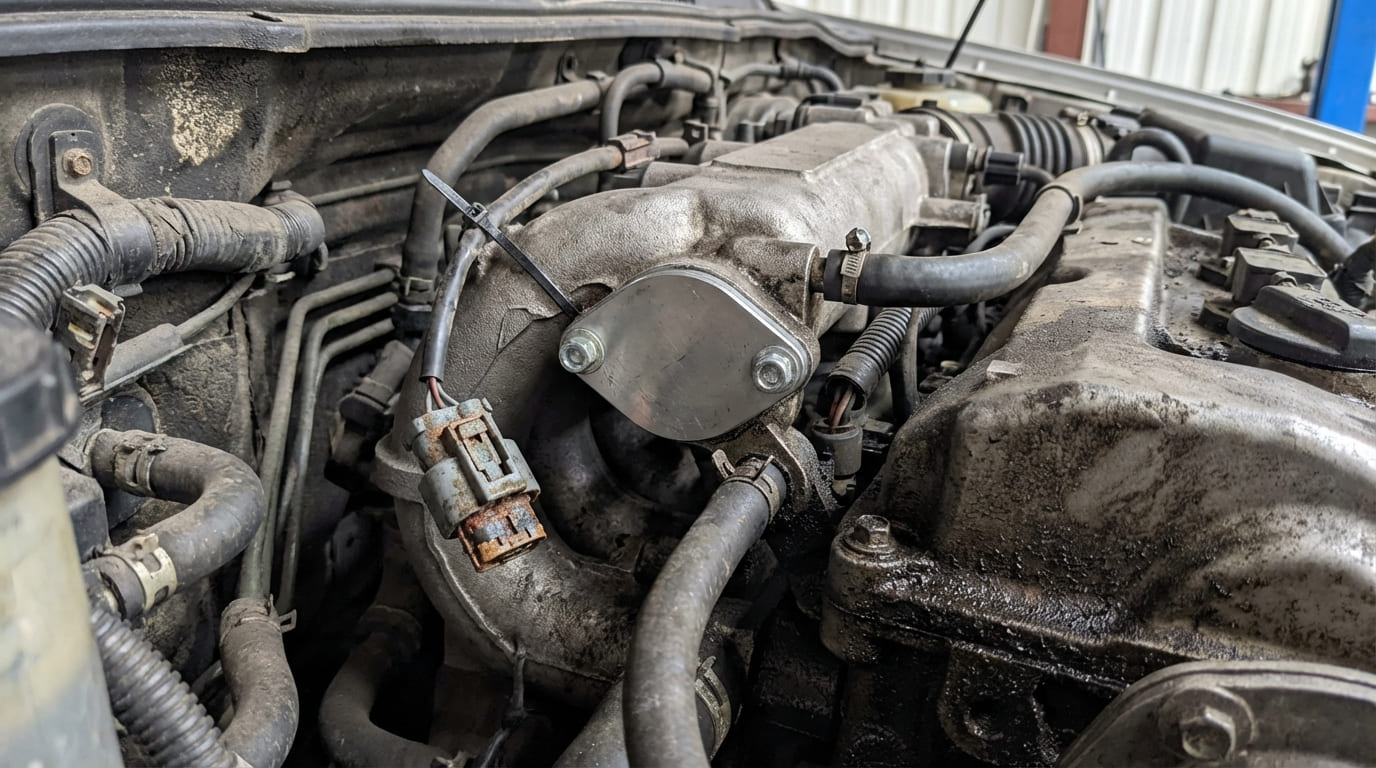
A metal plate is installed between the EGR valve and intake manifold, stopping exhaust gas flow. Stainless steel plates cost $15–$40. Installation requires basic hand tools and gasket sealant.
Downside: The ECU expects EGR flow. Without reprogramming, DTCs like P0401 will trigger the Check Engine Light. This method alone is not a complete solution.
Electronic Disablement (ECU Reprogramming)
Reflashing the ECU with a custom tune disables EGR logic and suppresses error codes. Tools like HP Tuners, Cobb Accessport, or open-source platforms (e.g., TunerPro) are required. Cost: $200–$600 for software and tuning service.
This is the only way to avoid dashboard warnings—but it’s not reversible without proper backup. Always archive the stock tune before modifying.
Disconnecting the Electrical Connector
Unplugging the EGR valve stops actuation but triggers immediate fault codes (P0403/P0404). The ECU detects open circuits. This is useful for diagnostics but not a valid long-term solution.
Complete EGR System Removal
Includes removing the valve, piping, and cooler (on diesels). Block-off plates seal all ports. Common in off-road builds or engine swaps.
On diesel engines, removing the EGR cooler may disrupt charge air cooler bypass circuits, affecting warm-up performance. Some modern diesels rely on EGR for temperature management during regeneration cycles.
Consequences of EGR Deletion
Deletion is often marketed for performance or reliability, but real-world results vary. The table below outlines typical outcomes by engine type.
| Scenario | Most Likely Outcome | Less Common but Possible |
|---|---|---|
| EGR blocked, no ECU tune | MIL illuminated, failed emissions test | Engine runs normally otherwise |
| EGR deleted + tuned | No MIL, passes visual if block-off hidden | Increased NOx, higher combustion temps, knock under load |
| EGR deleted on turbo diesel | Risk of increased exhaust temps, potential turbo damage | Minor power gain at high RPM, reduced low-end efficiency |
| EGR deleted on older gasoline engine | Potential for pinging under load | Engine adapts over time with fuel trims, but long-term durability drops |
Situation: A customer brought in a 2010 diesel pickup with a blocked EGR and modified tune. He claimed better fuel economy and no issues. Passed local inspection because the state didn’t require OBD2 checks at the time.
Discovery: Two years later, he moved to a stricter state and failed emissions. The shop he went to couldn’t clear the readiness monitors—ECU was locked. Even after reinstalling the EGR, the ECU wouldn’t relearn without a dealer-level reset.
Nuanced Lesson Learned: ECU modifications can create hidden dependencies. Just because a system is physically reversible doesn’t mean the software will cooperate. Always document your baseline.
Situation: A 2005 V8 SUV came in with a Check Engine Light and rough idle. Owner said he’d “fixed” a previous EGR code by unplugging the valve.
Discovery: The ECU had adapted aggressively to the lack of EGR flow. After reconnecting and replacing the valve, it took over 50 miles of varied driving for the fuel trims and ignition timing to stabilize.
Nuanced Lesson Learned: Modern ECUs don’t just monitor systems—they adapt to them. Removing a component changes long-term learning, and reintegration isn’t instant.
Situation: A shop-installed EGR delete on a turbocharged four-cylinder led to repeated knock sensor codes under load.
Discovery: Without EGR to moderate combustion temps, the engine’s ignition timing was being pulled aggressively. The tune didn’t compensate enough for the increased thermal load.
Nuanced Lesson Learned: EGR isn’t just about emissions—it’s a thermal management tool. Deleting it shifts the burden to other systems, often in ways that aren’t immediately obvious.
Best Practices: What to Do and Avoid
- ✅ Recommended: Diagnose EGR faults fully before considering deletion. A clogged passageway or failing DPFE sensor is often the real culprit—not the valve itself.
- ✅ Recommended: Clean EGR passages thoroughly during service. On many engines I see, carbon buildup in the intake manifold is the root cause of flow issues.
- ✅ Recommended: Use OEM or high-temp gaskets when reinstalling. Cheap gaskets can fail quickly under EGR exhaust heat.
- ⚠️ Avoid: Deleting EGR on daily drivers. The risk of inspection failure, increased engine wear, and unintended consequences outweighs most benefits.
- ⚠️ Avoid: Assuming a “tune” makes deletion invisible. Many states now use OBD2 data mining to detect non-stock calibrations.
- ⚠️ Avoid: Ignoring EGR cooler integrity on diesels. A leaking cooler can cause hydrolock—far more dangerous than a clogged valve.
Reversibility and Verification
If you temporarily disable the EGR for testing or off-road use, keep all original parts. Reinstalling the valve is only half the job. The ECU must complete a drive cycle to close the EGR readiness monitor. Clearing codes with a scanner won’t pass inspection.
Use a factory-specified drive cycle: typically includes idle, city driving, and highway cruising. On some vehicles, readiness won’t set without a dealer-level scan tool.
Check EGR mounting surface flatness before reassembly. Warpage over 0.002″–0.004″ on cast iron (tighter for aluminum) causes leaks. Use a straight edge and feeler gauge. Resurfacing may be needed.
While some argue that EGR systems are outdated, I’ve found they’re still a critical part of modern combustion control—especially with tighter emissions standards. The systems aren’t perfect, but they’re engineered for a balance of efficiency, emissions, and durability.