The Bottom Line: What You’ll Actually Pay
Based on current shop rates across the US, UK, Canada, Australia, and NZ, a complete engine block replacement (parts + labor + machining) typically costs between $3,700 and $14,500. The cheapest realistic path is a used long block swap (~$2,500–$4,500), while a full bare-block rebuild or new crate engine in a diesel/European vehicle can exceed $15,000. For most daily drivers, a remanufactured long block installed at an independent shop is the sweet spot: $4,000–$8,000 with a 3-year/100k-mile warranty.
Total Installed Cost by Replacement Type
Most online guides only show parts pricing. Here’s what you’ll actually pay “out the door,” including machine shop work, labor, fluids, and gaskets.
| Replacement Option | Parts Cost | Labor & Machining | Total Drive-Out | Warranty | Best For |
|---|---|---|---|---|---|
| Bare Block Rebuild | $700–$2,000 | $3,000–$6,000 | $3,700–$8,000 | 90 days–1 year | Performance builds, rare engines, full control |
| Remanufactured Long Block | $2,500–$5,000 | $1,500–$3,000 | $4,000–$8,000 | 3 yrs / 100k mi | Most daily drivers, best value |
| Used Engine Swap | $400–$1,500 | $1,200–$2,500 | $1,600–$4,000 | 30–90 days | Budget repairs, older vehicles |
| Complete Crate Engine (New) | $5,000–$12,000 | $1,500–$2,500 | $6,500–$14,500 | 3 yrs / unlimited | Fleet vehicles, high-value assets |
Cost Breakdown by Vehicle Class
Engine size, access difficulty, and parts availability drive major price differences. These ranges include typical machining and ancillary components.
| Vehicle Class | Typical Examples | Installed Cost Range | Why It Costs This Much |
|---|---|---|---|
| Economy 4-Cylinder | Honda Civic, Toyota Corolla, Mazda3 | $3,500–$5,500 | Easy engine bay access, cheap gasket sets, low machine shop time |
| Midsize Sedan / Crossover | Camry V6, Accord, Hyundai Sonata | $4,500–$7,000 | V6 complexity, moderate subframe removal |
| Midsize SUV | Toyota Highlander, Ford Explorer, Jeep Cherokee | $5,000–$7,500 | Subframe drop required, heavier components |
| Full-Size Pickup | F-150, Ram 1500 5.7L Hemi, Silverado 1500 | $6,000–$9,000 | Crade-mounted engines, TTY fastener requirements |
| European Luxury / Turbo | BMW 335i, Audi 3.0T, Mercedes M276 | $8,000–$14,000+ | Special tools, expensive OEM parts, complex sensors |
| Performance / Sports Car | Camaro SS, Mustang GT, WRX, M3 | $7,000–$12,000 | Tight engine bays, forged internals, precision balancing |
| Heavy-Duty Diesel | Duramax, PowerStroke, Cummins 6.7 | $10,000–$18,000+ | Weight, machining tolerances, injector/pump costs |
Regional Pricing: US, UK, Canada, Australia, NZ & Ireland
Labor rates and parts logistics vary dramatically by market. All figures converted to USD for comparison.
| Country | Indie Shop Rate | Dealer Rate | Typical Long Block Job | Notes |
|---|---|---|---|---|
| 🇺🇸 United States | $90–$160/hr | $140–$220/hr | $4,500–$8,000 | Widest parts availability; reman long blocks dominate |
| 🇨🇦 Canada | C$100–$170/hr | C$150–$230/hr | C$6,000–$10,500 | Slightly higher labor; import fees on some blocks |
| 🇬🇧 United Kingdom | £70–£110/hr | £120–£180/hr | £3,500–£7,000 | VAT (20%) included; strong reman market |
| 🇦🇺 Australia | A$120–$180/hr | A$170–$250/hr | A$7,000–$12,000 | Shipping costs for non-common engines; high labor |
| 🇳🇿 New Zealand | NZ$110–$170/hr | NZ$160–$230/hr | NZ$7,500–$13,000 | Import-heavy market; JDM blocks common |
| 🇮🇪 Ireland | €75–€120/hr | €130–€190/hr | €4,000–€8,500 | UK/EU parts supply; VAT at 23% |
Hidden Costs That Destroy Budgets
These line items get omitted from most quotes. If your mechanic doesn’t include them, ask why.
The “Ancillary Tax” — Parts You Must Replace While the Engine Is Out
- Full gasket & seal kit: $150–$500
- Water pump + thermostat: $150–$400 (cheap insurance — they fail at the worst time)
- Timing components (chain, guides, tensioners): $150–$600
- Oil pump (always inspect or replace): $80–$250
- Engine mounts: $100–$400
- Serpentine belt, tensioner, idlers: $80–$200
- Fluids (oil, coolant, break-in oil): $100–$200
The Machining Reality — What Machine Shops Actually Charge
If you’re going the bare-block route, expect $300–$800 for essential machine work:
- Hot tanking & cleaning: $75–$150
- Magnaflux (crack detection): $75–$125
- Deck resurfacing: $100–$200
- Align-honing main bores: $150–$300
- Cylinder boring/honing: $40–$75 per cylinder
Shop Foreman Warning #1: The TTY Bolt Trap. Torque-to-yield head bolts stretch permanently during installation. Reusing them is the #1 cause of head gasket failure in DIY and budget rebuilds. On engines like the 5.7L Hemi or BMW N54, a $100 bolt kit saves a $4,000 comeback. Never reuse TTY fasteners — period.
Shop Foreman Warning #2: The Hydro-Lock Thread Issue. Before installing head bolts, run a bottoming tap through every blind bolt hole in the block. Trapped coolant or oil can hydro-lock during torque, giving false readings and leading to head gasket failure within weeks. This 10-minute step saves thousands.
Shop Foreman Warning #3: The Oil Pump Debris Trap. Even “new” reman blocks ship with casting sand and machining debris. We always replace or fully disassemble the oil pump, flush the oil cooler lines, and install a magnetic drain plug. Skipping this is how engines die at 3,000 miles.
Repair vs. Replace: The Decision Framework
Not every cracked block is worth fixing. Use this framework before signing the work order.
The 50% Rule (and When to Break It)
If the repair exceeds 50–75% of the vehicle’s current market value, replacement is usually the smarter financial move. But exceptions exist:
- Repair is justified when the truck/car is rust-free, has a strong transmission, low body wear, and you plan to keep it 5+ years.
- Walk away if the vehicle has frame rust, a slipping transmission, failing electronics, or is already high-mileage with multiple upcoming repairs.
The 7-Question Checklist Before You Commit
| Question | If YES → | If NO → |
|---|---|---|
| Is the body/structure rust-free? | Lean toward repair | Sell for parts |
| Is the transmission under 100k miles? | Lean toward repair | Factor in $2,500+ trans rebuild |
| Are major electronics working? | Lean toward repair | Euro cars: budget $2k+ for module issues |
| Do you plan to keep it 3+ years? | Repair usually pays off | Consider replacement |
| Is there an extended warranty? | Dealer repair may be covered | Out-of-pocket pricing applies |
| Is the same engine common on the used market? | Used swap is viable | Reman/crate is your only path |
| Can you tolerate 1–3 weeks of downtime? | Full rebuild possible | Long block swap for speed |
Real Shop Case Studies: What Actually Goes Wrong
Three recent jobs from my bay that show why cheap shortcuts fail.
Case #1: The Phantom Coolant Leak (2010 Midsize Sedan)
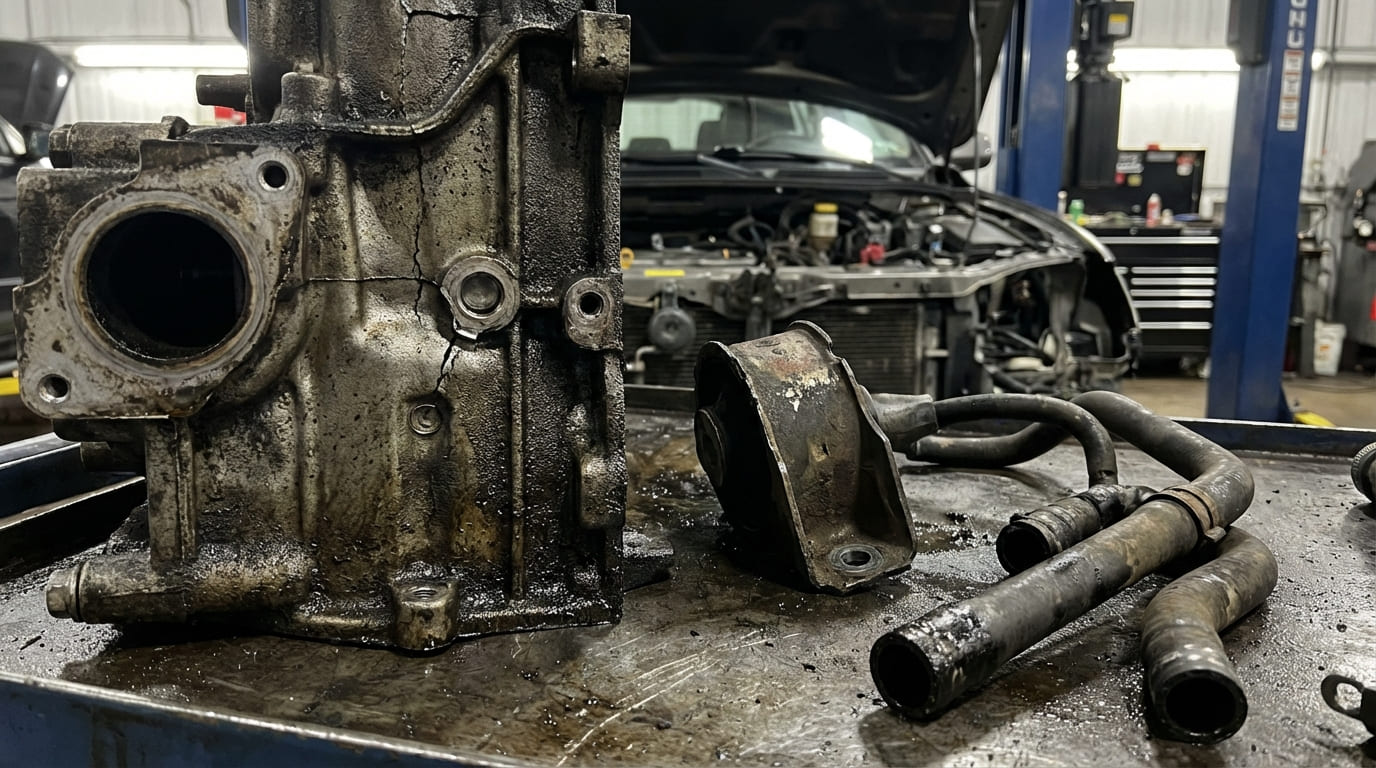
Symptom: White smoke, coolant loss, no visible leaks. Customer assumed head gasket.
Discovery: After head removal, decking was flat. Pressure test revealed a crack in the lifter galley — a casting flaw worsened by 15 years of thermal cycling.
Outcome: Block replacement required. Lesson: not all coolant intrusion is a head gasket. Always pressure-test the block with heads torqued down before condemning.
Case #2: The $100 Bolt Mistake (2014 Ram 1500 5.7L Hemi)
Symptom: Compression loss on two cylinders at 3,000 miles post-rebuild.
Discovery: DIYer reused original TTY head bolts. Deck was flat, gasket was quality, but clamp force was insufficient due to stretched bolts.
Outcome: Second teardown. $100 in bolts would have prevented a $2,800 comeback.
Case #3: The Debris Trap (2017 Diesel Pickup, Long Block Swap)
Symptom: Low oil pressure at 800 miles after a reman long block install.
Discovery: Tech reused the old oil pump. Pickup screen was clogged with casting sand and machining debris from the new block.
Outcome: New oil pump, cooler flush, magnetic drain plug. Lesson: always replace or inspect the pump — it’s the canary in the coal mine for debris.
The First 500 Miles: Shop Foreman’s Break-In Protocol
Modern engines still need break-in, especially fresh rings and bearings. Ignore this and your warranty is void.
- Oil change at 500 miles — mandatory. Removes break-in metal from new rings and bearings. Most shops skip this; don’t.
- Vary RPM constantly — no cruise control, no sustained highway speeds for the first 1,000 miles.
- No towing or heavy loads until after the 1,000-mile oil change.
- Monitor oil pressure and coolant temp like a hawk. Pull over immediately for any anomaly.
- Avoid extended idling — it starves cylinder walls of oil splash during critical ring seating.
I’ve seen reman engines die at 400 miles because the owner idled for 20 minutes post-install, then drove 600 highway miles nonstop. Break-in isn’t optional — it’s where the engine is born.
Frequently Asked Questions
Is it cheaper to rebuild a block or buy a used engine?
For common engines (4-cylinder economy, domestic V8s), a quality used long block swap is usually $1,500–$3,000 cheaper. For rare, performance, or diesel engines, rebuild is often the only viable option. Factor in mileage and warranty — a used engine with 150k miles is a roll of the dice.
How long does an engine block replacement take?
Long block swap: 1–3 days at a busy shop. Bare block rebuild: 1–3 weeks (machine shop queue is the bottleneck). Crate engine install: 1–2 days. Budget for the car to be in the shop longer than quoted — comebacks and parts delays are normal.
Does a new engine reset the car’s mileage?
Legally, no. The odometer stays as-is. Best practice: document the mileage at replacement on a sticker in the door jamb and keep receipts. This protects resale value and tracks the new engine’s service interval.
Can a cracked engine block be repaired without replacing it?
Sometimes. Cast iron blocks can be metal-stitched (pinning) for external cracks — typically $400–$900. Some aluminum blocks can be welded by specialists, but it’s risky and often cost-prohibitive. Internal cracks (lifter galley, cylinder walls) almost always require replacement.
What voids the warranty on a replacement engine?
Skipping the 500-mile oil change, reusing TTY fasteners, improper break-in (sustained highway miles), overheating events, and missed maintenance. Document everything — receipts are your defense if a claim arises.
Final Takeaway
An engine block replacement is one of the most expensive mechanical decisions you’ll face as a vehicle owner. The difference between a successful $6,000 repair and a $12,000 disaster usually comes down to three things: proper diagnosis (not assuming every coolant leak is a head gasket), correct component selection (reman long block vs. used vs. crate), and obsessive attention to small details (TTY bolts, thread cleaning, oil pump replacement).
Before authorizing any work, get a written quote that breaks out parts, labor, machining, and ancillary components. If your shop won’t itemize, walk away. And always ask: at this cost, does the rest of the vehicle justify the investment?