After two decades in the shop, from fleet hybrids to modern EVs, I’ve seen how regenerative braking changes everything—from energy use to brake wear. It’s not just a feature; it’s a core function that affects diagnostics, maintenance, and driver expectations. Misunderstanding it leads to misdiagnoses, unnecessary parts replacements, and frustrated customers. This guide cuts through the theory and gives you what you need: how to diagnose, repair, and advise with confidence.
How Regenerative Braking Works: The Practical View
When you slow down, your car has kinetic energy. In a gas-only car, that energy turns into heat at the brake pads and is wasted. Regenerative braking captures some of that energy, converts it to electricity, and stores it in the high-voltage battery. This extends range and reduces wear on friction brakes—especially in stop-and-go driving.
But it’s not magic. It’s a coordinated system involving the motor, battery, power electronics, and brake controls. When it fails, symptoms often mimic mechanical issues—but the root cause is usually electronic or software-based.
In my shop, we never replace a high-voltage component based on a DTC alone. We verify energy flow, sensor inputs, and driver behavior first. More than half the “failed inverter” cases I’ve seen were actually brake switch or calibration issues.
Key Components and Their Role in Diagnostics
Understanding the main players helps you trace problems efficiently. Here’s what matters most when diagnosing regen issues:
- Electric Motor/Generator: Acts as a generator during deceleration. Resistance slows the wheels, and electricity is sent back to the battery.
- High-Voltage Battery: Must accept charge. If it’s full, cold, or degraded, regen is limited or disabled.
- Inverter/Converter: Converts AC from the motor to DC for the battery. Manages voltage and current flow.
- Brake Actuator and Sensors: In blended systems, these manage pedal feel and coordinate hydraulic and regen braking.
- ECU and Software: Decides how much regen to apply based on inputs like speed, battery state, and driver behavior.
How to Check Regen Functionality
Don’t guess—test. Use a scan tool that reads hybrid/EV-specific data. Look for:
- Regen Amperage or Power Output: Should show negative current (charging) during deceleration.
- Battery State of Charge (SOC): If near 100%, regen will be limited.
- Battery Temperature: Below 5°C (41°F), regen may be reduced or disabled.
- Brake Pedal Position Switch: A stuck or misadjusted switch can disable regen, thinking the driver wants friction brakes.
- Drive Mode Settings: Some vehicles disable strong regen in “Comfort” mode unless the driver enables “One-Pedal” or “B” mode.
Always test drive with a scan tool connected. Regen issues are often intermittent and only appear under specific conditions—like lifting off the throttle at 30 mph. If you’re not seeing live data, you’re working blind.
When Regen Fails: Common Symptoms and Real Causes
Customers often describe regen problems as “no engine braking” or “soft pedal.” But these symptoms have different roots. Use this diagnostic table to prioritize checks:
| Symptom | Possible Causes | Probability (Based on Field Experience) | First Steps |
|---|---|---|---|
| Reduced or no regen during decel | High battery SOC, low battery temperature, battery degradation, inverter fault | High: SOC or temp; Low: inverter | Check SOC, battery temp, DTCs, perform drive cycle |
| Unusual brake pedal feel | Brake actuator fault, pressure sensor issue, air in hydraulic system | Moderate: sensor; Low: actuator | Inspect for DTCs, bleed system if needed, check calibration status |
| Vehicle doesn’t slow when lifting off accelerator | Driver expectation mismatch, regen disabled due to fault, traction control intervention | High: driver expectation; Moderate: fault | Verify drive mode, check for active DTCs, test in different conditions |
| Excessive brake dust or wear despite regen | Driving style (aggressive braking), one-pedal driving not used, system not engaging regen | High: driving style; Moderate: system fault | Review driving habits, verify regen data via scan tool |
Repair vs. Replace: Cost and Viability
High-voltage components are expensive. Before replacing anything, confirm the fault. Here’s what you’re looking at cost-wise:
| Part | Typical Cost (Part Only) | Repair Viability |
|---|---|---|
| Inverter | $800–$2,500 | Low—usually replaced, not repaired |
| High-Voltage Battery | $2,000–$8,000+ | Medium—some packs can be rebuilt; consider refurbished |
| Brake Actuator (e.g., Honda, Toyota) | $600–$1,200 | Medium—requires calibration after replacement |
| Brake Pedal Position Switch | $25–$75 | High—easy fix, often overlooked |
| Motor/Generator | $1,500–$4,000 | Low—rarely fails; verify control circuits first |
I’ve saved customers thousands by replacing a $50 brake switch instead of a $1,200 actuator. Always start with the cheapest, most likely cause. And remember: if the battery can’t accept charge, no amount of motor or inverter work will restore regen.
Vehicle-Specific Behavior You Need to Know
Not all regen systems work the same. Driver expectations vary—and that leads to “no problem found” returns. Know these differences:
- Toyota/Lexus Hybrids: Subtle regen on lift-off. Stronger in “B” mode. One-pedal driving is limited.
- Honda Hybrids: More aggressive lift-off deceleration. Uses Intelligent Brake Assist for blending.
- Tesla and Other BEVs: Strong one-pedal driving standard. Can be adjusted or disabled.
- Nissan Leaf: “e-Pedal” mode allows full one-pedal driving—disable it if the driver prefers traditional feel.
Always ask: “What kind of EV or hybrid have you driven before?” A Tesla driver switching to a Prius will think it’s broken. Educate before you diagnose.
Brake Maintenance in the Age of Regen
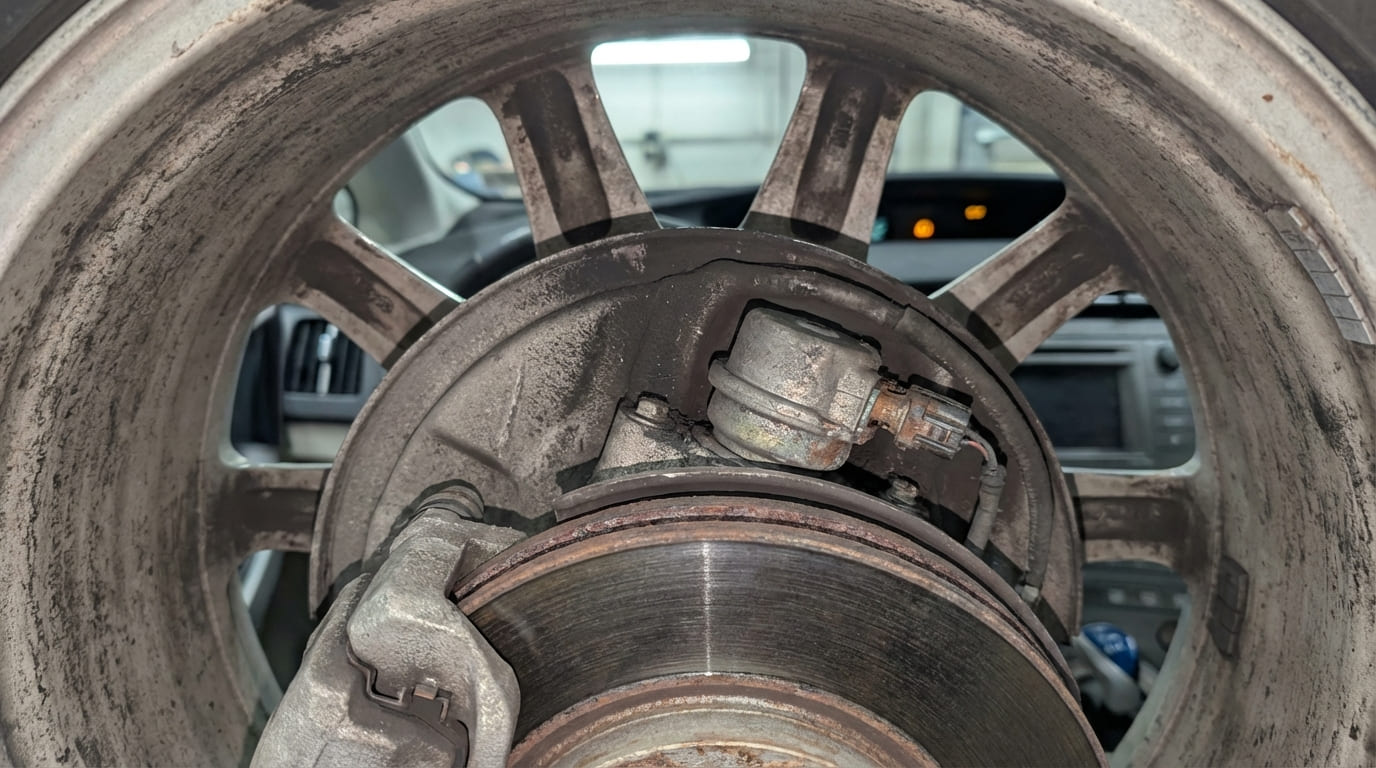
Friction brakes wear slower—but they still need care. Neglect leads to seized calipers, rusted rotors, and failed ABS modules.
In cold, wet climates, rear rotors often develop surface rust from sitting. First brake application may feel grabby—this is normal. But if it persists, inspect for seized slides or calipers.
Brake fluid still matters. Moisture in the system affects the brake actuator and ABS pump. Follow OEM flush intervals—typically every 2–3 years.
Recommended Maintenance Practices
- ✅ Inspect friction brakes every 12 months—even if pads are 80% life. Check for rust, seizing, and uneven wear.
- ✅ Flush brake fluid on schedule. Use OEM-specified DOT fluid.
- ✅ Test brake actuator function with a scan tool during major service.
- ⚠️ Don’t assume no pad wear = no brake issues. Hydraulic components degrade with age, not just use.
- ⚠️ Don’t disable regen without understanding the impact on battery health and vehicle dynamics.
Real-World Diagnostics: Lessons from the Bay
Situation: 2018 Toyota Camry Hybrid, “brakes don’t slow the car.” No DTCs.
Findings: Regen data showed normal function. Battery at 60% SOC. Customer was used to Tesla’s one-pedal driving.
Solution: Explained system behavior. No repair needed. Customer adjusted driving style.
Situation: Nissan Leaf, weak regen above 20 mph. Battery health at 82%.
Findings: Brake pedal switch intermittently stuck, signaling “brake applied” and disabling regen.
Solution: Replaced $40 switch. Regen restored. No need for battery or inverter work.
Situation: 2020 Prius, spongy pedal, occasional ABS light.
Findings: No leaks. Bleeding did nothing. Scan tool showed erratic brake actuator pressure output.
Solution: Replaced and calibrated brake actuator. Pedal feel returned. No hydraulic issues found.
Regenerative braking changes how cars stop—but it doesn’t eliminate the need for skilled diagnosis. Always verify before replacing. Use data, not assumptions. And remember: sometimes the fix isn’t under the hood. It’s behind the wheel.