Over two decades in the bay, I’ve seen oil consumption complaints run the gamut—from subtle quirks to full-blown mechanical failures. What surprises many is that high oil use doesn’t always mean smoke, leaks, or catastrophic damage. In my experience, understanding the context—driving habits, maintenance history, engine design—is just as critical as any test. Let’s walk through the real-world diagnostic pathways I use when oil disappears without obvious clues.
Exhaust Smoke Present: Where Oil Meets Flame
Visible blue-gray smoke means oil is entering the combustion chamber. The key is identifying the route: up past the rings, down through the valve train, or pulled in via ventilation failure. Don’t assume the most obvious cause—test first.
Piston Ring or Cylinder Damage
Blue smoke under acceleration or load usually means oil is bypassing the piston rings. Start with a compression test: below 100 psi or more than 20% variation between cylinders warrants a leak-down test. Over 10% leak-down with air escaping through the oil filler cap confirms ring or cylinder wall issues.
Carbon buildup can stick rings even if compression looks okay. A borescope inspection reveals scoring, carbon-packed ring lands, or broken rings. On turbocharged engines with high mileage, this is common. Chemical ring cleaning may help temporarily, but worn cylinders require honing or replacement.
Cost to rebuild: $2,500–$5,000. Consider engine replacement if block damage is severe.
Valve Guide or Stem Seal Wear
Blue smoke on cold start or deceleration typically points to valve seals. But seals only work if guides are within spec. Use a borescope to check for oil residue on valve stems or in ports. If guides are worn—especially over 0.006” clearance—new seals won’t fix the leak.
On older V6 and inline-six engines, exhaust guides wear faster due to heat. Reconditioning guides or installing oversized valves may be needed. Replacing seals alone costs $300–$800; full guide work adds $1,000+.
In my shop, we always measure valve guide clearance before replacing seals. I’ve seen too many come back with the same issue—new seals can’t seal a hole twice their size.
PCV System Malfunction
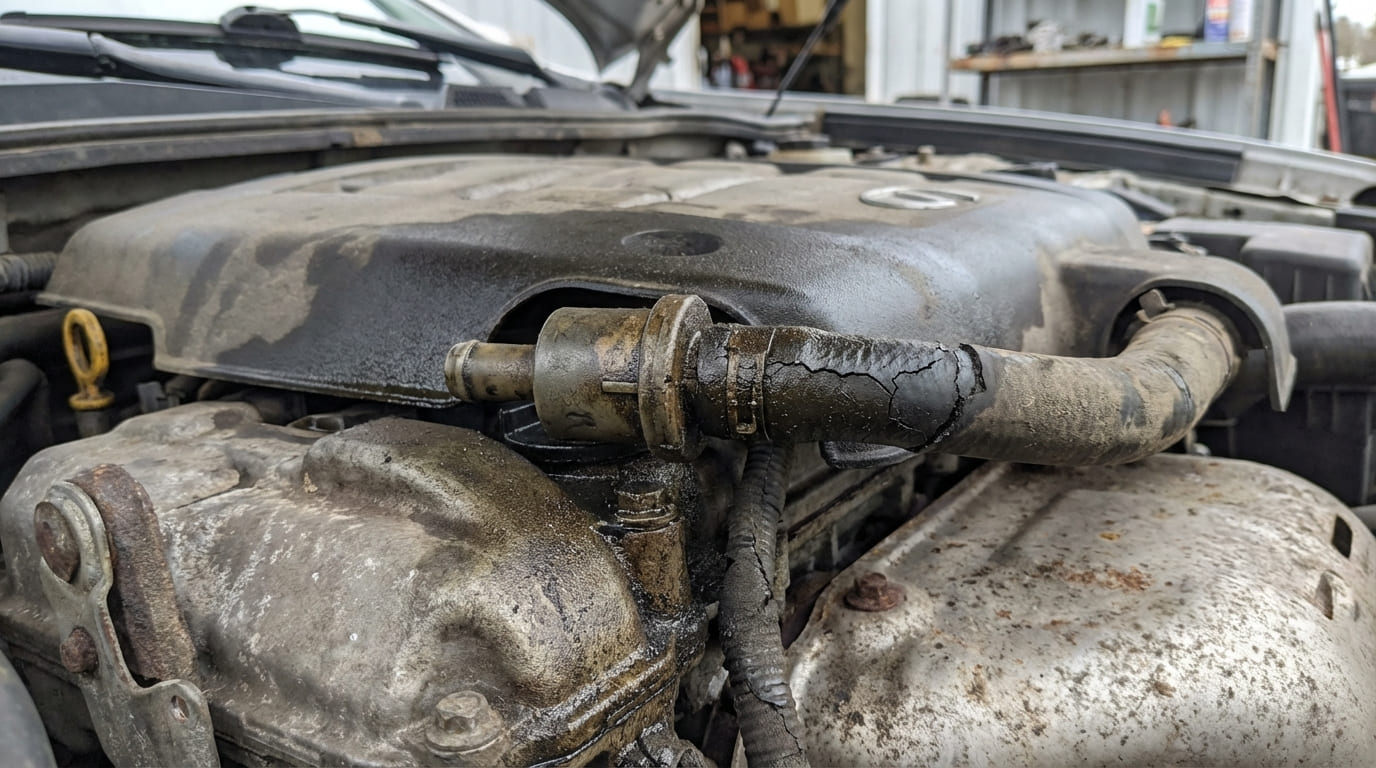
A stuck-open PCV valve or clogged breather hose creates excessive crankcase vacuum, pulling oil into the intake. Even without smoke, this can burn a quart every 1,000 miles. Test crankcase pressure at idle: over 0.5 inH₂O vacuum (or outside OEM spec) indicates a problem.
Shaking the PCV valve checks for gross failure, but use a manometer for accuracy. Inspect the intake tract for oil mist or sludge—common on engines with integrated crankcase separators. Replace the valve and hoses; clean the separator if clogged.
Parts cost: $30–$120. Labor: 1–2 hours. High ROI repair—don’t skip it.
Turbocharger Seal Failure
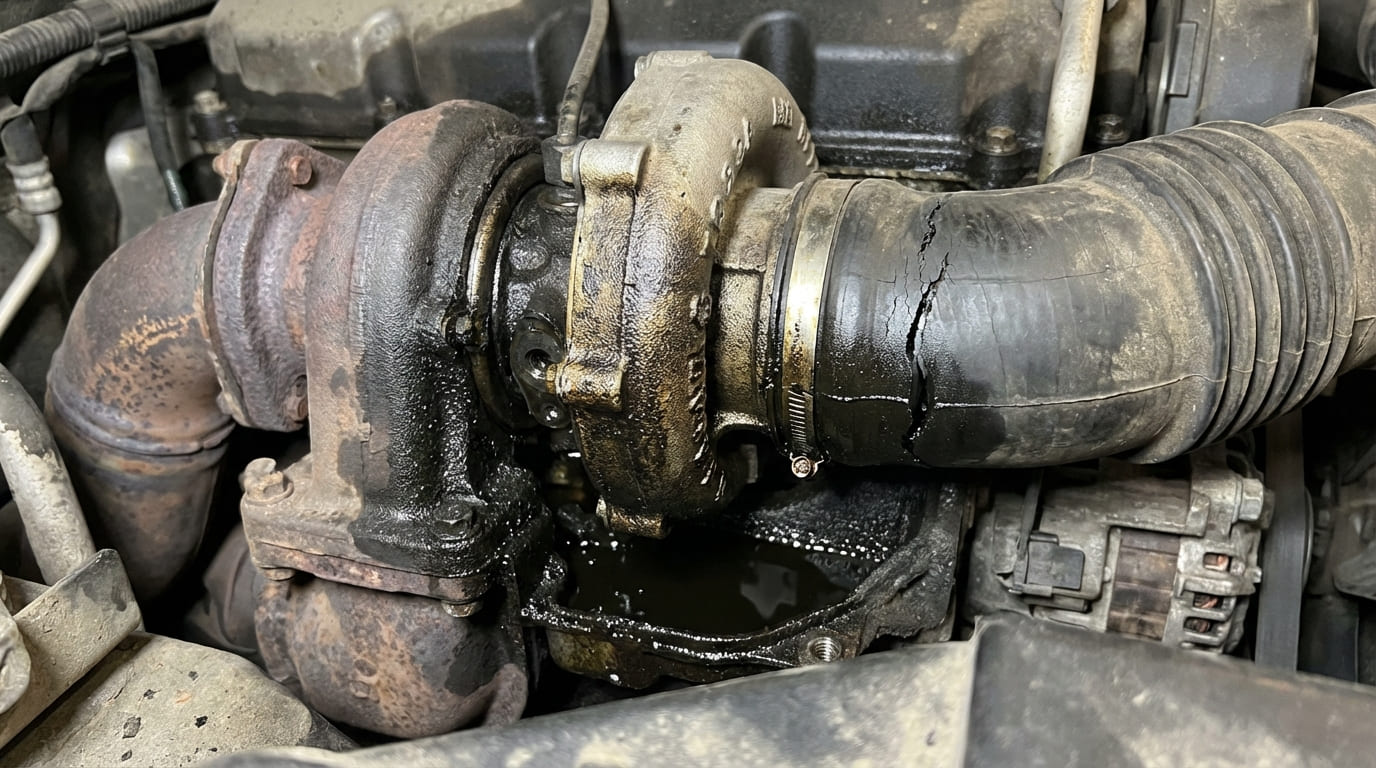
Oil in the intake pipe after the turbo compressor wheel suggests a failed seal. Check for shaft play: over 0.005” radial or 0.003” axial movement means the bearings are worn. But don’t assume the turbo is guilty—first rule out crankcase overpressure pushing oil mist into the intake.
Inspect the turbo inlet and intercooler. If both are dry but the compressor housing is oily, the seal is likely bad. Rebuild kits cost $150–$300; full replacement: $800–$2,000.
Sudden Spike in Oil Use: Acute Failures
A rapid increase in consumption—especially with power loss—means something broke. Diagnose fast to prevent engine seizure.
Catastrophic Piston or Ring Failure
Compression below 50 psi or leak-down over 25% with audible blow-by in the crankcase signals major damage. A borescope will show broken rings, melted pistons, or deep scoring. Track-driven or overheated engines are common culprits.
Rebuild or replace. No band-aid fixes here. Cost: $3,000–$7,000. If the car isn’t worth it, consider a used long-block.
Internal Oil/Coolant Heat Exchanger Failure
Some engines route oil through a cooler inside the cooling system. If it cracks, oil can enter coolant or vice versa. Milky oil isn’t always a head gasket—check the exchanger.
Pressure test the unit if accessible. Oil analysis showing coolant contamination without combustion gases supports this. Replace the exchanger—typically $400–$900 in parts and labor. Prevents ongoing oil loss and coolant degradation.
No Smoke, No Leaks: The Stealthy Oil Disappearance
This is the most common—and most misdiagnosed—scenario. The oil isn’t leaking or burning visibly. It’s being consumed through subtle mechanical issues, design quirks, or misread conditions.
Subtle Piston Ring Wear or Sticking
Compression and leak-down may be within spec but on the low end. Oil analysis showing fuel dilution over 2% suggests short trips are washing down cylinder walls, reducing ring seal. Extended highway driving can help free sticky rings.
Engine flushes have limited success. On aluminum blocks with thin liners, once ring tension is gone, a rebuild is the only real fix. Cost: $2,500+.
Subtle Valve Seal or Guide Wear
Not all seal leaks produce visible smoke. A faint sheen on the valve stem seen via borescope may be the only clue. Check under specific conditions: cold start followed by sudden acceleration. Look from behind the vehicle—blue haze is easier to see in sunlight.
If consumption is consistent and PCV is good, head work is likely needed. Always verify guide condition first.
PCV System Issues (Low-Level)
Even minor restrictions—like a partially clogged breather filter on an off-road vehicle—can raise crankcase pressure enough to force oil past seals. Use a manometer to measure pressure at idle and under load. Compare to OEM specs: some allow up to 0.8 inH₂O positive pressure, others demand near-neutral.
Clean or replace breather filters and hoses. This $20 fix can eliminate a quart-per-1,000-mile loss.
Oil Dilution: The Hidden Culprit
Fuel or coolant in the oil thins it, making the dipstick read low. The engine isn’t burning oil—it’s diluted. Oil analysis is the only reliable way to detect this.
Fuel dilution over 5% is common in turbocharged engines with leaking injectors. Coolant contamination, even at 0.5%, changes oil volume appearance and harms lubricity. Fix the root cause: injectors, head gasket, or heat exchanger.
In my shop, we run oil analysis on every high-consumption case before tearing into the engine. More than once, it’s saved a customer from a $4,000 rebuild they didn’t need.
Engine Design or OEM-Specific Behavior
Some engines are designed to consume oil. GM LS-based V8s, certain BMW and Audi turbo engines, and some Subarus may use a quart every 1,000–1,500 miles and still be “within spec.” Check TSBs and owner forums before assuming failure.
For example, BMW issued updated piston rings for some N54/N55 engines—but not under warranty after 100k miles. Replacing rings may reduce consumption, but it’s labor-intensive. Sometimes, the best fix is monitoring and topping off.
Cylinder Block Porosity (Rare)
Microscopic casting pores in the block can allow oil to seep internally—into coolant or the ground—without a visible leak path. Suspect this only after ruling out all other causes.
Confirm by disassembling and pressure-testing the block with coolant passages sealed. If oil appears in coolant with no head gasket breach, porosity is possible. Repair with block sealant or replacement. Extremely rare—seen it maybe five times in 20 years.
Wrong Oil Viscosity or Specification
Using 0W-20 in an engine designed for 5W-30 can increase consumption, especially in high-mileage engines. Thinner oil slips past worn seals and guides more easily.
Switch to a high-mileage oil with seal conditioners and slightly higher viscosity. Monitor consumption. Oil analysis can verify if the oil is within expected viscosity range after use.
| Symptom / Observation | Most Likely Causes (in order of probability) | Diagnostic Priority |
|---|---|---|
| Blue smoke on cold start | Worn valve stem seals, worn valve guides, PCV over-vacuum | Borescope inspection, PCV function test |
| Blue smoke under load | Piston ring wear, broken ring, cylinder scoring | Leak-down test, borescope |
| Oil loss with no smoke or leaks | PCV malfunction, subtle ring wear, oil dilution, design tolerance | Oil analysis, crankcase pressure test, TSB check |
| Sudden oil consumption spike | Catastrophic ring/piston failure, turbo seal failure, heat exchanger leak | Compression/leak-down, visual inspection of intake/exhaust, oil analysis |
| Oil in coolant, no overheating | Internal oil cooler leak, block porosity, head gasket (less likely) | Pressure test cooler, inspect oil for coolant |
Best Practices: What to Do and Avoid
- ✅ Clean cylinder head bolt threads with a bottoming tap before reassembly. Dirty threads cause inaccurate torque and head warpage.
- ✅ Replace valve stem seals every time the valve train is accessed. Reused seals often leak prematurely.
- ✅ Perform a crankcase pressure test on turbocharged and high-mileage engines. It’s fast and reveals hidden ventilation issues.
- ⚠️ Never reuse torque-to-yield (TTY) head or rod bolts unless the manual allows it. Once stretched, they can’t safely clamp again.
- ⚠️ Don’t assume oil consumption is normal without checking OEM specs. Some engines allow it; most don’t.
- ⚠️ Never skip oil analysis on subtle cases. It’s the only way to catch dilution or early wear.
Situation: A 2012 turbocharged sedan came in using a quart every 500 miles. No smoke, no leaks, compression within spec.
Initial Assumption: Internal engine wear—maybe rings or guides.
Deep Dive: Oil analysis showed 4.2% fuel dilution. Further inspection revealed a leaking fuel injector O-ring allowing raw fuel into the cylinder, washing down the oil film.
Nuanced Lesson Learned: High oil consumption isn’t always about oil escaping—it can be about fuel thinning it. Always rule out dilution before condemning internal components.
Situation: A high-mileage V8 burned oil, especially after idling. Blue smoke on startup.
Initial Assumption: Classic valve stem seal failure.
Deep Dive: Replaced seals—no improvement. Borescope revealed excessive exhaust valve guide wear—over 0.008” clearance. Seals can’t compensate for that.
Nuanced Lesson Learned: Seals are only as good as the guides they ride on. On older engines, measure guide clearance before assuming seals are the fix.
Situation: A diesel SUV consumed oil with no exhaust smoke. PCV hose was dry.
Initial Assumption: Internal engine wear.
Deep Dive: Crankcase pressure test showed high positive pressure. The crankcase breather filter was clogged—common on off-road vehicles with dirty air.
Nuanced Lesson Learned: Even without visible blockage, a restricted breather can increase pressure enough to force oil past seals. Ventilation health is often overlooked.
Diagnosing oil consumption isn’t about jumping to the loudest symptom—it’s about methodical testing and knowing what’s normal for the engine. Always consult the service manual for specs, test procedures, and known issues. Combine oil analysis, pressure tests, borescope inspection, and vehicle history for the clearest picture. In my career, the most expensive repairs were avoided not by tearing into the engine, but by testing first and questioning assumptions.