Glow plugs are essential for reliable cold starts in diesel engines. Unlike gasoline engines, diesels rely on compressed air heating to ignite fuel—but when the engine is cold, compression heat alone isn’t enough. Glow plugs provide the extra heat needed to ensure quick, clean ignition. As a master mechanic, I’ve seen countless hard-start issues traced back to glow plug system faults. This guide cuts through theory and gives you the practical diagnostics, repair steps, and pro tips you need to keep diesel engines starting strong—even in freezing weather.
How Glow Plugs Work: The Real-World Purpose
Diesel engines ignite fuel by compressing air until it’s hot enough to cause spontaneous combustion. But cold metal saps heat from compressed air, especially in winter. When cylinder temperatures drop below 400°C, diesel fuel won’t ignite reliably—leading to hard cranking, white smoke, and rough idle. Glow plugs solve this by heating up to 850–1100°C before startup, creating a hot spot in the combustion chamber where fuel can ignite easily.
They don’t spark like spark plugs. Instead, they act as preheaters—active only during startup and warm-up. Many modern systems keep glow plugs energized for up to several minutes after start (the “afterglow” phase) to smooth idle and reduce emissions.
In my shop, we always tell customers: if your diesel cranks fine but won’t start cold, suspect glow plugs before injectors or compression. It’s the most common failure point—and often the easiest fix.
How to Diagnose Glow Plug Problems
Start with symptoms. If the engine turns over normally but struggles to fire when cold—especially with white smoke—the glow plug system is a prime suspect. But don’t jump straight to replacing parts. Follow a systematic diagnostic path.
Step-by-Step Diagnostic Process
Use this sequence to isolate the issue without guesswork:
- Check the “wait-to-start” light. If it doesn’t illuminate, the problem may be upstream: blown fuse, faulty relay, or control module issue.
- Verify battery voltage. Weak batteries (below 12.4V) can’t power glow plugs effectively. Test under load—many glow plug circuits draw 60+ amps.
- Scan for coolant temperature (ECT) readings. A faulty sensor telling the ECU the engine is warm will cut preheat time short—even if the engine is stone cold.
- Test glow plug resistance with a digital multimeter. Disconnect each plug and measure ohms across the terminal and cylinder head.
- Check voltage at the glow plug connector during preheat. You should see full battery voltage for the duration of the preheat cycle.
- Inspect the glow plug control module (GPCM) or ECU outputs using a scan tool. Monitor duty cycle and activation duration.
| Symptom | Most Likely Causes | How to Verify |
|---|---|---|
| Hard cold start, white smoke | Glow plug failure, weak battery, faulty ECT sensor | Test plug resistance, check battery health, scan ECT value at cold start |
| Rough idle for 1–2 minutes | Afterglow not working, GPCM fault | Monitor glow plug duty cycle post-start with scan tool |
| No wait-to-start light | Blown fuse, failed relay, wiring break | Check fuse, test relay operation, verify power to GPCM |
| Frequent DPF regens | Glow plugs not aiding regeneration heating | Review regen logs, test plug performance under load |
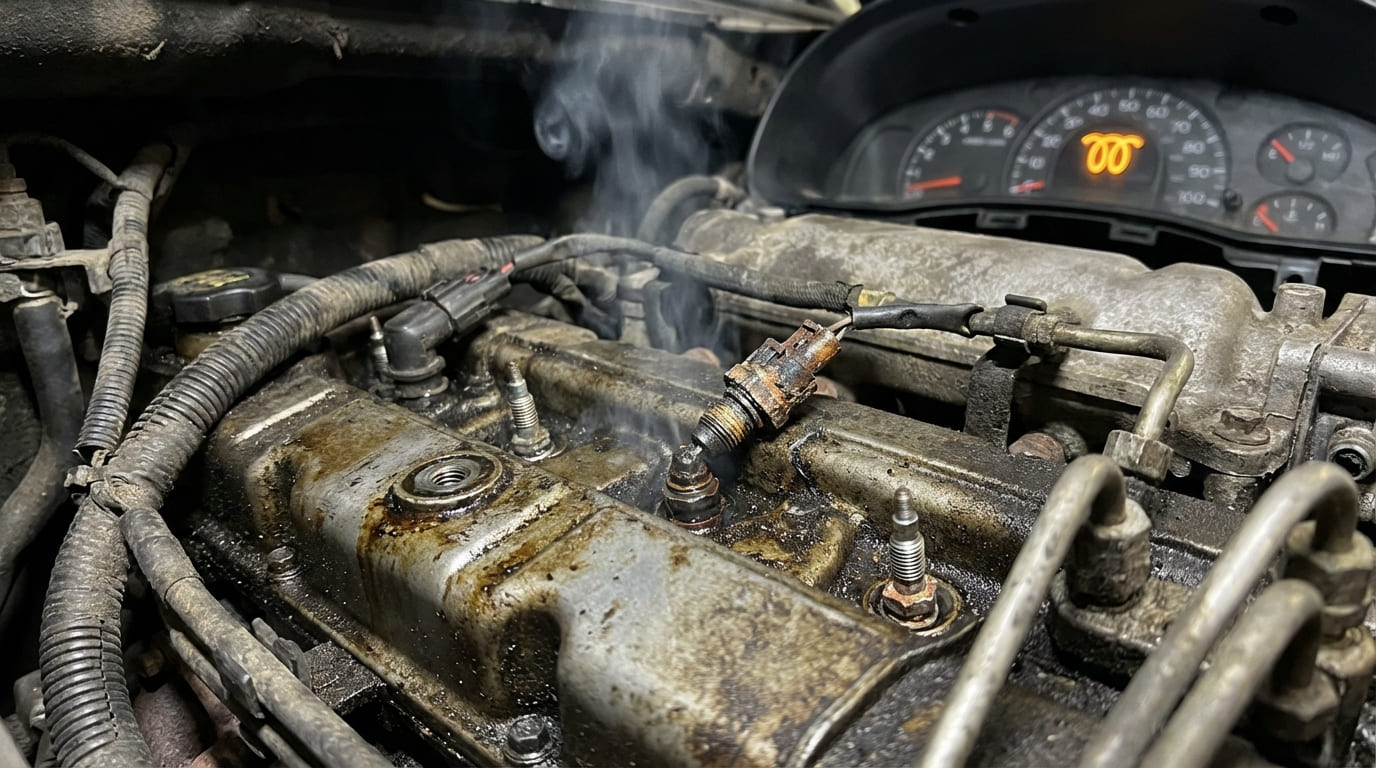
Here’s a trick I use: after cranking, remove the glow plugs and inspect the tips. A clean, evenly heated tip means the plug worked. A cold tip on one cylinder? That’s your culprit. Black soot or melted tips indicate overuse or voltage issues.
Glow Plug Types and Replacement Tips
There are two main types: metal and ceramic. Know which your engine uses—because replacement procedures differ.
| Type | Heat-Up Time | Lifespan | Cost (per plug) |
|---|---|---|---|
| Metal | 10–20 seconds | 80,000–120,000 miles | $15–$30 |
| Ceramic | 2–4 seconds | 100,000–150,000 miles | $30–$60 |
Ceramic plugs are standard on modern diesels. They heat faster and run hotter—but are more fragile. Metal plugs are tougher but slower, common on older or heavy-duty engines.
Replacement Best Practices
- Replace all glow plugs as a set—even if only one is bad. Mismatched heating causes uneven combustion and extra stress.
- Use a torque wrench. Ceramic plugs typically require 10–15 ft-lbs. Over-tightening cracks the insulator.
- Clean cylinder head threads with a bottoming tap before installation. Carbon buildup can prevent proper seating and lead to leaks or breakage.
- Do not use anti-seize unless specified by the manufacturer. It can alter torque values and cause plugs to loosen over time.
- Recheck the “wait-to-start” light after replacement. If it doesn’t come on, verify power and ground at the harness.
In my shop, we always test new glow plugs for resistance before installing. I’ve seen brand-new aftermarket plugs with open circuits. A 30-second check saves a re-teardown later.
When to Repair vs. Replace
Glow plugs themselves are relatively inexpensive. But labor varies by engine layout. On some trucks, they’re easily accessible. On others (like certain V6 diesels), intake manifolds must be removed—adding $300+ in labor.
If you’re seeing repeated failures, don’t just keep replacing plugs. Look upstream:
- Check for overvoltage (above 13.5V during preheat). A failing alternator or voltage regulator can fry glow plugs.
- Inspect ground connections. Poor grounding causes uneven heating and false resistance readings.
- Verify the GPCM is functioning. A faulty module can over-energize plugs or cut power too soon.
Chronic glow plug failure is never normal. If you’ve replaced them more than once in 80,000 miles, there’s an electrical or control issue killing them. Fix the root cause—or you’ll keep paying.
Final Thoughts: Keep It Simple
Glow plugs are simple devices—but their control systems aren’t. Always start with the basics: battery, fuses, sensors, and wiring. More than half the glow plug jobs I see come in with good plugs but bad information feeding the ECU.
My rule: check the coolant temp sensor first. It’s cheap, easy to test, and responsible for more glow plug misdiagnoses than any other part.