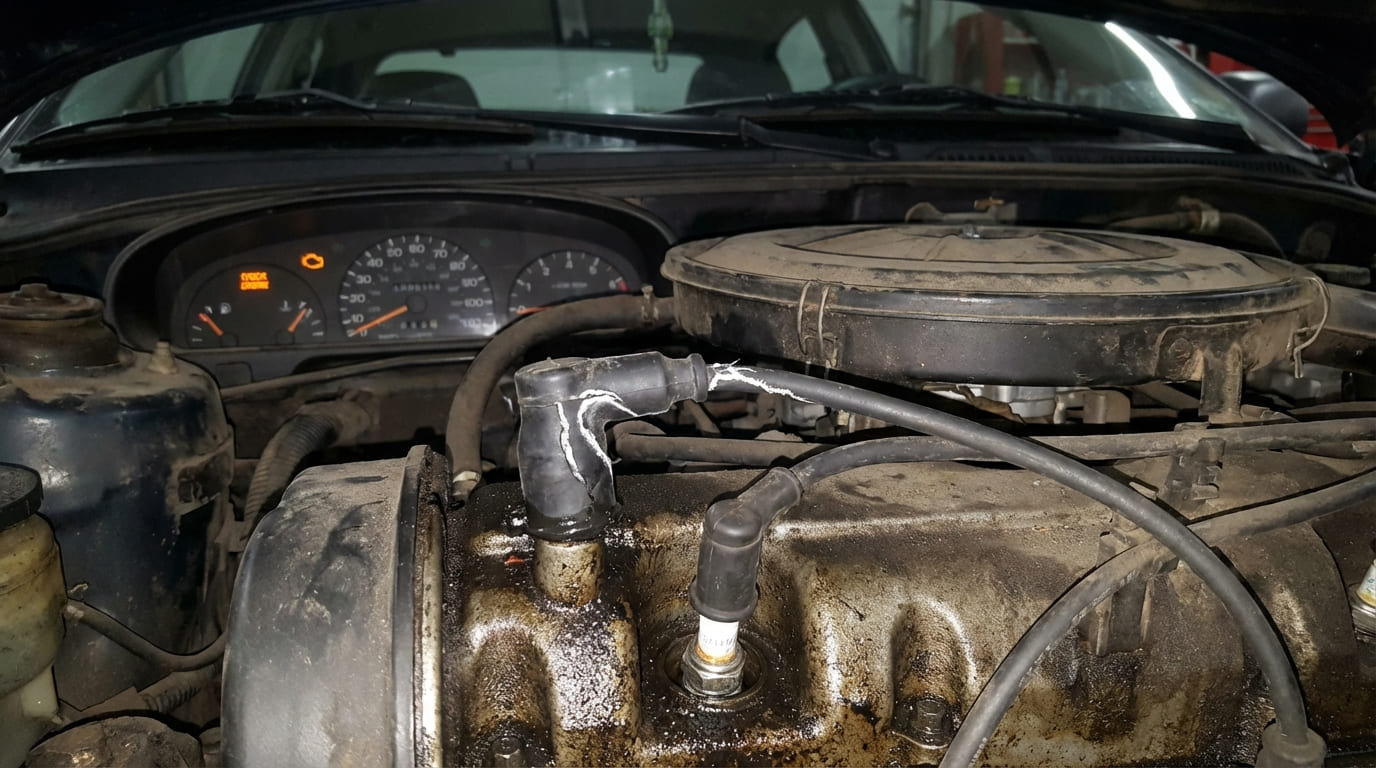
Spark plug wires are a common source of ignition trouble, but they’re often misdiagnosed. As a master mechanic, I see too many DIYers replace wires without confirming the fault—wasting time and money. This guide cuts through the noise. You’ll learn how to accurately diagnose bad spark plug wires, differentiate them from similar issues, and decide whether to repair or replace.
Key Symptoms and How to Check Them
Engine Misfire
Misfires are the most common sign of failing spark plug wires, but they’re not exclusive to them. A misfire feels like hesitation, rough idle, vibration, or power loss. Don’t assume it’s the wires—verify.
How to Check:
- Use an OBD2 scanner to pull misfire codes (P030X for specific cylinder, P0300 for random).
- Check freeze frame data: Was the misfire under load? High-load misfires often point to ignition system strain.
- Monitor real-time misfire counts via Mode $06 or live PIDs. A single-cylinder pattern suggests localized ignition failure.
In my shop, we never replace wires based on a misfire code alone. We verify the ignition circuit first. Too often, a clogged injector or vacuum leak mimics the same pattern.
Check Engine Light (CEL) with Misfire Codes
The CEL is often the first clue. P030X or P0300 codes are strong indicators, but they don’t confirm the cause.
How to Check:
- Scan for codes and note which cylinder(s) are affected.
- Swap ignition coils (on coil-on-plug systems) or spark plugs between cylinders. If the misfire follows the part, that’s your culprit.
- If the misfire stays on the same cylinder, suspect the wire, fuel injector, or mechanical issue (valve, compression).
Engine Hesitation or Stalling Under Load
Hesitation during acceleration or stalling can stem from intermittent arcing in spark plug wires. These issues often don’t trigger codes because they’re brief.
How to Check:
- Test drive while monitoring live misfire and RPM data. Look for spikes during acceleration.
- Inspect wire routing: Does engine torque shift cause a wire to rub against a grounded surface?
- Use an inductive timing light or oscilloscope on the ignition primary circuit to detect erratic spark under load.
I once diagnosed a truck with no stored codes but clear hesitation. A scope revealed noise on the #5 coil driver circuit. The wire was frayed and rubbing the block—intermittent but disruptive. Live monitoring caught what the ECU missed.
Reduced Fuel Economy
Unburned fuel from misfires increases fuel trims. The PCM adds more fuel to compensate, dropping MPG.
How to Check:
- Scan fuel trims: STFT and LTFT consistently above +10% suggest a lean condition caused by misfires.
- Rule out other causes: Check MAF sensor, fuel pressure, and for vacuum leaks.
- If trims normalize after fixing ignition issues, you’ve confirmed the link.
Radio Interference (AM Static)
Static that increases with RPM is classic EMI from arcing ignition wires.
How to Check:
- Listen to AM radio at idle and under load. Does static rise with RPM?
- Turn off engine: If static stops, it’s engine-related.
- Disconnect coils or wires one at a time. If static drops when #4 is unplugged, inspect that circuit.
A customer had AM noise and poor MPG but no CEL. We unplugged coils one by one—noise vanished on #4. The boot had internal carbon tracking, invisible externally. Isolating by removal is a powerful, underused trick.
Visible Arcing or Snapping Sounds
Blue or white sparks jumping from wires or boots in the dark mean insulation failure.
How to Check:
- Inspect at night or in a dark garage with engine running.
- Look near coil boots, spark plug ends, and along wire paths near metal surfaces.
- Listen for faint snapping or cracking at idle—signs of electrical leakage.
I’ve seen wires test fine with a multimeter but arc under load. Always inspect under operating conditions. Heat and vibration expose weaknesses cold tests miss.
Testing Spark Plug Wires: Practical Diagnostics
Resistance Test (Multimeter Check)
Measuring resistance helps screen wires, but it’s not foolproof.
How to Test:
- Disconnect wire from coil and spark plug.
- Set multimeter to ohms (kΩ).
- Probe from end to end. Compare to specs.
| Wire Type | Typical Resistance |
|---|---|
| Standard Carbon Core | 5,000–10,000 Ω per foot |
| RFI Suppression (Mag Wire) | 500–1,000 Ω per foot |
| Spark Plug (Component) | Check service manual—varies by model |
A wire can read within spec cold but fail under heat and load. I treat resistance as a screening tool, not a final verdict. Open circuit? Definitely bad. Within spec? Still suspect if symptoms persist.
Common Causes of Failure
Wires don’t fail randomly. Look for these root causes:
- Heat cycling: Repeated expansion/contraction cracks insulation, especially near exhaust manifolds.
- Mechanical damage: Pinched, scraped, or improperly routed wires develop weak spots.
- Contamination: Oil, fuel, or coolant leaks degrade insulation faster.
- Worn spark plugs: Excessive gap increases voltage demand, stressing wires and coils.
Risks of Ignoring Faulty Wires
Driving with misfires isn’t just annoying—it’s costly.
- Catalytic converter damage: Unburned fuel overheats the converter. Replacement: $800–$2,500.
- Failed emissions test: High hydrocarbons from misfires will fail inspection.
- Fire risk: Severe arcing near fuel or oil leaks can ignite under extreme conditions.
Repair vs Replace: Cost and Viability
Repairing wires isn’t practical. Splices increase resistance and failure risk. Replacement is the only reliable fix.
| Component | DIY Cost | Shop Cost |
|---|---|---|
| Spark Plug Wire Set | $40–$120 | $150–$300 (labor included) |
| Individual Boot/End | $15–$30 (if available) | $80–$150 |
| Ignition Coil (COP) | $60–$150 | $200–$400 |
Never replace just one wire. If one failed, the others are near end-of-life. Mismatched resistance unbalances ignition performance. Replace the full set—and inspect spark plugs while you’re there.
Best Practices: Do and Avoid
- ✅ Do: Clean coil and spark plug boot threads with a tap. Corrosion disrupts ground paths and causes misfires.
- ✅ Do: Apply dielectric grease inside boots—sparingly. Prevents moisture ingress and eases future removal.
- ✅ Do: Route wires exactly as factory. Avoid crossing or pinching. Use loom clips to secure.
- ⚠️ Avoid: Universal wires. They often don’t match OEM resistance, causing ECU feedback issues.
- ⚠️ Avoid: Skipping spark plug gap check. A gap too wide increases voltage demand and accelerates wire wear.
- ⚠️ Avoid: Overtightening coil boots. Cracks the insulator—common on aluminum heads.
Diagnostic Scenarios and Likely Causes
| Symptom | Most Likely Causes (in order) | Less Common But Possible |
|---|---|---|
| Single-cylinder misfire at high load | Worn spark plug, failing wire, weak coil | Intake leak on that runner, restricted injector |
| Random misfires, multiple cylinders | Failing coil pack, degraded wires, low fuel pressure | Cam/crank sensor issue, ECU ground fault |
| AM radio static rising with RPM | Arcing wire, cracked boot, poor shielding | Failing alternator diodes, bad radio ground |
| CEL with P0300, no visible issues | Carbon tracking in boots, intermittent wire breakdown | Early cat failure, vacuum leak |
A 2010 V6 came in with P0303 after the owner replaced the plug and coil twice. Compression and fuel tests were fine. In the dark bay, I saw faint arcing from the #3 wire over the exhaust. Insulation was cracked from heat. Resistance tested okay cold—proof that real-world conditions matter more than bench tests.
Diagnosing spark plug wires isn’t about guessing—it’s about process. Start with the scanner, confirm with inspection, test under load, and consider the entire system. Always consult the service manual for specs and procedures. What works on one engine may damage another.