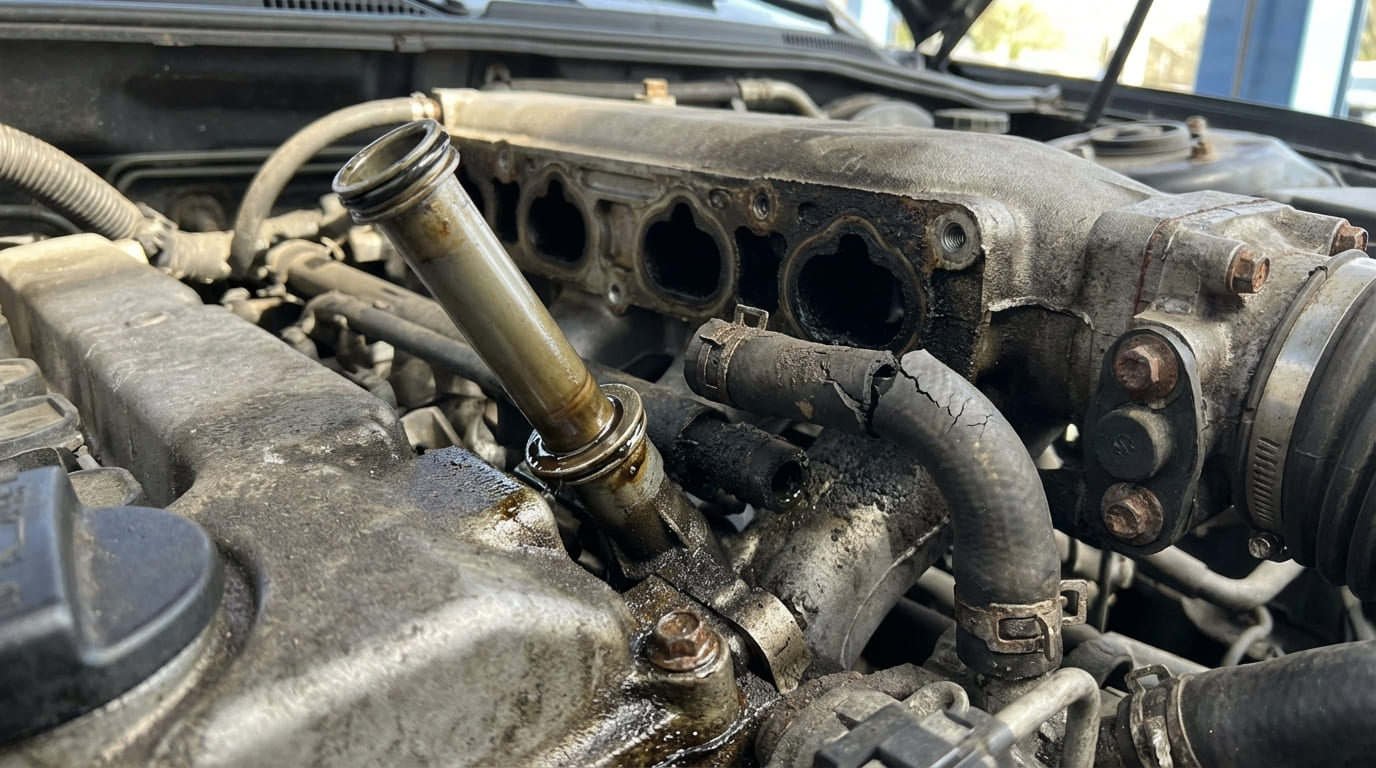
Over two decades in the shop, I’ve seen more than a few engines come in with oil dripping from the dipstick tube or sludge pooling in the intake manifold. While some online forums rush to declare “blown head gasket” or “turbo failure,” the real answers are usually more nuanced. In my experience, these symptoms typically trace back to crankcase ventilation issues or internal wear—but not always in the way you might expect.
Primary Cause: Excessive Crankcase Pressure
Oil escaping the dipstick or pooling in the intake manifold is most often due to elevated crankcase pressure. The PCV (Positive Crankcase Ventilation) system maintains slight vacuum to pull blow-by gases and oil mist back into the intake for combustion. When that system fails or internal engine wear increases pressure, oil gets forced out through the weakest seals—like the dipstick tube—or pulled into the intake.
How to Check: Crankcase Pressure Test
This test is the first step in any diagnosis. It separates simple fixes from major repairs.
- Tool: Use a Magnehelic or water manometer calibrated for low pressure (±10 inches H₂O).
- Connection: Remove the oil fill cap or dipstick and insert a rubber adapter to connect the gauge.
- Conditions: Engine at full operating temperature. Test at idle and 2,500 RPM.
- Normal Reading: –1.0 to –4.0 inches H₂O (vacuum). Any sustained positive pressure (e.g., +0.5 inches H₂O or more) indicates a problem.
- Interpretation: Positive pressure means either too much blow-by or a blocked PCV system.
In my shop, we always pressure-test before replacing parts. I’ve saved customers hundreds by catching a $15 hose collapse instead of selling them a turbo or engine rebuild.
Common Causes and How to Diagnose Them
Start with the simplest and most common issues before moving to internal engine diagnostics.
1. PCV System Failure
The PCV system is the usual culprit—especially on high-mileage or poorly maintained engines.
- PCV Valve: Remove and shake it. A rattle means it’s likely functional. No rattle? Replace it. For accuracy, apply 18 in-Hg vacuum with a hand pump: it should open and close smoothly. Cost: $10–$30. Always use OEM-spec parts—cheap generics often flow incorrectly.
- Hoses and Tubing: Remove and inspect every inch. Look for internal collapse, sludge, or cracking. Blow compressed air through them. Even partial blockages disrupt vacuum. Replacement cost: $20–$60 for a full kit.
- Oil Separator or Valve Cover Assembly: On modern engines (e.g., BMW, Ford EcoBoost, VW TSI), the separator is built into the valve cover. If clogged, it restricts flow. Disassembly is required for inspection. Replacement: $200–$600. Labor: 2–4 hours. Not a DIY-friendly job unless you’re experienced.
I always clean every PCV passage with a small wire brush and solvent—even if hoses look clean. Sludge hides in elbows and fittings and comes back fast if not fully removed.
2. Excessive Blow-by from Internal Engine Wear
If the PCV system is clear but pressure is high, the problem is likely internal.
- Cylinder Leak-Down Test: More accurate than compression testing. Pressurize each cylinder at TDC and listen for air escaping through the oil fill, dipstick, or intake. More than 15–20% leakage indicates ring or cylinder wear.
- Borescope Inspection: Insert through the spark plug hole. Look for scoring, taper, or carbon buildup on cylinder walls. Deep scoring means a rebuild is likely.
- Piston Ring Failure: Common in engines with overheating history or poor oil changes. If leak-down is high and you hear air at the oil fill, rings are suspect. Rebuild cost: $2,500–$6,000. Often not worth it unless the car has high value.
Not every engine with blow-by needs a rebuild. I’ve seen V8s run 50,000 more miles with 25% leak-down—just burning a quart every 1,500 miles. Know the customer’s budget and goals before recommending major work.
3. Turbocharger Seal Failure (If Equipped)
Failed turbo seals can dump oil into the intake or intercooler. But don’t assume the turbo is guilty—PCV issues can mimic this.
- Inspect Intercooler and Intake Pipes: Remove hoses and look for oil residue. A dry system suggests PCV, not turbo, is the source.
- Check Turbo Shaft Play: Grab the compressor wheel and wiggle. Any lateral movement? Seal likely failed.
- Oil Level: Overfilled oil can also cause oil in the intake. Check dipstick level—common mistake after oil changes.
Replacement turbo: $500–$1,500. Labor: 3–5 hours. Rebuild kits exist but are risky unless you’re a specialist.
Oil in Intake Without High Crankcase Pressure
Sometimes oil appears in the intake even when pressure is normal. The cause? Vacuum pulling oil through worn components.
- Valve Stem Seals: Hardened or cracked seals allow oil to wick down valve stems. Diagnose with a cold-start test: blue smoke on startup or deceleration is classic. Borescope can show oil pooling on stems. Replacement: requires removing valve train. Cost: $800–$1,800. Often done with a head rebuild.
- Intake Manifold Gasket Leak: On V6/V8 engines, some intake gaskets seal oil galleries. A failed gasket can leak oil into the plenum. Oil is usually pooled in the valley. Fix: replace gasket. Cost: $300–$700. Check for coolant mix—could indicate a more serious head gasket issue.
- Head Casting Porosity or Cracks: Rare. Usually from chronic overheating. Oil or coolant can leak into intake ports. Diagnosis: remove head and pressure-test. Repair: weld or replace. Cost: $1,500+. Only pursue if all else fails.
Best Practices and Cost-Smart Decisions
Follow this logic to avoid wasted time and money.
- ✅ Start with PCV: Replace the valve and clean/replace hoses. Low cost, high impact.
- ✅ Test before replacing: Use a pressure gauge. Don’t assume.
- ✅ Check oil type and service history: Some synthetic blends or extended intervals accelerate sludge. Stick to manufacturer specs.
- ⚠️ Don’t replace the turbo first: Rule out PCV and oil level.
- ⚠️ Don’t rebuild unless necessary: Moderate blow-by may be acceptable depending on vehicle value.
- ⚠️ Don’t ignore small signs: Early PCV maintenance prevents major issues.
Diagnostic Comparison Table
| Symptom | Most Likely Cause | Less Common Causes | Diagnostic Priority |
|---|---|---|---|
| Oil blown from dipstick at idle | PCV valve stuck closed | Turbo seal leak, severe blow-by | High – Start with PCV inspection |
| Oil in intake plenum, no smoke | Clogged oil separator, PCV routing issue | Intake gasket leak, valve seal wear | Medium – Check vacuum routing and separator |
| Blue smoke on startup, oil in intake | Worn valve stem seals | Guide wear, PCV sucking oil | High – Borescope valve area |
| High crankcase pressure, low power | Piston ring blow-by | Cylinder damage, head gasket breach | High – Perform leak-down test |
| Oil in intercooler, turbo whine | Turbocharger seal failure | Overfilled oil, PCV pushing oil | Medium – Inspect turbo, check oil level |
Real-World Case Studies
Situation: A 2015 turbocharged SUV came in with oil pooling in the intake manifold and occasional misfires. No visible smoke, but the dipstick had traces of oil spray.
Initial Assumption: Faulty turbo seals—common on this model.
Deep Dive: I pulled the intercooler hose—dry. Crankcase pressure test showed +2.5 inches H₂O at idle. PCV valve appeared functional, but the hose to the intake elbow was collapsed internally. Cut it open—packed with gelatinous sludge.
Nuanced Lesson Learned: Don’t assume the turbo is guilty just because oil is in the intake. Internal hose collapse can mimic seal failure, and PCV restrictions can push oil backward through the system.
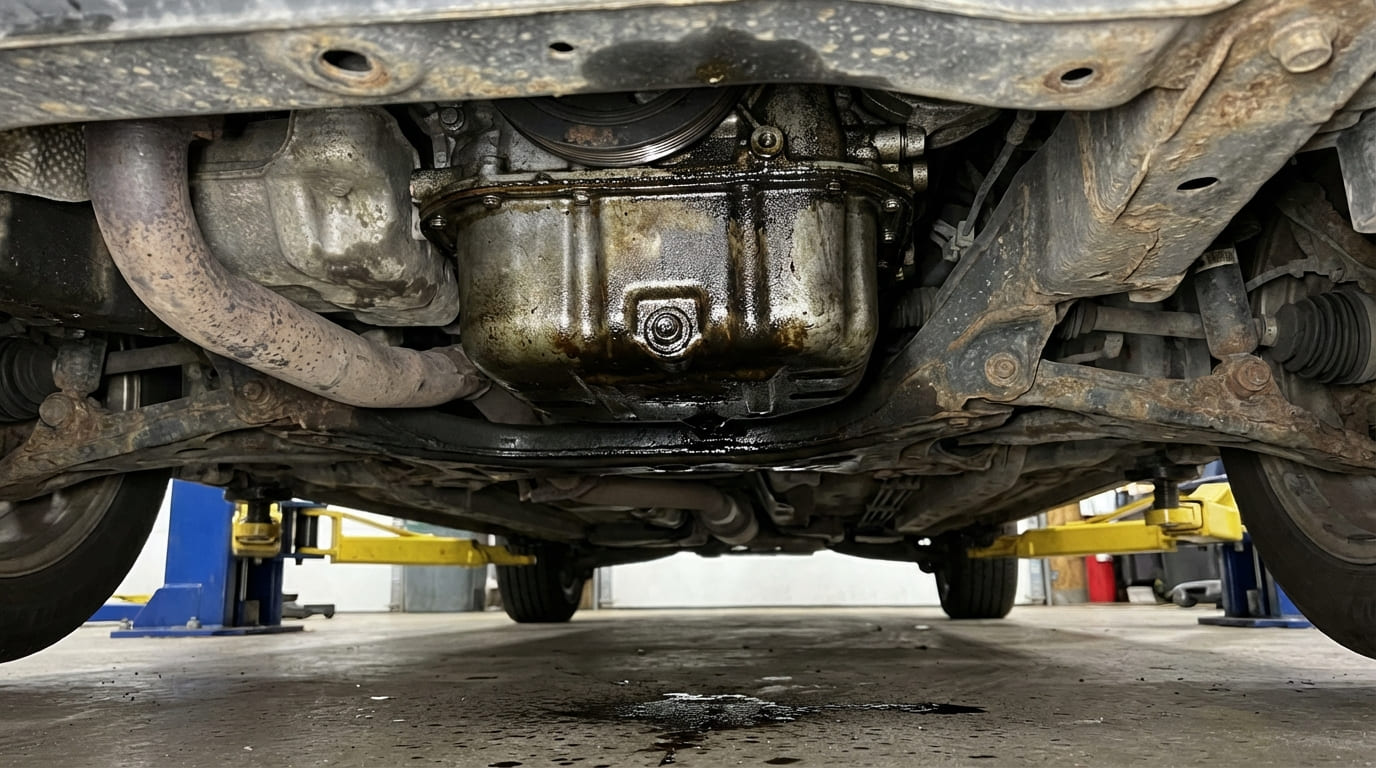
Situation: A high-mileage V8 had consistent oil on the garage floor under the dipstick tube. Owner had replaced the valve cover gasket twice.
Initial Assumption: Bad gasket installation or warped valve cover.
Deep Dive: Leak-down test showed 28% leakage on two rear cylinders. Borescope revealed broken compression rings. Crankcase pressure was +3.0 inches H₂O at 2,500 RPM.
Nuanced Lesson Learned: External leaks aren’t always gasket-related. Internal engine wear can create pressure that overwhelms even perfect seals. Diagnose systemically.
Situation: A 2012 sedan had oil in the intake plenum and a check engine light for catalyst efficiency.
Initial Assumption: Failed PCV system.
Discovery: PCV system was clean. Crankcase pressure was normal. Borescope showed oil on intake valve stems. Valve stem seals were hardened and cracked.
Nuanced Lesson Learned: Oil in the intake doesn’t always come from pressure. Vacuum pulling oil past worn seals can be silent and slow—but just as damaging over time.
In my shop, I’ve learned that oil where it shouldn’t be is rarely about a single failed part. It’s about system dynamics—pressure, flow, vacuum, and wear. The best approach is methodical: measure first, inspect thoroughly, and consider all pathways. And above all, refer to the specific service manual for tolerances and procedures—because while patterns exist, every engine has its own story.