After 20 years in the shop, I’ve seen ignition coils fail in every way imaginable—some sudden, some slow. But before you start swapping parts, you need to know exactly what the coil does, how it fails, and how to confirm it’s the real culprit. This guide cuts through the noise with actionable diagnostics, real-world costs, and the kind of insight only comes from turning wrenches under pressure.
What the Ignition Coil Actually Does
The ignition coil’s job is simple: convert the battery’s 12–14 volts into 20,000–50,000 volts needed to fire the spark plug. Without that high-voltage surge, the air-fuel mixture won’t ignite under cylinder pressure. No spark means misfires, poor fuel economy, and eventually, a disabled engine.
Modern engines rely on precise spark timing and intensity. A weak or erratic spark doesn’t always kill the engine, but it hurts performance, increases emissions, and can fool you into chasing other problems.
How to Diagnose a Failing Ignition Coil
Don’t guess—test. Here’s how I approach every ignition issue in the shop:
Step-by-Step Diagnostic Process
- Scan for codes: Pull trouble codes with an OBD2 scanner. P030X (cylinder-specific misfire) or P035X (ignition coil circuit) are red flags, but not proof.
- Inspect spark plugs: Remove and examine the plug from the misfiring cylinder. A wide gap, carbon fouling, or oil contamination can mimic coil failure. Replace if worn—NGK or Denso plugs cost $5–$15 each.
- Swap test (COP systems): If you have coil-on-plug, swap the suspect coil with a known good one. If the misfire moves, the coil is bad. If not, look elsewhere—like fuel or compression.
- Check for spark: Use a spark tester (not a screwdriver to ground). Connect it between the coil and spark plug wire or boot. Crank the engine. No spark? The coil or its circuit is suspect.
- Test resistance: Use a multimeter. Check primary (coil + to –) and secondary (coil + to output tower) resistance. Compare to factory specs—don’t rely on generic ranges. But remember: a coil can pass resistance tests and still fail under load.
- Check power and ground: At the coil connector, verify 12V on the power wire with key on. Ground should be less than 0.2 ohms to chassis. Low voltage or poor ground kills spark.
- Scope the primary circuit (advanced): If available, connect an oscilloscope to the coil’s control wire. A clean square wave means the PCM is switching properly. Distortion or missing signal points to wiring, connector, or PCM issues.
When to Suspect Heat-Related Failure
Coils often fail when hot. If the engine runs fine cold but misfires or stalls after 20 minutes, suspect thermal breakdown. Let it cool—does it restart? This is common on COP systems near exhaust manifolds.
In my shop, we simulate heat soak by running the engine until the misfire appears, then immediately test spark output. If it fails hot but works cold, the coil is done—even if it tests fine on the bench.
Ignition Coil Types and Real-World Failure Patterns
Know your system. The type affects how you diagnose and what you’re likely to see.
| Coil Type | Common Failure Signs | Diagnosis Tips | Avg. Replacement Cost (Part Only) |
|---|---|---|---|
| Distributor Coil | Engine won’t start, intermittent misfire, carbon tracking in cap | Check rotor, cap, and wires first. Many “bad coils” are just worn distributor parts. | $40–$80 |
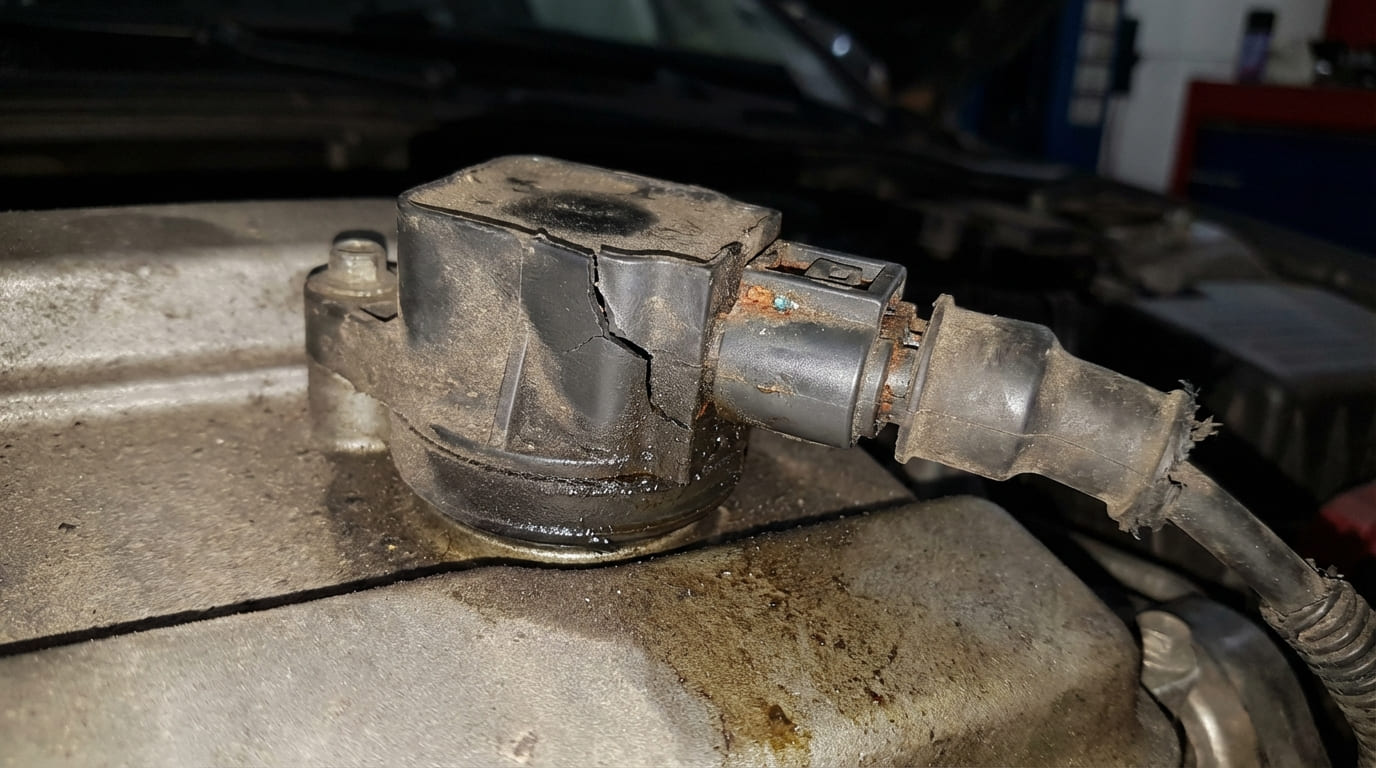
| Coil-on-Plug (COP) | Cylinder-specific misfire, rough idle, heat-related stalling | Swap test is gold standard. Inspect boot for cracks or carbon tracking. | $60–$120 per coil |
| Waste Spark (CNP) | Misfire on paired cylinders (e.g., 1 and 4), no spark on two plugs | Test both plugs in the pair. A bad coil kills two cylinders at once. | $70–$130 |
I once spent an hour chasing a P0302 on a Honda—replaced the coil, then the plug. Misfire came back. Swapped the coil to cylinder 4—misfire followed. But the new coil was bad out of the box. Lesson: aftermarket coils vary wildly in quality. For high-heat locations, I stick to OEM or OE-equivalent (Denso, Bosch, ACDelco).
Repair vs Replace: What Makes Sense?
Ignition coils are rarely repairable. Internal windings and electronics can’t be fixed. Replacement is the only real option.
Costs vary by vehicle. Luxury and performance models often have expensive coils—$150+ each. But on most domestic and Asian vehicles, you’ll pay $60–$100 per coil.
When to Replace Multiple Coils
If one coil fails on a high-mileage engine (100k+ miles), the others are likely near the end. I recommend replacing all COP coils in sets of 4 or 6 if labor is intensive (e.g., under intake manifolds). Prevents repeat visits.
But if the engine is low-mileage and only one fails? Replace just the bad one—after confirming it’s actually the problem.
A Ford F-150 came in with a P0355. Tech replaced the coil—misfire returned. I checked system voltage and found 11.8V at idle. New alternator fixed it. Moral: low voltage starves coils of power. Always verify charging system health before blaming ignition parts.
Common Mistakes to Avoid
- Assuming the code tells the whole story: P0351 says “Coil A circuit,” but it could be a broken wire, bad connector, or failed PCM driver—not the coil.
- Skipping spark plug inspection: Worn or gapped-too-wide plugs overwork the coil. Replace plugs every 30k–100k miles depending on type.
- Reusing damaged coil boots: Cracked or carbon-tracked rubber boots cause misfires. Replace or clean with dielectric grease.
- Over-tightening mounting bolts: COP bolts often go into aluminum. Overtightening strips threads. Use a torque wrench—typically 6–10 ft-lbs.
- Testing spark by grounding to block: This can send voltage spikes back through the system and damage the PCM. Use a proper spark tester.
Final Tips from the Bench
Ignition problems are among the most misdiagnosed issues I see. Don’t rush to replace parts. Follow a system: inspect, test, verify.
Always check the simple stuff first—plugs, connectors, power, ground. A $20 spark plug can save you a $100 coil.
And when in doubt, swap it. The swap test is the fastest, cheapest way to confirm a bad coil on modern engines.
On a Toyota Camry with a recurring P0304, the owner replaced the coil twice. I scoped the primary signal and saw a jagged, inconsistent waveform. Traced it to a chafed wire near the valve cover. The PCM thought the coil was failing—it was actually getting interrupted signals. Fix: repair the harness. Lesson: diagnose the circuit, not the code.