In my two decades as a master technician and shop foreman, one of the most frequent questions I hear—from both junior mechanics and seasoned DIYers—is whether an engine’s oil consumption is “normal.” The answer, more often than not, isn’t straightforward. While some online forums claim any oil use is a sign of failure, real-world experience tells a different story. Modern engines are engineered with tight tolerances and efficiency in mind, and a small amount of oil consumption can be part of normal operation. Let’s break this down with practical diagnostics, cost-aware decisions, and real-world context.
What Is Normal Oil Consumption?
The rule of thumb I use daily: up to one quart (0.946 liters) every 3,000 miles (4,800 km) is generally acceptable for most modern gasoline engines. This is a safe benchmark for naturally aspirated and many turbocharged engines under normal driving conditions.
However, some manufacturers—especially with high-performance or turbocharged engines like GM Ecotec, Ford EcoBoost, or BMW N54—explicitly allow up to one quart per 1,000 miles (1,600 km) in service documentation. That may sound excessive, but it reflects design trade-offs for performance and efficiency. Always consult the OEM service manual before making a call.
How to Check Oil Consumption Accurately
Guessing based on oil change intervals leads to false diagnoses. Follow this precise method I use in my shop to get reliable data.
- Drain and refill with the OEM-specified oil and volume. Use a new or known-good oil filter.
- Run the engine until it reaches full operating temperature (85–105°C coolant temp).
- Shut off and wait 5–10 minutes for oil to settle in the pan.
- Drive under normal conditions for 1,000 to 3,000 miles. Avoid extreme towing or track use unless that’s your typical driving.
- Repeat the warm-up and dipstick check. Add oil precisely to return to “FULL.” Record total added volume.
- Calculate: (mL added) ÷ (miles driven) = mL/mile. Example: 250 mL over 2,000 miles = 0.125 mL/mile.
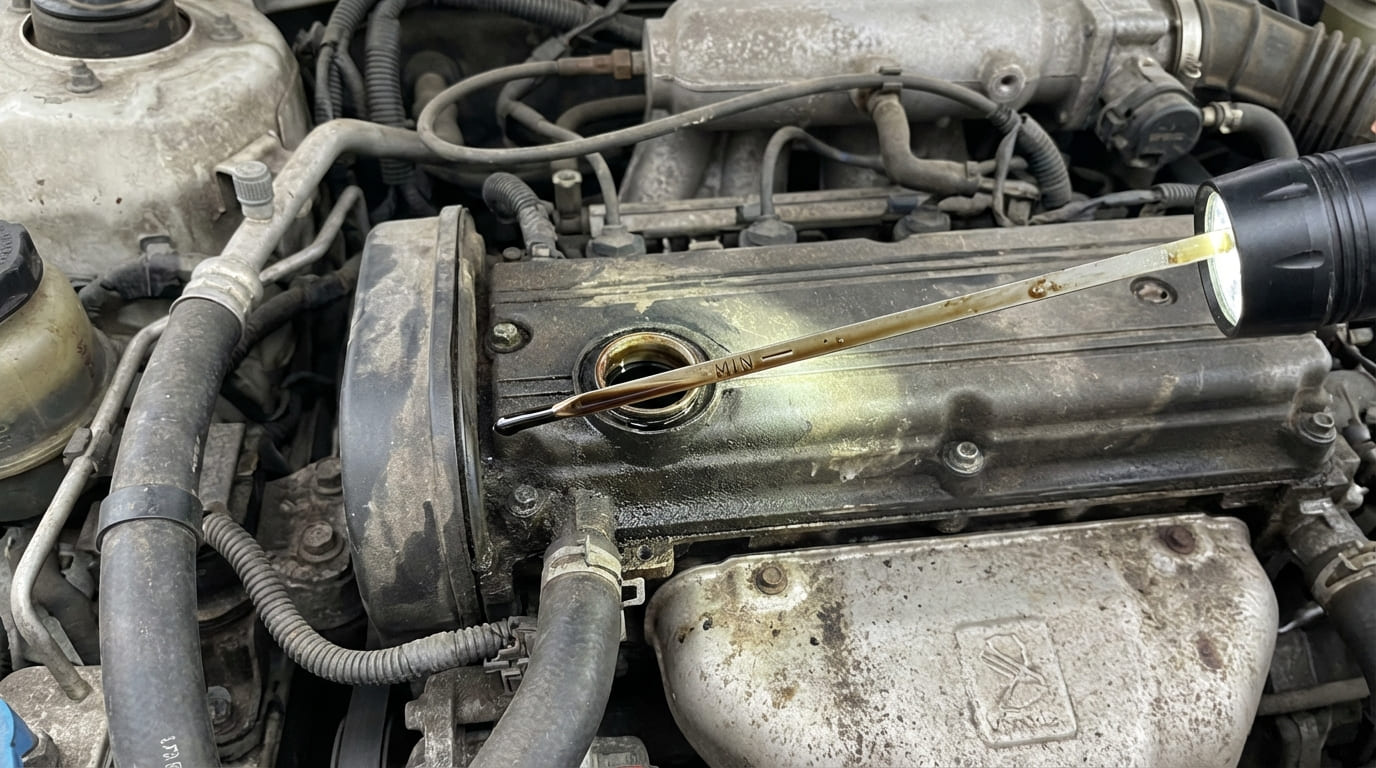
Check the dipstick. Add or remove oil in 50 mL increments to hit exactly “FULL.” Record the initial odometer reading.
I recommend repeating the test over a second interval. If results vary by more than 10%, recheck for leaks, oil type changes, or inconsistent driving. Consistency confirms a real issue.
Key Factors That Affect Oil Consumption
Before assuming mechanical failure, consider these real-world variables that influence oil burn.
Engine Design and Wear
- Piston Rings: Low-tension rings in modern engines improve fuel economy but allow slight oil passage, especially during warm-up or high-RPM use.
- Valve Guides and Seals: Even within spec, guides allow a thin oil film. Worn or hardened seals can increase seepage, often visible as blue smoke on cold start.
- PCV System: A clogged or failed PCV valve increases crankcase pressure, forcing oil into the intake. This mimics internal engine wear.
Driving Conditions
- High RPM or Heavy Load: Towing, aggressive acceleration, or sustained highway speeds increase oil splash and combustion chamber heat, raising temporary consumption.
- Frequent Short Trips: Engines that don’t reach full temp accumulate moisture and fuel dilution, thinning oil and increasing burn-off until contaminants clear.
Oil Type and Viscosity
- Low-Viscosity Oils (e.g., 0W-20): More prone to volatilization in high-heat areas like the valve train. Slight increase in consumption is common.
- Full Synthetic: Lower NOACK volatility than conventional oils, meaning less burn-off. I recommend it for high-mileage or performance engines.
- API SP or ILSAC GF-6: Newer specs include stricter volatility limits. Upgrading can reduce consumption in borderline cases.
When to Worry: Red Flags for Excessive Consumption
Consumption over one quart per 1,000 miles in a non-turbo, non-performance engine is a red flag. A sudden increase—even if below OEM limits—warrants investigation.
- Consistent use of >1 qt/1,000 miles in a naturally aspirated engine suggests developing wear.
- Any blue smoke under acceleration points to piston ring or turbo seal issues.
- Blue smoke on cold start or deceleration often means worn valve stem seals.
First Diagnostic Steps (Before Major Repairs)
Don’t jump to ring replacement. Rule out simpler, cheaper causes first.
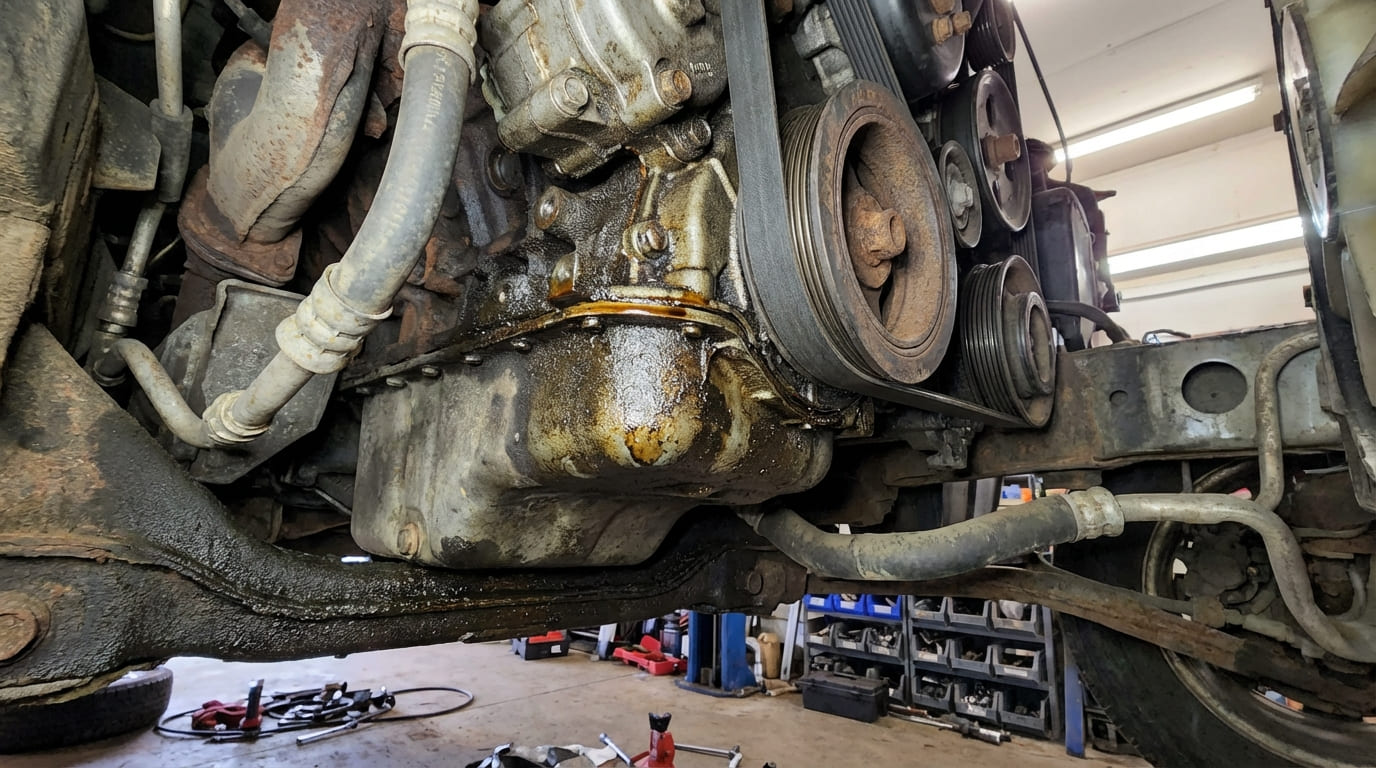
- Check for External Leaks: Inspect oil pan, valve covers, front/rear main seals, turbo oil lines, and filter housing. Use UV dye and blacklight for hidden leaks.
- Test the PCV System: Shake the PCV valve—it should rattle. Check hoses for cracks or collapse. At idle, crankcase vacuum should be 0.5–2.0 inches of water (12.7–50.8 mm H₂O).
- Verify Oil Level Reading: Clean the dipstick, recheck multiple times. Misreading is a top cause of false alarms.
Common Causes of Excessive Oil Consumption
Once leaks and PCV issues are ruled out, internal sources become likely.
- Worn Piston Rings: Allows oil into combustion chamber. Check with compression and leak-down tests. Ring groove carbon or cylinder wall glazing can prevent proper sealing.
- Valve Stem Seals: Hardened or cracked seals drip oil down stems when engine is off. Borescope inspection can confirm.
- Turbocharger Seals: Failed shaft seals leak oil into intake or exhaust. Check intercooler piping and turbo housing for oil residue.
- Block Porosity: Rare but possible in older cast iron or aluminum blocks. Pressure test oil system with cooling system open—bubbles in coolant indicate porosity.
Diagnostic Decision Tree
| Symptom / Observation | Possible Causes (Ranked by Likelihood) | Recommended Next Steps |
|---|---|---|
| Oil level drops, no visible leaks, no smoke | Normal consumption (especially turbo/high-performance), minor internal seepage | Perform accurate consumption test; verify oil type and driving conditions |
| Blue-tinted smoke on cold start or deceleration | Valve stem seal wear, guide wear, PCV over-ventilation | Inspect PCV system; consider borescope inspection of combustion chambers |
| Blue smoke under acceleration | Piston ring wear, cylinder wear, turbo seal failure | Perform compression and leak-down test; inspect turbo inlet for oil |
| Oil consumption + coolant loss, no mixing | Possible block porosity, head gasket bypass (not full failure) | Pressure test cooling system and oil system separately; check for bubbles in coolant |
| Sudden increase in consumption | PCV failure, internal leak (gasket, seal), oil contamination (fuel, coolant) | Inspect for recent repairs, fuel dilution (smell, viscosity), coolant in oil |
Repair vs Replace: Cost and Viability
Internal engine repairs are expensive. Here’s how I evaluate options:
| Issue | Typical Repair Cost (USD) | Repair vs Replace Logic |
|---|---|---|
| PCV Valve Replacement | $20–$100 | Always fix first. A $20 part can resolve symptoms of a failing engine. |
| Valve Stem Seal Replacement | $600–$1,200 | Viable if cylinders are in good condition. Often done without full engine teardown. |
| Piston Ring Replacement | $2,000–$4,500 | Only if cylinder walls are salvageable. Worn bores require boring/honing—adds cost. |
| Engine Replacement (Remanufactured) | $3,000–$6,000 | Often more cost-effective than major rebuilds, especially on high-mileage vehicles. |
Best Practices: Do and Avoid
- ✅ Use OEM-specified oil: Viscosity and API category matter. Deviating can increase consumption and void warranty.
- ✅ Test consumption over consistent driving: Real-world data beats speculation. Repeat the test for accuracy.
- ✅ Clean dipstick and recheck: Misreading is the most common false alarm.
- ⚠️ Don’t assume all oil burn is mechanical failure: Modern engines vary. Turbo engines may consume more by design.
- ⚠️ Don’t replace rings without checking cylinder walls: A fresh ring set won’t seal on a worn or glazed bore.
- ⚠️ Don’t ignore the PCV system: A $20 valve can mimic a $2,000 engine rebuild.
Situation: A 2016 Subaru WRX owner brought in the car with a complaint of using a quart every 1,500 miles. No smoke, no leaks. Initial assumption was turbo seal failure.
Discovery: After checking the intercooler and intake—clean—we ran a consumption test. It confirmed the rate. But a borescope revealed minimal carbon on the pistons. Leak-down test showed all cylinders within 8%. Then we checked the PCV system: the valve was gummed up, and the hose to the intake was collapsing under vacuum.
Nuanced Lesson Learned: Even in a turbocharged engine, don’t assume internal wear is the culprit. A restricted PCV system can increase crankcase pressure enough to force oil past seals without classic symptoms.
Situation: A 2010 Toyota Camry 4-cylinder was burning a quart every 2,000 miles. Owner insisted it was “too much.” No smoke, no leaks.
Discovery: We verified the consumption was real. Compression and leak-down were excellent. Borescope showed clean chambers. Then we switched from 0W-20 to 5W-30 synthetic. Over the next 3,000 miles, consumption dropped to negligible levels.
Nuanced Lesson Learned: Oil formulation and viscosity can significantly affect consumption, especially in high-mileage engines where clearances are slightly increased. Not every oil burn is mechanical failure.
Situation: A 150,000-mile Ford 4.6L V8 was using a quart every 1,000 miles. Mechanic had already replaced valve covers and rear main seal—no change.
Discovery: Leak-down test showed 18% on cylinder #5, mostly to the crankcase. Bore inspection revealed vertical scoring and ring land wear. Customer had a history of occasional overheating.
Nuanced Lesson Learned: Chronic mild overheating can degrade ring tension over time without causing a head gasket failure. Ring seal loss isn’t always due to mileage alone—thermal history matters.