In my two decades turning wrenches in independent shops and dealerships, I’ve seen engines fail not from catastrophic breakdowns, but from something as simple as a neglected air filter. Airflow is critical to combustion. When it’s restricted, the engine reacts—sometimes subtly, sometimes severely. Here’s exactly what to look for, how to diagnose it, and when to act.
Reduced Engine Performance
When airflow is choked, power drops. On most naturally aspirated engines, a clogged filter can cost 5–10% of horsepower. The engine can’t burn fuel efficiently without sufficient air. Even with a perfect fuel system, the ECM may reduce fuel delivery to avoid a rich condition, worsening the power loss.
Drivers notice it as sluggish acceleration or a lack of punch during highway merging. If a customer says, “It just doesn’t feel right,” check the air filter before diving into sensors or fuel systems.
How to Check for Power Loss Due to Air Restriction
- Compare 0–60 mph times before and after filter replacement (if drivetrain is consistent).
- Use a scan tool to monitor MAF (Mass Air Flow) readings at idle and wide-open throttle. Compare to manufacturer specs. Low readings suggest restriction.
- Inspect intake vacuum at idle. A rise of more than 1–2 inHg over baseline can indicate filter blockage.
In my shop, we always check the air filter before replacing coils or injectors. More than once, a $20 filter fixed a “misfire” that had already cost the customer $300 in unnecessary parts.
Sluggish Throttle Response and Hesitation
A dirty filter delays airflow during rapid acceleration. The engine can’t “gulp” air fast enough, causing hesitation. This is most noticeable in stop-and-go traffic or when passing.
Technicians often misdiagnose this as a throttle position sensor or fuel delivery issue. But if the filter is packed with fine dust—especially in rural or construction zones—it can restrict airflow severely.
How to Diagnose Throttle Lag from Air Restriction
- Perform a snap-throttle test: Rev the engine quickly from idle to 3,000 RPM. A healthy engine should respond instantly. Delayed rise in RPM suggests airflow issues.
- Monitor MAF g/s (grams per second) during the test. If it lags or peaks low, check the filter and intake path.
- Remove the air filter temporarily (for test only) and repeat. If response improves, replace the filter.
Engine Misfires and Rough Idling
A severely clogged filter can disrupt the air-fuel ratio. The MAF sensor reports low airflow, but the ECM may still inject fuel based on other inputs, creating a rich mixture. This can lead to misfires, especially under load.
Codes like P0300 (random misfire) or P0301 (cylinder 1 misfire) may appear. Don’t jump to replace coils or injectors—first rule out airflow issues.
How to Diagnose Misfires Linked to Air Filter
- Check long-term fuel trims (LTFT). Sustained negative trims (below -10%) suggest the ECM is removing fuel due to perceived richness—often from low airflow.
- Inspect live MAF data. If readings are abnormally low at idle (e.g., under 2.0 g/s on a 2.5L engine), suspect restriction.
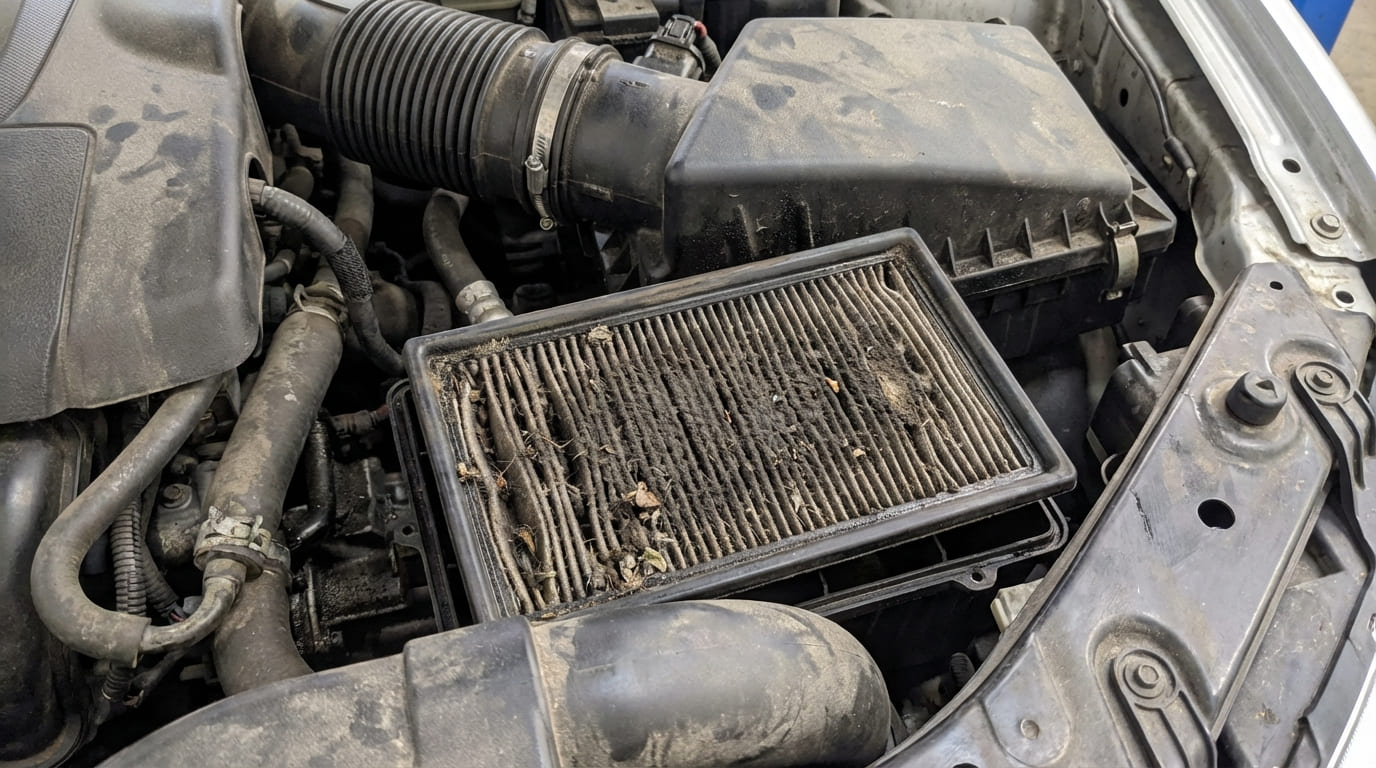
- Remove the filter and inspect for blockage. Even if it looks okay, hold it to a bright light. If light doesn’t pass through the pleats, replace it.
Decreased Fuel Economy
A dirty filter can reduce fuel economy by 1–3 mpg, more in city driving. The ECM enriches the mixture during acceleration or warm-up to compensate for low airflow, burning extra fuel.
Customers often blame fuel quality or tire pressure. While those matter, a clogged filter is an often-overlooked contributor.
How to Confirm Fuel Economy Drop from Air Filter
- Track fuel economy over 3–5 fill-ups before and after replacement.
- Ensure driving habits, routes, and tire pressure are consistent.
- Check for stored codes like P0172 (System Too Rich), which can stem from airflow issues.
I had a customer swear their mileage dropped after an oil change. The tech had forgotten to reinstall the air filter. Once it was replaced, fuel economy returned to normal. Always verify the filter is in place and seated correctly.
Check Engine Light (CEL) and Diagnostic Trouble Codes
A dirty filter alone rarely triggers the CEL, but it can cause conditions that do. Common codes include:
- P0172 / P0175 (System Too Rich)
- P0101 (MAF Circuit Range/Performance)
These often appear when the MAF sensor reports low airflow, but fuel trims go negative—the ECM is correcting for what it thinks is a rich condition.
How to Diagnose CEL Caused by Air Filter
- Read live data: Check MAF g/s, LTFT, and STFT. Low MAF + negative trims = likely airflow restriction.
- Inspect the air filter and intake housing for debris, cracks, or bypass.
- Do not replace the MAF sensor first. Clean it only if necessary, but always inspect the filter first.
| Symptom | Most Likely Causes | Less Common But Possible | Diagnostic Priority |
|---|---|---|---|
| Reduced power | Dirty air filter, intake restriction | Fuel pump weakness, clogged catalytic converter | High – inspect filter first |
| P0172 / P0175 | MAF contamination, vacuum leak, dirty filter | Fuel pressure regulator failure, leaking injectors | Medium – check airflow and trims |
| Rough idle | Ignition issues, vacuum leaks | Severe air restriction, EGR malfunction | Low – filter is rarely sole cause |
Visible Contamination and Physical Inspection
This is the fastest diagnostic step. Remove the air filter housing—takes less than 5 minutes. Inspect the filter:
- If you can’t see light through the pleats, replace it.
- Look for oil saturation (common in aftermarket oiled filters), which traps debris faster.
- Check the housing for leaves, insects, or plastic bags—especially on trucks and SUVs.
- Inspect seals and clamps. Cracked housing or loose clamps allow unfiltered air bypass.
In dusty environments, I recommend checking the filter every 10,000 miles. I’ve seen filters clog in half the normal interval on rural routes. Prevention is cheaper than engine repairs.
Unusual Intake Noises
A whistling or hissing sound from the intake can occur with extreme restriction. The engine is “sucking hard” through a blocked filter, creating turbulence.
How to Diagnose Intake Noise from Filter
- With the engine running, remove the air filter temporarily (do not drive).
- If the noise drops or disappears, the restriction was the cause.
- Inspect for debris, housing cracks, or improper filter fit.
Long-Term Consequences of a Dirty Air Filter
Neglecting the filter doesn’t just hurt performance—it risks engine damage.
When a filter is too clogged, the engine may draw air around it through gaps, pulling in unfiltered, dirty air. This leads to:
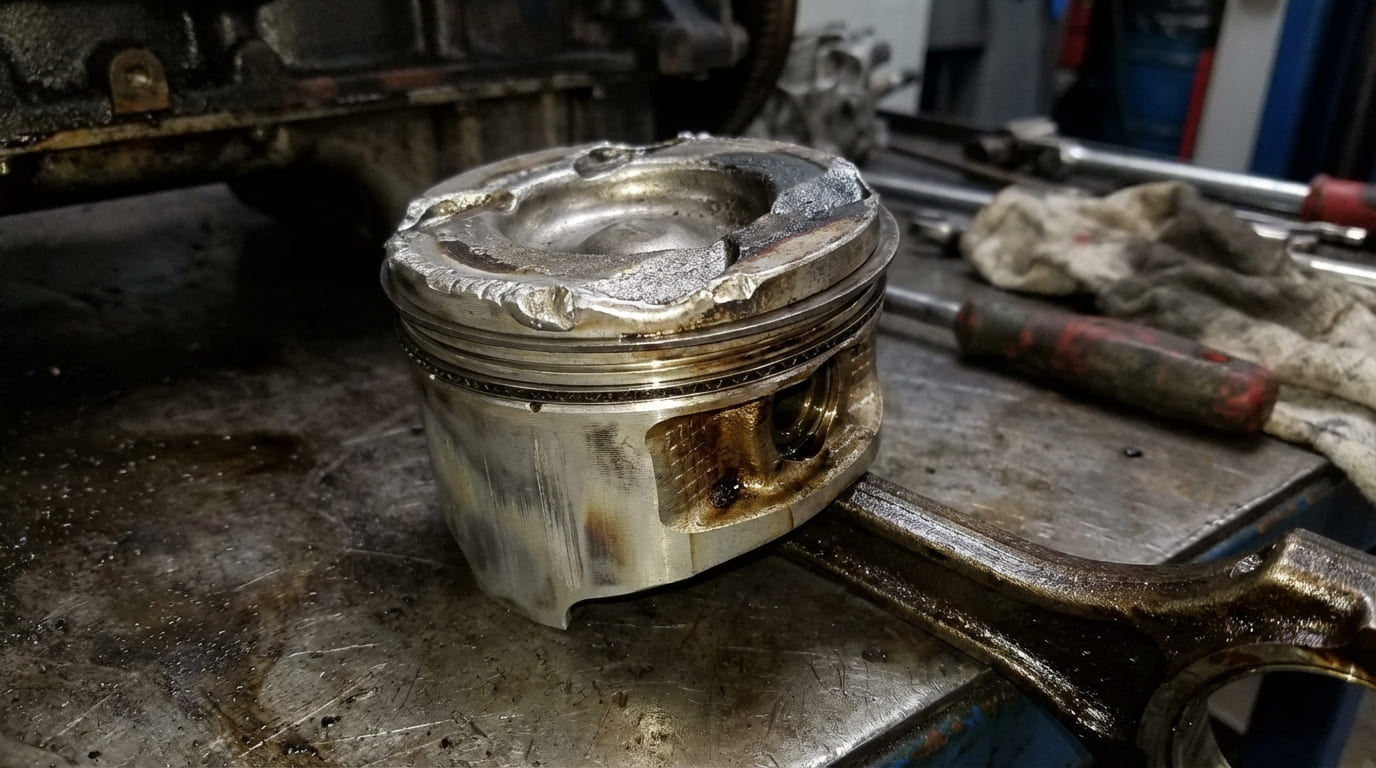
- Accelerated cylinder wall wear from abrasive particles.
- Premature MAF sensor failure—dust can coat or damage the hot-wire element.
- Catalytic converter overheating from persistent rich conditions, leading to meltdown.
Oil analysis showing elevated silicon levels is a red flag for dirt ingestion. Bore scope inspections can reveal cylinder scoring—often preventable with proper filtration.
Situation: A 2014 Toyota Camry with P0172 and poor fuel economy. Previous shop replaced the MAF sensor—code returned. Discovery: Filter looked okay, but held to light, barely any light passed through. MAF readings were low, LTFT was -14%. Fix: New filter cleared the code and restored fuel economy. Lesson: Visual “dirtiness” isn’t enough—use light test and live data.
Situation: Ford F-150 with rough idle and misfires. Coils and plugs replaced—no fix. Discovery: Bird’s nest completely blocked the filter. Engine was pulling air through a housing gap, causing turbulence and unfiltered intake. Fix: Removed debris, replaced filter and seal. Lesson: Inspect the entire intake tract, not just the filter.
Situation: Customer claimed performance air filter improved power. Dyno test showed a slight torque loss. Discovery: After 5,000 miles, the oiled filter clogged faster than OEM, causing erratic MAF readings. Lesson: Higher airflow isn’t better if filtration suffers. Some aftermarket filters need more frequent cleaning.
Maintenance and Prevention
Prevention is simple, cheap, and effective.
Best Practices: Do and Don’t
- ✅ Do: Inspect the filter at every oil change. It takes 5 minutes and prevents big problems.
- ✅ Do: Use OEM-spec or high-efficiency aftermarket filters. Avoid cheap “performance” filters that sacrifice filtration.
- ✅ Do: Check housing seals and clamps. A perfect filter won’t help if air bypasses it.
- ⚠️ Don’t: Clean pleated paper filters with compressed air—it damages the media.
- ⚠️ Don’t: Assume a clean-looking filter is good. Some contaminants aren’t visible.
- ⚠️ Don’t: Skip MAF readings before and after replacement. Confirm the fix with data.
Replace the filter every 30,000 to 45,000 miles under normal conditions. In dusty areas, replace every 15,000–20,000 miles.
Torque air box screws snugly by hand—about a quarter-turn past finger tight. Overtightening cracks plastic housings; undertightening causes air leaks.
The air filter is one of the cheapest parts on your engine—but one of the most important. Check it early, check it often, and avoid preventable damage.