In my two decades as a working mechanic, I’ve seen countless engines come in with misfires, hard starts, or rich-running conditions—all pointing to fuel system issues. One part that often gets misdiagnosed early is the fuel pressure regulator (FPR). When it fails, it mimics other problems. Here’s how to spot a bad FPR, test it properly, and avoid costly mistakes.
Key Symptoms and How to Diagnose Them
These are the most common signs of a failing fuel pressure regulator. But each overlaps with other issues, so testing is essential.
Engine Cranks But Won’t Start
This can happen if fuel pressure bleeds off after shutdown. A ruptured diaphragm or failed check mechanism in the FPR may allow fuel to return to the tank or enter the intake. Most common on older return-style fuel systems with vacuum-referenced regulators.
How to Check: Use a fuel pressure gauge. Prime the system (turn key to ON, not start), then turn off. Watch pressure for 10 minutes. If it drops more than 5–10%, there’s a leak. Isolate by pinching the return line—if pressure holds, the issue is likely the pump’s check valve or an injector, not the FPR.
Hard Starting After Sitting
If the engine cranks longer than usual after sitting, especially overnight, low residual fuel pressure could be the cause. A leaking FPR diaphragm may let fuel drain back or seep into the intake.
How to Check: Confirm cranking voltage is good (10V minimum). Weak batteries mimic hard starting. Then perform a leak-down test with a gauge. If pressure builds fast but drops quickly, suspect FPR, pump, or injectors.
Engine Misfires or Rough Idle
Too much or too little fuel pressure causes misfires. High pressure over-fuels; low pressure leans the mixture. A stuck FPR can cause consistent misfires across cylinders.
How to Check: Don’t assume fuel. First, rule out spark and vacuum leaks. Check live fuel trims with a scan tool. If long-term fuel trim (LTFT) is below -15%, the engine is compensating for richness—possibly from a failed FPR. Confirm with a mechanical fuel pressure gauge.
Reduced Engine Performance
Hesitation under acceleration or lack of power may stem from inadequate fuel delivery. If the FPR can’t maintain pressure during load, the engine runs lean when it needs more fuel. Conversely, a stuck-open regulator causes a rich condition and poor combustion.
How to Check: Test fuel pressure at idle and under load (2500–3000 RPM). Pressure should stay steady or rise slightly. If it drops, test fuel flow volume. A weak pump often looks like a bad regulator.
Black Smoke or Strong Fuel Smell
Thick black exhaust smoke or raw fuel odor indicates over-fueling. A failed FPR allowing excessive pressure can cause this. Fuel in the vacuum line is a telltale sign.
How to Check: Remove the vacuum hose from the FPR (engine off). Smell it. If it’s wet with fuel, the diaphragm is ruptured. Replace the regulator. But also check for stuck injectors or faulty sensors (like coolant temp) before condemning the FPR.
Fuel Odor in Vacuum Lines or Engine Bay
Fuel in the vacuum line leading to the FPR is a strong indicator of a ruptured diaphragm. The fuel gets pulled into the intake, causing rich running and poor fuel economy.
How to Check: Inspect the vacuum line at idle and after shutdown. Look for fuel residue. Not all vehicles have vacuum-referenced FPRs—returnless and direct-injection systems use electronic regulation. Confirm your system type first.
Fuel in Engine Oil
Fuel dilution in the oil is serious. A severely ruptured FPR diaphragm can allow fuel to enter the intake via vacuum, then pass into the crankcase through the PCV system. Oil level may rise, and the smell is unmistakable.
How to Check: Check oil level and odor. If fuel is present, pull spark plugs and inspect for wetness. Perform a compression test to rule out leaking injectors, which are a more common cause. Oil analysis confirms dilution but isn’t DIY-friendly. Replace oil immediately if fuel is found.
Check Engine Light and Diagnostic Trouble Codes
Codes like P0172 (system too rich) or P0087 (fuel rail pressure too low) may point to FPR issues—but not directly.
How to Check: Use a scan tool to view live data: fuel rail pressure, fuel trims, and sensor voltages. Compare actual fuel pressure (from a mechanical gauge) to the FRP sensor reading. If they don’t match, the sensor or wiring may be faulty. LTFT consistently below -15% suggests richness from a mechanical source like a failed FPR.
How to Tell FPR Issues from Other Problems
Fuel system symptoms overlap. Use this guide to differentiate.
| Symptom | Possible Cause | Likelihood | How to Differentiate |
|---|---|---|---|
| Hard Starting | FPR leak-down | Moderate | Check residual pressure; inspect vacuum line for fuel |
| Hard Starting | Fuel pump check valve failure | High | Same leak-down test; pressure loss identical. Pinch return line—if pressure holds, pump is faulty |
| Rich Condition | FPR diaphragm rupture | Moderate | Check vacuum line for fuel; verify fuel trims and actual pressure |
| Rich Condition | Faulty coolant temp sensor | High | Scan tool: ECT should rise steadily. Cold reading when engine is warm = faulty sensor |
| Low Fuel Pressure | Clogged fuel filter | High on older vehicles | Test pressure before and after filter; check flow volume (1 pint in 15 sec minimum) |
| Low Fuel Pressure | FPR stuck open | Low | Rare. Usually causes high pressure. Confirm with gauge and vacuum test |
Proven Diagnostic Procedures
Guessing leads to wasted parts. These tests deliver real answers.
Fuel Pressure and Leak-Down Test
Connect a mechanical gauge to the fuel rail’s Schrader valve. Turn the key to ON (don’t start) to prime. Note pressure—compare to factory spec (typically 35–65 PSI). Turn key off. Watch for 10–15 minutes. More than 5–10% drop means a leak. To isolate, pinch return line or command injector shutoff via scan tool.
Vacuum Response Test (Vacuum-Referenced FPRs Only)
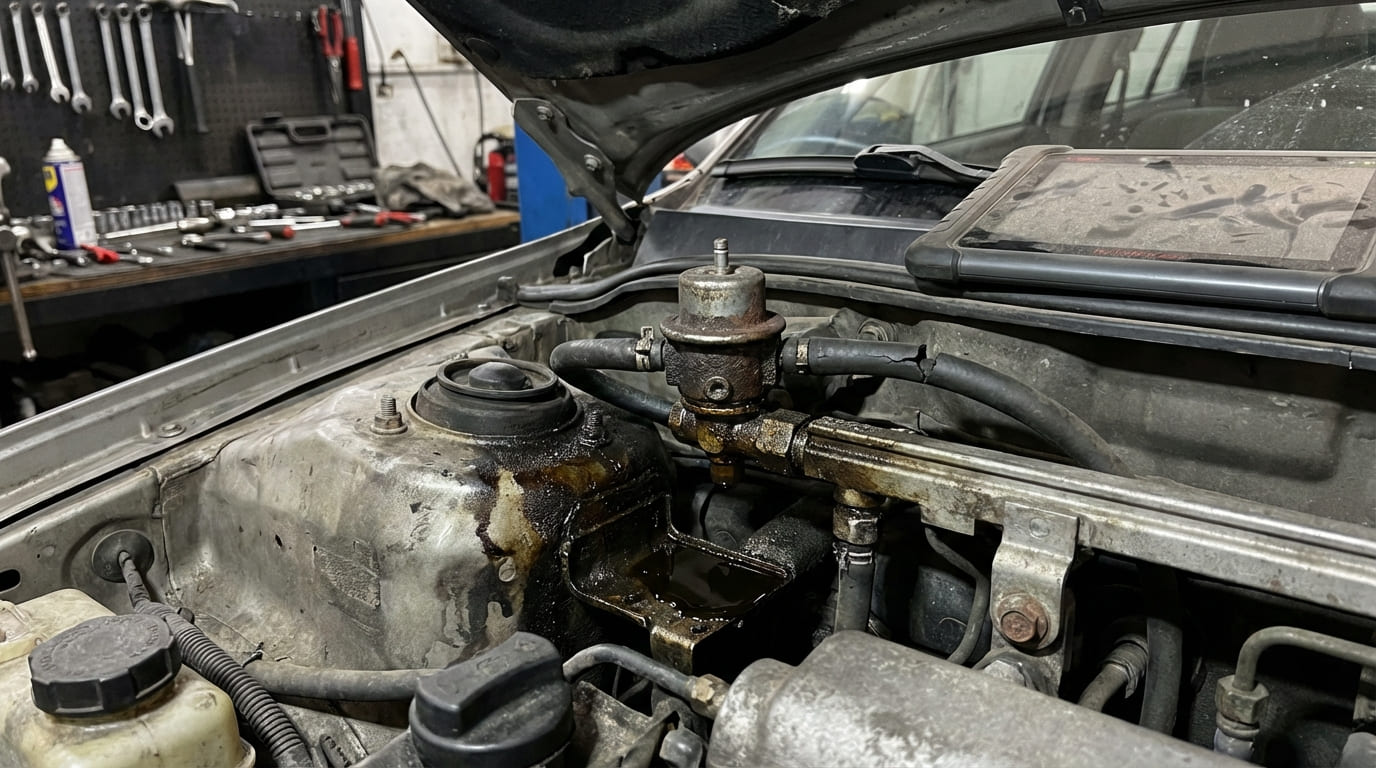
With engine idling, remove the vacuum hose from the FPR. Fuel pressure should rise 5–10 PSI. Reconnect—pressure should drop. No change? Regulator isn’t working. Fuel in the line? Diaphragm is ruptured. Replace—no repair possible.
Scan Tool and Sensor Verification
Compare the fuel rail pressure (FRP) sensor reading to your mechanical gauge. Discrepancy means sensor or wiring issue. Watch fuel trims: LTFT below -15% indicates richness the PCM is correcting for—could be FPR, injectors, or sensor.
Costs, Repair vs. Replace, and Practical Tips
Replacing an FPR is usually cheaper than misdiagnosing it. But don’t skip testing.
| Part | Cost Range | Labor Time |
|---|---|---|
| Fuel Pressure Regulator | $30–$120 | 0.5–1.5 hours |
| Fuel Pump | $100–$300+ | 1–3 hours |
| Fuel Filter | $15–$50 | 0.5–1 hour |
Repair vs. Replace: FPRs are not repairable. If failed, replace. But always confirm the fault. A $100 regulator won’t fix a $250 fuel pump issue.
In my shop, we never replace a fuel pressure regulator without a leak-down test and vacuum line inspection. Even with textbook symptoms, we verify. I’ve saved customers hundreds by finding a cracked vacuum hose instead of blaming the regulator.
Always use a mechanical gauge. I’ve seen FRP sensors read 58 PSI when actual pressure was 42. The PCM was compensating, but the root cause was a clogged filter. Tools don’t lie—sensors do.
Real-World Cases That Changed My Approach
Situation: 2003 Ford Taurus with hard starting and black smoke. Codes: P0172, P0300.
Assumption: Bad FPR—classic signs.
Action: Replaced regulator. Problem returned in 48 hours.
Fix: Found a cracked vacuum hose. Engine wasn’t getting proper vacuum signal. New hose solved it.
Lesson: Even with fuel in the line, check the entire vacuum circuit. A $5 hose can mimic a failed $80 part.
Situation: 2010 Chevy Silverado with rough idle and fuel smell.
Assumption: Ruptured FPR diaphragm.
Action: No vacuum line—returnless system. Pressure stable. No fuel in lines.
Fix: Found leaking injector O-ring dripping into engine valley.
Lesson: Not all fuel smells mean FPR. Know your engine’s layout before tearing into parts.
Situation: 1998 Toyota Camry, hard start after sitting. Pressure dropped to zero in 3 minutes.
Assumption: Leaking FPR or injector.
Action: Isolated FPR—no leak. Pinched return line—pressure held.
Fix: Faulty fuel pump check valve. Pump wasn’t holding prime.
Lesson: The FPR shares the system’s fate. Isolate components before replacing parts.
Final Advice
The fuel pressure regulator isn’t a frequent failure point, but when it fails, it causes cascading issues. Don’t fear it—diagnose it. Use a gauge, a scan tool, and a systematic approach. Always check the cheapest, most common causes first. And remember: what’s normal for a Mustang isn’t normal for an Accord. Consult your vehicle’s service manual. Trust data over assumptions.