How to Diagnose Faulty Spark Plugs: Practical Steps That Work
When spark plugs fail, they disrupt combustion, leading to performance issues. But many problems mimic plug failure. As a master mechanic, I focus on diagnostics that isolate the true cause. Below are the real-world symptoms, how to check them, and what they actually mean.
Engine Misfire and Rough Operation
A misfiring engine is the most common sign of bad spark plugs. You’ll feel a shudder at idle, hesitation during acceleration, or a sudden loss of power. The check engine light often comes on with codes like P0300 (random misfire) or P030X (cylinder-specific misfire).
How to Check:
- Use an OBD2 scanner to read misfire counters in live data. If one cylinder consistently misfires, inspect that plug first.
- Remove the suspect spark plug and examine it. Look for fouling, excessive gap, or damaged electrodes.
- Test for spark using an in-line spark tester (e.g., Lisle 20700). A strong blue spark means ignition is working; if the engine still misfires, the issue may be fuel or compression.
- Perform a dry and wet compression test if the plug looks okay. Low compression that improves with oil suggests worn piston rings. No improvement points to valves or head gasket issues.
In my shop, we never replace a plug without checking why it failed. A fouled plug is a symptom—fixing it without diagnosis is just a temporary band-aid.
Reduced Performance and Poor Acceleration
If the car feels sluggish or hesitates under load, inefficient combustion could be the culprit. Spark plugs that fire weakly or intermittently cause partial burns, reducing power.
How to Check:
- Take the car for a road test. Note flat spots between 2,500 and 4,000 RPM.
- Use a scan tool to monitor throttle position (TPS), engine load, and ignition timing. If timing is pulled or fuel trims are high, combustion is likely unstable.
- Swap ignition coils between cylinders. If the performance issue moves, the coil—not the plug—is the problem.
Decreased Fuel Economy
Unburned fuel due to weak spark can reduce fuel efficiency by 10–15%. But don’t trust the trip computer—track actual MPG over 3–4 fill-ups for accuracy.
How to Check:
- Monitor fuel trims. Long-term trims above +8% suggest the engine is adding fuel to compensate for lean misfires—often from bad plugs.
- Check for carbon-fouled plugs, which indicate incomplete combustion.
- Rule out other causes: clogged air filter, dirty injectors, or oxygen sensor issues.
Hard Starting or No-Start
If the engine cranks but won’t start, spark plug condition matters—but only after ruling out basics.
How to Check:
- Verify battery health: cranking voltage must stay above 10.5V.
- Check fuel pressure with a gauge. No fuel pressure? Look at the pump and filter.
- Test for spark on two or more cylinders using an in-line tester.
- Remove 1–2 plugs. If they’re wet and oily, suspect oil fouling from valve seals or PCV failure. If wet with fuel, check for leaking injectors or flooding.
I once diagnosed a no-start that turned out to be a $12 PCV valve. The plugs were oil-fouled because crankcase pressure pushed oil into the combustion chamber. Replaced the valve, cleaned the intake, new plugs—and the car fired right up.
Engine Knocking or Pinging Under Load
Knocking can stem from spark plugs that run too hot or have carbon buildup creating hot spots. This is common in turbocharged or high-compression engines.
How to Check:
- Monitor knock sensor activity via scan tool. If the PCM is pulling timing, detonation is occurring.
- Inspect plugs for melted electrodes or blistered porcelain—signs of overheating.
- Verify you’re using the correct heat range plug. Too hot? It can cause pre-ignition. Too cold? It may foul.
- Check for root causes: low-octane fuel, EGR blockage, or cooling system issues.
Raw Fuel Smell from Exhaust
A strong gasoline odor indicates unburned fuel exiting the tailpipe—common with a dead cylinder due to a fouled or failed spark plug.
How to Check:
- Inspect the exhaust tip for black, sooty deposits.
- Use a 5-gas analyzer: high hydrocarbons (HC) with normal CO/CO2 suggest misfire. High CO as well? Then look at fuel pressure or injectors.
- Check spark and compression on the affected cylinder.
Common Spark Plug Failure Types and What They Mean
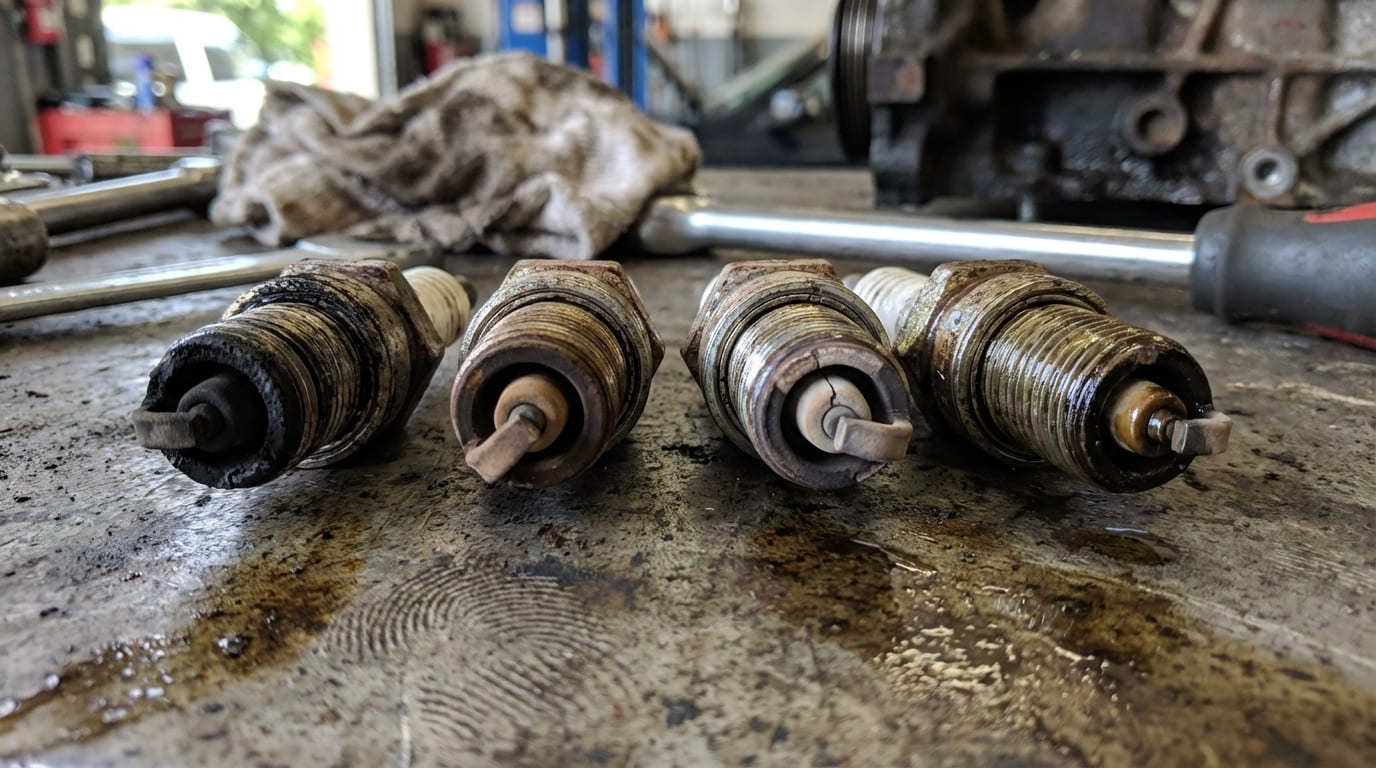
What you see on the spark plug tells a story. Here’s how to read it.
| Failure Type | Appearance | Root Causes | Fix |
|---|---|---|---|
| Carbon Fouling | Black, sooty deposits | Rich mixture, short trips, weak spark, clogged air filter | Replace plugs, fix root cause (e.g., clean filter, check coils) |
| Oil Fouling | Wet, oily residue | Worn valve seals, guides, or PCV system failure | Replace plugs, repair oil consumption issue |
| Ash Fouling | Light brown or white crusty deposits | Oil or fuel additives burning incompletely | Switch to OEM-recommended oil/fuel, replace plugs |
| Overheating | Blistered insulator, melted electrodes | Too hot heat range, lean mixture, incorrect timing, boost leak | Use correct plug, diagnose combustion environment |
| Worn Electrodes | Large gap, eroded center electrode | Normal wear, exceeding service life | Replace plugs, check gap before install |
Repair vs. Replace: Cost and Practicality
Spark plugs are cheap—labor is not. On most 4-cylinder engines, parts cost $20–$60. Labor: $100–$200. But if you’re doing it yourself, it’s a 30-minute job with a socket and ratchet.
When to just replace:
- Plugs are at or past recommended interval (30k for copper, 60k for platinum, 100k for iridium).
- Multiple cylinders show wear or fouling.
- You’re already doing related work (e.g., valve cover gasket).
When to dig deeper:
- One plug fails early—check for oil, coolant, or mechanical issues.
- Same cylinder misfires after plug/coil replacement.
- You see signs of engine wear (oil consumption, low compression).
Pro Tips: What Master Mechanics Do Differently
- ✅ Clean the threads: Use a tap to clean spark plug holes, especially on aluminum heads. Prevents binding and head damage.
- ✅ Gap with wire gauge: Flat feeler gauges are inaccurate for fine-wire iridium plugs. A wire gauge ensures precision.
- ✅ Torque to spec: Never “eyeball” it. Aluminum heads typically need 13–18 ft-lbs, but always check the manual. Over-tightening cracks heads.
- ✅ Use anti-seize sparingly: Most modern plugs come pre-coated. Too much can cause over-torquing or loosening.
- ⚠️ Don’t reuse TTY boots: Coil-on-plug connectors stretch. Reusing them risks poor connection and misfire.
- ⚠️ Match heat range: Iridium plugs aren’t universal. Using the wrong heat range leads to fouling or pre-ignition.
Real-World Case Studies: Lessons from the Bay
Situation: 2014 F-150, P0305, rough idle. Previous shop replaced coil and plug—misfire returned in two weeks.
Diagnosis: Plug was oil-fouled. Compression test passed, but leak-down test showed 18% loss at cylinder 5. Torn valve stem seal.
Fix: Replaced valve seals, plugs, and cleaned intake. No more misfire.
Takeaway: Oil fouling isn’t always rings. Check valve seals—especially on single-cylinder issues.
Situation: Turbo Subaru WRX, pinging under boost. Plugs had melted electrodes. Replaced with same type—failed again in 3,000 miles.
Diagnosis: Intercooler pipe leak causing high intake temps. Plugs overheated despite correct tuning.
Fix: Replaced intercooler hose, upgraded to colder heat range plug.
Takeaway: Plug failure can be a symptom of airflow or cooling issues—not just spark.
Situation: High-mileage Camry, chronic misfires after tune-up. New plugs and coils didn’t help. Fuel trims at +12%.
Diagnosis: Smoke test revealed small vacuum leak at intake manifold gasket.
Fix: Replaced gasket. Misfire gone. Plugs were fine.
Takeaway: Not every misfire is ignition-related. Small air leaks can fool the system.
Spark plugs are a wear item—but their condition reflects the entire engine’s health. Treat them as diagnostic tools, not just parts to swap. Diagnose the why, not just the what, and you’ll fix the problem for good.