Intake manifold problems can mimic other engine issues, leading to misdiagnosis and wasted money. As a master mechanic, I’ve seen intake-related faults blamed on fuel systems, sensors, and even head gaskets—when the real culprit was a cracked manifold or failed gasket. This guide cuts through the noise, focusing on real-world symptoms, how to confirm them, and whether to repair or replace based on cost and complexity.
Common Symptoms and How to Diagnose Them
Engine Performance Issues from Vacuum Leaks
A vacuum leak lets unmetered air into the engine, disrupting the air/fuel ratio. The PCM tries to correct it, but often can’t keep up—especially under load. Here’s what to look for:
- Rough or fluctuating idle (especially when cold)
- Hesitation or stumble during acceleration
- Reduced engine power, particularly at part-throttle
- Increased fuel consumption despite lean conditions
- Whistling or hissing noise from the engine bay
These symptoms are most noticeable at idle and low RPM, where vacuum is highest.
How to Check for a Vacuum Leak
Don’t guess—verify. Here are the three most effective methods I use in my shop:
- Smoke Test: Seal the intake and introduce smoke via a throttle body adapter. Any visible smoke escaping from gaskets, cracks, or fittings confirms a leak. This is the gold standard—effective even on tiny leaks.
- Propane Enrichment Test: With the engine idling, slowly move a propane torch (unlit) around suspect areas. If RPM increases when propane reaches a spot, unmetered air is entering there. Safer than flammable sprays.
- Carb Cleaner Spray (Use with Caution): Spray near gasket seams while idling. A temporary RPM rise indicates a leak. Never use near hot exhaust—fire risk is real.
In my shop, we always start with a smoke test. It’s non-invasive, definitive, and saves hours of trial-and-error. If you don’t have a smoke machine, rent one—costs less than a misdiagnosed MAF sensor.
Check Engine Light and Fuel Trim Analysis
Lean condition codes like P0171 (System Too Lean Bank 1) and P0174 (Bank 2) are red flags for vacuum leaks. But don’t stop at the code—check live data:
- Short Term Fuel Trim (STFT) consistently above +10%
- Long Term Fuel Trim (LTFT) above +15% at idle
If both are high, unmetered air is likely. But remember: similar trims can come from weak fuel pumps or dirty injectors. Always rule those out.
Other related codes:
- P0507 (High Idle): Large vacuum leak bypassing idle control
- P030X (Cylinder Misfire): Lean mixture fails to ignite, not a spark issue
Brake Booster Problems
If your brake pedal feels harder than normal and stopping distance increases, the intake manifold may be robbing vacuum from the brake booster. This is common on older V6 and V8 engines.
How to Check
Perform the brake pedal drop test:
- Turn off the engine.
- Pump the brake pedal 4–5 times to deplete vacuum.
- Hold the pedal down and start the engine.
- If the pedal doesn’t drop slightly, vacuum isn’t being applied.
Next, isolate the source. Use a smoke test at the booster vacuum line. If smoke escapes at the intake manifold port, the manifold or gasket is leaking.
Coolant Leaks: External and Internal
On engines like GM LS, Ford Modular, and Chrysler HEMI, the intake manifold routes coolant. Gasket failure or casting cracks can cause leaks—external or internal.
External Coolant Leaks
Coolant pooling in the engine valley or dripping from the back of the engine often points to intake gasket failure. Don’t assume it’s the water pump.
How to Check
Perform a cooling system pressure test:
- Cap the radiator or surge tank.
- Pump to 15–18 psi (OEM spec).
- Wait 15–30 minutes. A pressure drop indicates a leak.
- Inspect visually—some leaks only appear when hot.
On plastic manifolds, I always re-torque after the first heat cycle. Gaskets settle, and a small leak can turn into a big one if not caught early.
Internal Coolant Leaks
If coolant enters the combustion chamber, you’ll see:
- White smoke from the exhaust (especially at idle)
- Low coolant with no visible external leak
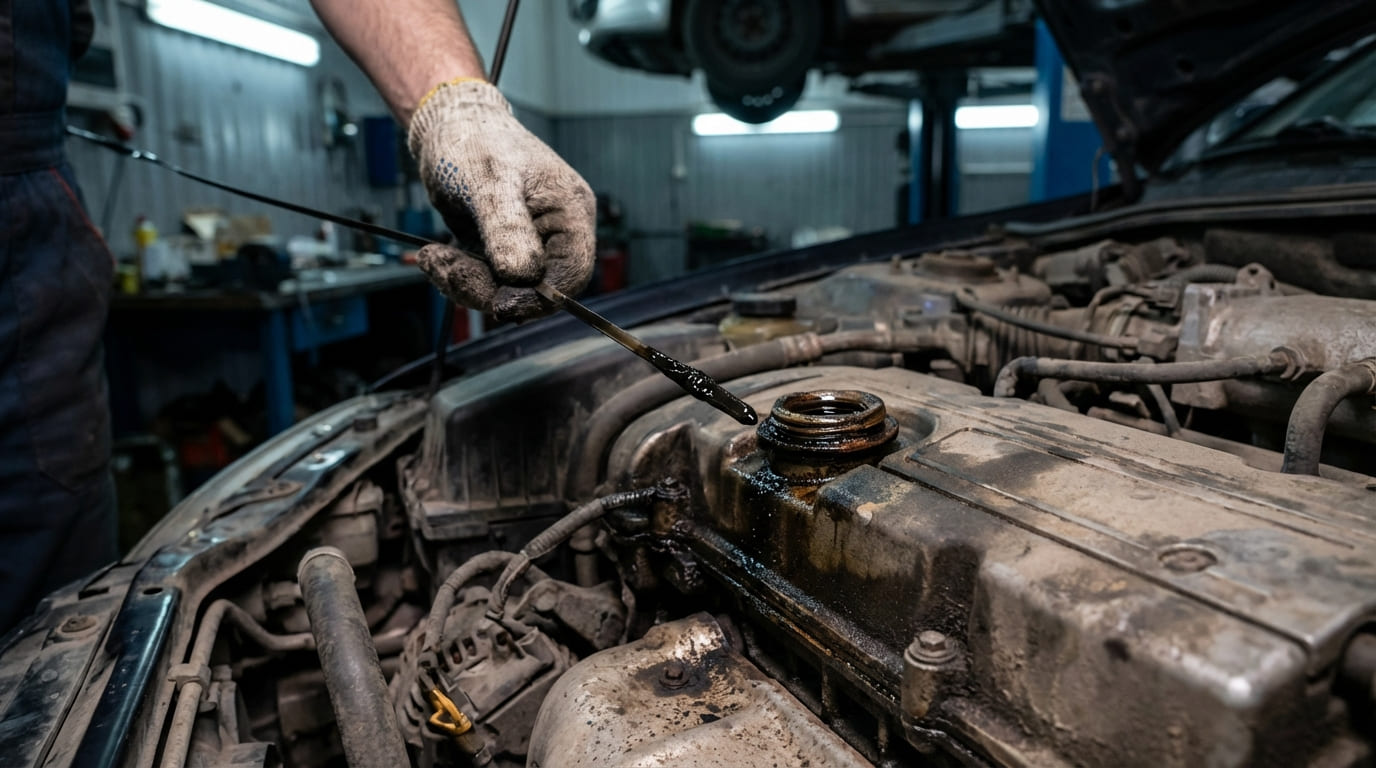
- White, milky film under the oil cap (less common—usually head gasket)
- Crusty white deposits on one or more spark plugs
How to Check
- Block Test: Use a combustion leak tester. Blue fluid turning green means exhaust gases in coolant—points to head gasket or cracked head.
- Spark Plug Inspection: Remove plugs. A single wet or crusty plug (especially rear cylinder) suggests coolant entering via intake runner.
- UV Dye Test: Add UV dye to coolant, run engine, then scan with blacklight. Reveals leaks invisible to the eye.
I once diagnosed a “blown head gasket” that was actually a cracked intake manifold on a 5.7L HEMI. Block test was negative, oil was clean, but dye showed coolant leaking into the valley. Saved the customer thousands.
Heater Performance Issues
Some intake manifolds route coolant to the heater core. If a passage is clogged or a gasket blocks flow, cabin heat suffers. Don’t replace the heater core first—check the manifold.
How to Check
- Feel both heater hoses at operating temperature.
- If one is hot and the other cold, flow is restricted.
- Remove the manifold and inspect coolant passages for debris or warpage.
Variable Intake System Failures (IMRC, DISA, VRIS)
Many modern engines use flaps inside the intake manifold to optimize airflow. When these stick, power suffers—especially in the 2,500–4,500 RPM range.
Symptoms:
- Loss of mid-range power (“hits a wall”)
- Poor fuel economy
- Check Engine Light with codes like P2004 (runner stuck open) or P2006 (stuck closed)
How to Check
- Use a bi-directional scan tool to command flap movement.
- Watch the position sensor in live data.
- If the sensor responds but flaps don’t move, the internal linkage or cam is broken.
- If no response, check wiring, fuse, and actuator.
On Ford 3.0L and 3.5L engines, the IMRC cam inside the manifold often cracks due to plastic fatigue. Replacing the actuator won’t fix it—you need a new manifold or repair kit.
Sensor and Mounting Issues
MAP, IAT, and TPS sensors mounted on the manifold can fail if the manifold cracks or warps. An erratic MAP reading, for example, can mimic MAF sensor problems.
How to Check
- Scan for sensor-specific codes (e.g., P0106 for MAP).
- Check live data for erratic voltage or vacuum readings.
- Inspect the sensor bore for cracks or oval deformation—common on aged plastic manifolds.
Material Degradation and Cracking
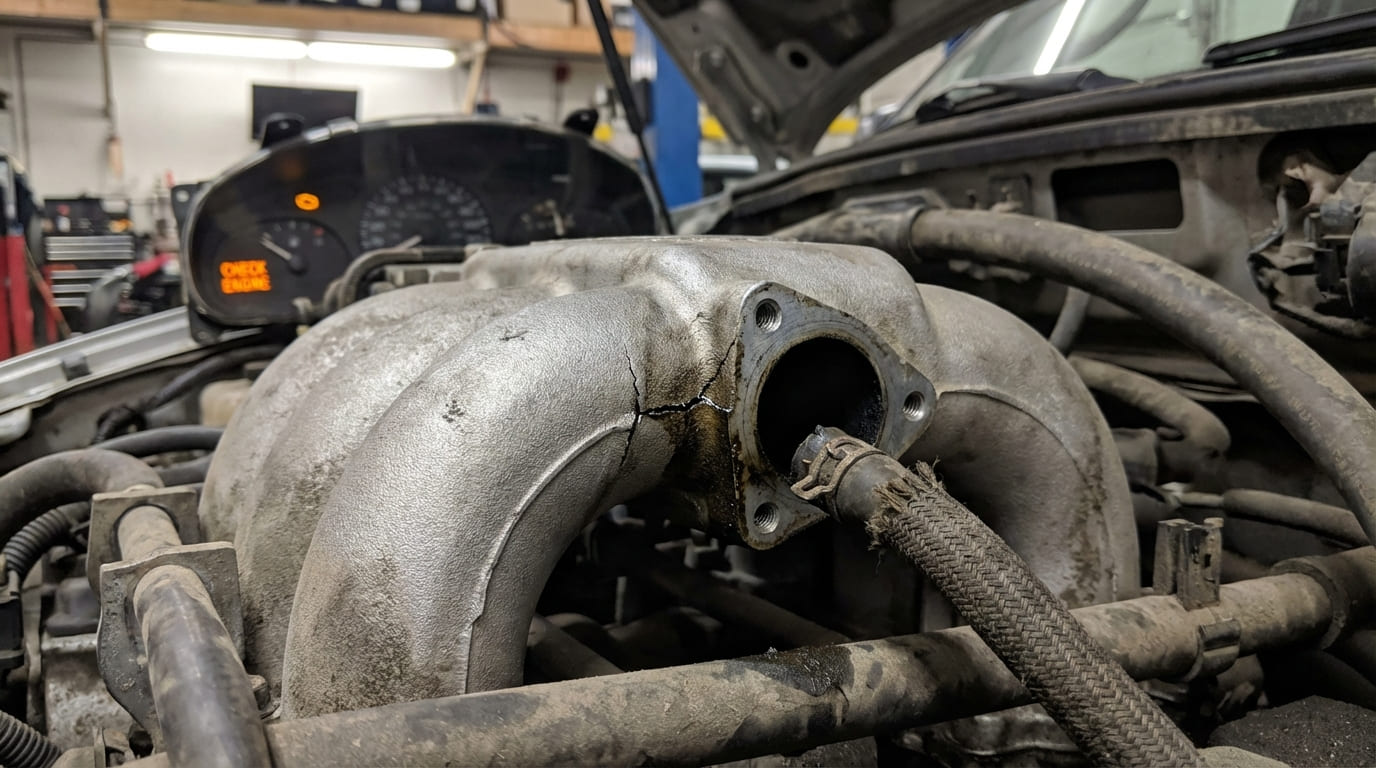
Plastic manifolds (common on Ford, GM, and Chrysler) degrade over time. Cracks often start near coolant ports, sensor bosses, or bolt holes due to thermal cycling.
How to Check
- Inspect with a bright light and mirror—especially in the valley.
- Use UV dye and blacklight for coolant leaks.
- Perform a smoke test with the engine warm—cracks may only appear when expanded.
Repair vs Replace: Cost and Viability
Here’s a realistic look at costs and decisions:
| Issue | Repair Option | Replace Option | Cost Range (Part + Labor) |
|---|---|---|---|
| Intake gasket leak | Re-torque or replace gasket | Replace manifold if cracked | $200–$600 |
| Coolant leak (gasket) | Replace gasket and reseal | Replace manifold if cracked | $300–$800 |
| Cracked plastic manifold | Epoxy repair (temporary) | Replace manifold | $500–$1,200 |
| Failed IMRC mechanism | Internal cam repair kit | Replace manifold | $400–$900 |
For minor gasket leaks, repair is almost always worth it. But if the manifold is cracked or the IMRC cam is broken, replacement is usually more reliable. Epoxy fixes fail under heat and vibration.
Diagnostic Decision Table
| Symptom | Most Likely Causes | Less Common But Possible Causes | Recommended Diagnostic Step |
|---|---|---|---|
| Rough idle + P0171/P0174 | Intake gasket leak, cracked manifold | Dirty MAF, PCV leak, vacuum hose off | Smoke test + fuel trim analysis |
| White smoke + low coolant | Intake manifold coolant leak | Head gasket, cracked head, heater core | Block test + pressure test + spark plug check |
| P2004 (IMRC stuck open) | Broken linkage, failed actuator | Carbon buildup, wiring fault | Bi-directional test + visual flap check |
| Hard brake pedal | Manifold vacuum leak, cracked booster line | Failed check valve, booster diaphragm | Brake pedal drop test + smoke test |
Situation: 2008 Silverado 5.3L with P0171/P0174, rough idle, high fuel trims.
Action: Smoke test showed no leaks. Propane test did nothing. Checked PCV valve—stuck open, pulling air from valve cover.
Lesson: Not every lean code is an intake manifold. Always verify the air path—crankcase ventilation is often overlooked.
Situation: 2005 Chrysler 300C 5.7L with white smoke, low coolant, no oil contamination.
Action: Block test negative. Pressure test showed coolant bubbling from intake valley. Removed manifold—found cracked coolant passage.
Lesson: Coolant in combustion chamber doesn’t mean head gasket. Intake manifolds with coolant routing can fail internally.
Situation: 2010 Ford Fusion 2.5L with P2004, poor mid-range power. Actuator replaced—no fix.
Action: Bi-directional test showed actuator moving, but flaps didn’t. Disassembly revealed broken plastic cam inside manifold.
Lesson: The actuator can work fine while the internal mechanism fails. Always confirm physical movement.
Intake manifold issues require methodical diagnosis. Symptoms can overlap with other systems, so always test before replacing parts. Use a smoke machine, scan tool, and pressure tester as your first tools—not a wrench. And remember: the cheapest fix isn’t always the right one. Consult your vehicle’s service manual for torque specs, gasket types, and warpage limits. When in doubt, pull the manifold and inspect it—sometimes the answer is right in front of you.