In my 20 years as a master mechanic, I’ve seen countless engines fail due to overlooked valve springs. These small coils are critical to engine operation—keeping valves sealed and synchronized. When they fail, the results range from rough idling to total engine destruction. This guide cuts through theory and gives you what you need: how to diagnose, test, and fix valve spring issues with real-world practicality.
Core Functions of Valve Springs
Valve springs do three essential jobs: close the valve, maintain contact in the valve train, and control valve motion. Without proper spring function, the engine loses compression, power, and reliability. Here’s how each function breaks down in real-world operation.
Valve Closure and Compression Seal
After the camshaft opens the valve, the spring forces it closed against the seat. This seal is vital for maintaining cylinder compression. A weak or broken spring can cause incomplete sealing, leading to misfires and burned valves. In daily drivers, this often shows as a steady misfire on one cylinder.
Preventing Valve Float at High RPM
At high engine speeds, weak springs can’t keep the valve train components in contact. The lifter or rocker arm loses touch with the cam lobe—this is valve float. Drivers feel it as a sudden power loss near redline. Performance engines and high-mileage trucks are especially vulnerable. If your engine “hits a wall” at 5,000 RPM or higher, suspect valve float before blaming fuel or ignition.
Controlling Valve Bounce
A spring must close the valve firmly but not too abruptly. If the valve slams shut, it can bounce off the seat, reopening slightly and disrupting timing. This is common in older engines with worn valve seats. A quality spring with proper damping reduces bounce, minimizing wear and maintaining combustion efficiency.
Common Types of Valve Springs
Spring design varies by engine use. Choosing the right type matters for longevity and performance.
- Single Valve Spring: Found in most economy cars. Cost-effective but prone to harmonic resonance at high RPM. Replace in sets if one fails.
- Dual Valve Spring: Two concentric springs, often wound in opposite directions. Used in performance V8s to cancel vibrations. If the outer spring breaks, the inner may hold temporarily—but don’t count on it.
- Beehive Valve Spring: Tapered design reduces weight at the top, improving high-RPM stability. Common with roller rockers. More expensive but ideal for performance builds.
- Progressive Rate Valve Spring: Coil pitch varies, increasing resistance as it compresses. Great for street-performance engines needing smooth idle and firm control at redline.
In my shop, we always match valve springs to the camshaft profile. A high-lift cam demands higher seat pressure. But too much pressure accelerates wear on lifters and guides. It’s a balance—never over-spring.
How to Check for Valve Spring Failure
Symptoms can mimic other issues. Use this diagnostic flow to isolate spring problems.
Step-by-Step Diagnosis
Follow this sequence before tearing into the engine:
- Listen for noise: A ticking or clicking sound that increases with RPM may point to a cracked or broken spring. Use a mechanic’s stethoscope—place it on the valve cover near each retainer. Loudest point often reveals the culprit.
- Perform a compression test: Low compression in one cylinder? Do a wet test. If compression doesn’t rise significantly, the issue is likely poor valve sealing—not piston rings.
- Run a leak-down test: Apply air to the cylinder at TDC. If you hear air escaping through the intake or exhaust, the valve isn’t sealing. Test at idle and again under load (on a dyno if possible). A spring that fails only under load indicates float.
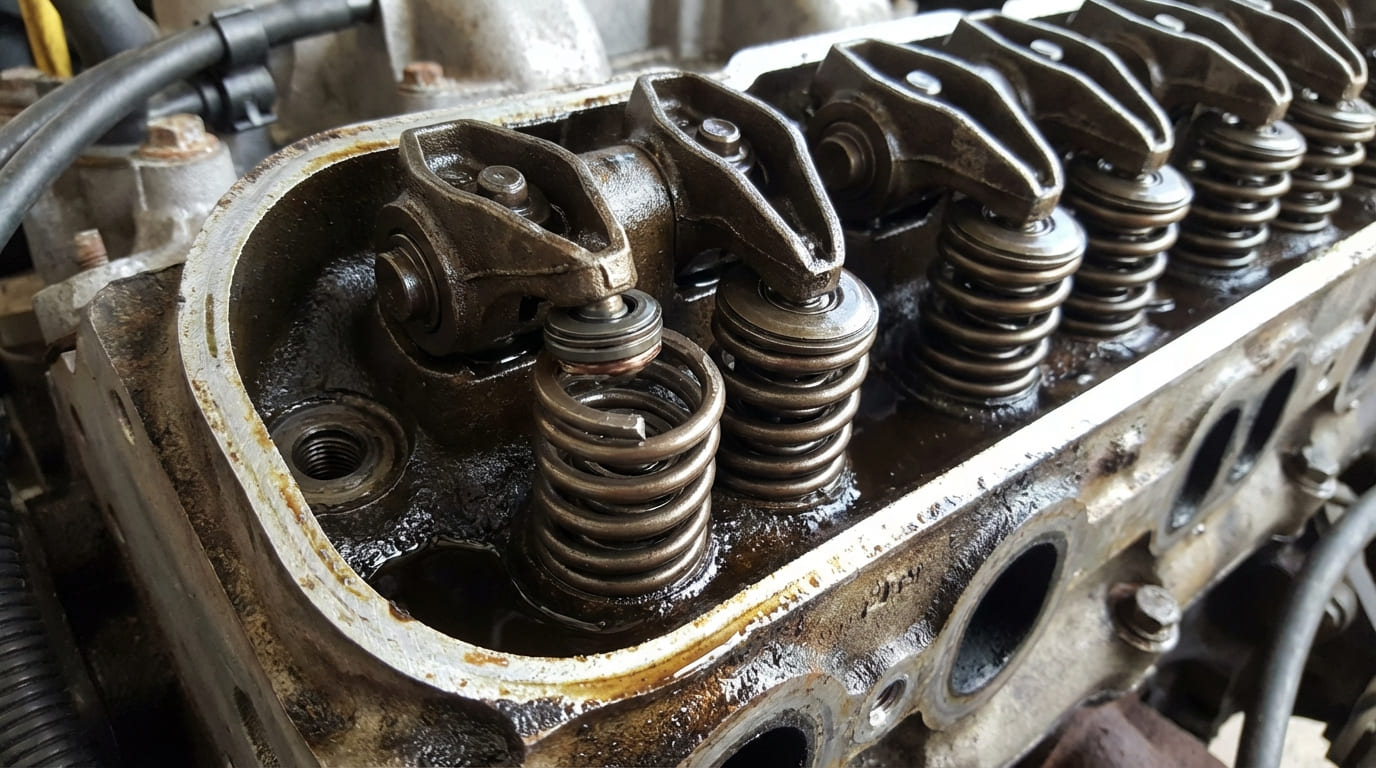
- Inspect visually: Remove the valve cover. Look for broken coils, dislodged retainers, or cracked spring bases. Rotate the engine by hand and watch for uneven spring movement.
- Measure free length and pressure: Use a micrometer to check free length. Compare to factory specs. A loss of more than 1 mm indicates fatigue. Use a spring tester to verify pressure at installed and full-open heights.
Symptoms and What They Mean
Use this table to triage common issues quickly.
| Symptom | Most Likely Cause | Less Common Causes | Diagnostic Priority |
|---|---|---|---|
| Single-cylinder misfire at idle | Worn valve stem seal or guide | Weak spring losing tension at low lift | Compression → leak-down → visual inspection |
| Power loss above 5,500 RPM | Valve float from weak or fatigued springs | Ignition roll-off or fuel starvation | Scan tool → dyno test → spring pressure check |
| Ticking noise increasing with RPM | Broken or cracked spring | Faulty hydraulic lifter or rocker arm | Stethoscope → valve cover removal → spring inspection |
| Excessive oil consumption, no blue smoke | PCV issue or ring wear | Weak springs reducing vacuum at valve guides | Check PCV → leak-down → spring height/pressure |
I once diagnosed a “lifter knock” that turned out to be a hairline crack in a spring base. The spring lost tension only when hot. Lesson: always test springs under operating conditions or compare them side-by-side with a known good set.
Why Valve Springs Fail
Failure isn’t always age-related. These are the top causes I see in the shop.
- Fatigue: After 100,000+ miles or high-RPM use, springs lose tension. Track-driven cars may need replacement well before 100k miles.
- Overheating: Prolonged heat can anneal spring steel, reducing strength. Check cooling and oil flow—especially in the cylinder head.
- Corrosion: Moisture from short trips or poor ventilation causes pitting. Even minor surface cracks become stress risers.
- Improper Installation: Installed height must be precise. A variance of just 0.030” can push springs into coil bind or reduce seat pressure dangerously.
- Material Defects: Rare, but cheap aftermarket springs sometimes fail prematurely due to poor tempering.
Repair vs. Replace: Cost and Practicality
Valve spring replacement ranges from $300 to $1,200+ depending on engine design. Here’s how to decide:
- If only one spring is broken but others are within spec, you *might* replace just that one—on a non-performance engine. But I recommend replacing in sets. Mismatched springs can cause imbalance.
- On engines with removable valve springs (like many pushrod V8s), you can replace them with the head on using compressed air or the rope trick. Risky—only for experienced DIYers.
- On DOHC or interference engines, full head removal is safer. Dropping a valve into the cylinder means a complete rebuild.
- Always replace keepers and inspect retainers. Keepers cost $10 for a set—don’t risk a dropped valve to save a few bucks.
I’ve seen too many reused keepers fail. They’re cheap and critical. Replace them every time. Same goes for worn retainers—they can crack under load and drop a valve.
Specifications You Need to Know
Always consult the factory manual, but here are typical ranges I work with:
| Specification | Typical Range | Action if Out of Spec |
|---|---|---|
| Free Length Tolerance | ±0.5 mm | Replace if more than 1 mm shorter than new |
| Installed Pressure | 80–120 lbs | Test with spring tester; adjust with shims if needed |
| Squareness | Max 1.5° deviation | Replace if rocking on flat surface |
Pro Tips from the Shop
- ✅ Clean spark plug holes and valve cover surfaces before reassembly. Debris can fall into guides or springs.
- ✅ Use a thread chaser on head bolt and spring stud holes. A binding bolt can under-torque and lead to head gasket failure.
- ✅ Measure installed height with a dial caliper. Adjust with shims to hit factory specs exactly.
- ⚠️ Never reuse old keepers or worn retainers. It’s a $10 part with a $2,000 consequence if it fails.
- ⚠️ Never compress a spring beyond coil bind. It can permanently deform the coils.
- ⚠️ Avoid mixing spring brands or batches. Even if dimensions match, spring rates and harmonics can differ.
Valve springs don’t fail in a vacuum. They’re part of a system. Always check the entire valve train—cam, lifters, pushrods, rockers—and consider engine history. Overheating, high RPM use, and poor maintenance all contribute. The real fix is often in the details most people skip.