Engine Performance Issues
When the Variable Valve Timing (VVT) system fails, engine performance takes a direct hit. The camshaft phasers can’t adjust timing properly, hurting cylinder filling and exhaust scavenging. Drivers notice reduced responsiveness, especially under load or during highway acceleration. Don’t rely solely on feel—track performance over time and rule out simpler causes like dirty air filters or exhaust restrictions.
Power Loss, Poor Fuel Economy, and Rough Running
Incorrect valve timing reduces combustion efficiency, leading to higher fuel consumption. Monitor fuel economy over at least three full tanks to spot real trends. A sudden drop combined with a Check Engine Light (CEL) often points to VVT issues, but don’t overlook oxygen sensor faults or EGR problems that can mimic symptoms.
Rough idling or stalling typically happens when the VVT system is stuck in a high-RPM timing profile. Excessive valve overlap dilutes the air-fuel mixture, causing misfires. Before tearing into the VVT, check for vacuum leaks, throttle body carbon buildup, and EGR valve operation—common culprits that mimic VVT failure.
Acceleration hesitation, especially between 1,500 and 3,000 RPM, suggests delayed or blocked oil flow to the phasers. Use an OBD2 scanner to compare commanded vs. actual camshaft position. A lag or no movement indicates a hydraulic or mechanical fault in the VVT system.
In my shop, we always verify throttle body cleanliness and perform a base idle relearn before condemning any VVT part. Carbon buildup on the bore can cause idle instability that looks exactly like a stuck phaser.
Audible Warnings from the Engine
Noises from the front of the engine, especially on cold start, are red flags. A ticking or rattle that fades after 10–15 seconds often points to delayed oil pressure reaching the VVT phasers. If it persists, the phaser itself may be worn or damaged.
Use an automotive stethoscope to pinpoint the sound near the timing cover or cam sprockets. A rhythmic clunk under load can indicate internal vane wear—even if the phaser rotates freely by hand.
A high-pitched whine or buzzing near the valve cover usually means a failing VVT solenoid. Remove and inspect the solenoid’s inlet screen for sludge. Cleaning or replacing it often fixes both noise and performance issues—provided oil flow and pressure are adequate.
I’ve seen more VVT solenoids fail from dirty oil than electrical faults. Always inspect the screen. If it’s clogged, ask about oil change history—chances are it’s overdue.
Check Engine Light and Diagnostic Trouble Codes
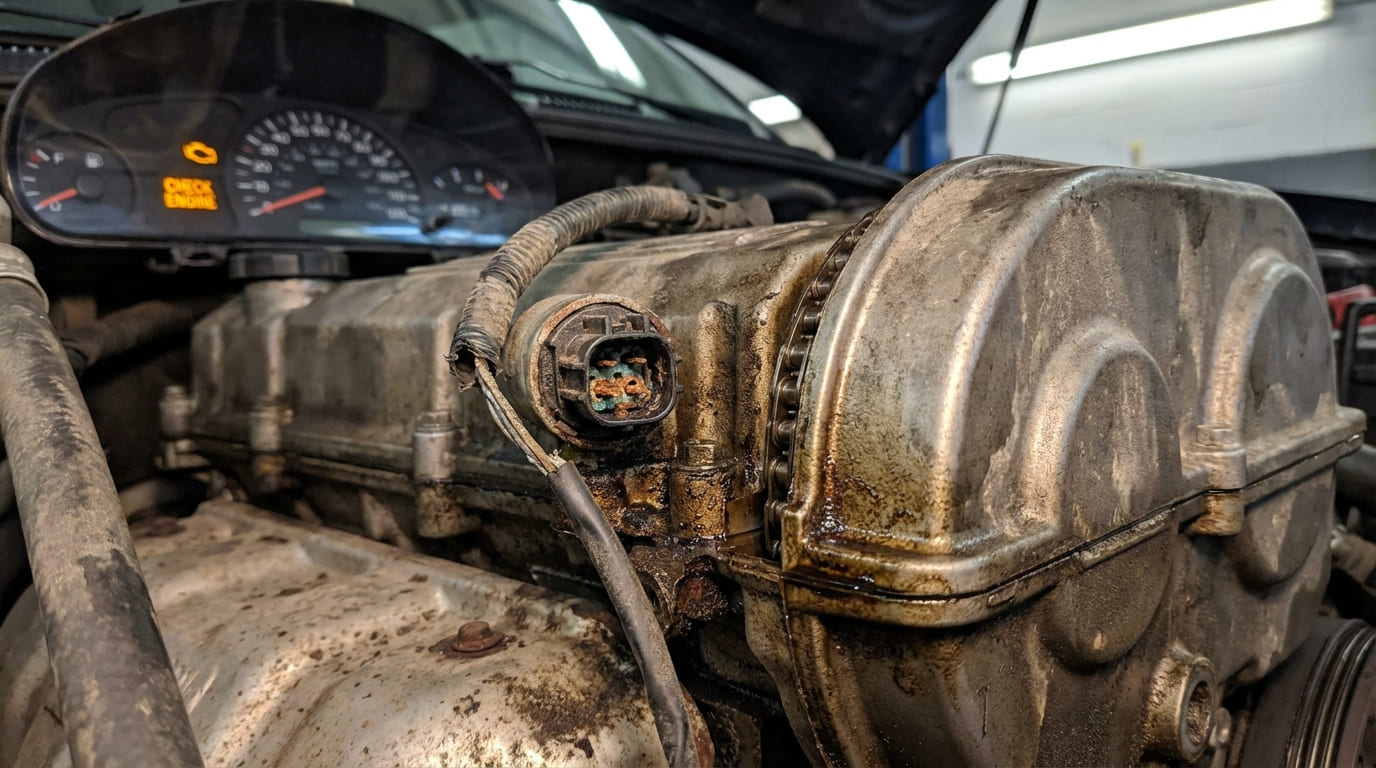
The ECM constantly monitors camshaft position. If actual timing deviates too far from commanded values, the Check Engine Light (CEL) illuminates. Always pull freeze frame data to see conditions when the code set—idle vs. acceleration, oil pressure, load. This tells you whether the issue is mechanical, hydraulic, or intermittent.
Codes in the P0010–P0029 range are VVT-specific. For example, P0011 (Intake Camshaft Position Timing Over-Advanced) suggests the intake cam is too far ahead. But don’t trust the code alone—verify with live data. A faulty camshaft position sensor or damaged reluctor wheel can send false signals.
If commanded timing changes but actual position doesn’t move, the problem is downstream: stuck solenoid, clogged oil passage, or failed phaser. If neither command nor actual moves, suspect sensor, wiring, or ECM issues.
Oil Condition: The Hidden Culprit
VVT systems depend on clean, properly viscous oil at sufficient pressure. Sludged, low, or incorrect oil will prevent phasers from operating. I’ve replaced multiple solenoids only to see the same code return—because the oil hadn’t been changed in 15,000 miles.
Before replacing any VVT component, check oil level, color, and service history. If the oil looks like chocolate milk or hasn’t been changed on time, address that first. A flush and fresh oil/filter can restore function without costly parts replacement.
Oil is the lifeblood of the VVT system. I won’t touch a solenoid or phaser until I’ve confirmed oil condition and pressure. It’s saved me hours of comebacks.
Diagnostic Decision Tree
VVT diagnosis requires a systematic approach. Use this table to guide your troubleshooting based on observed symptoms.
| Symptom | Most Likely Causes | Less Common But Possible | Diagnostic Next Step |
|---|---|---|---|
| CEL + P0011 (Over-Advanced) | Stuck-open VVT solenoid, low oil pressure, clogged oil passage | Faulty cam sensor, damaged reluctor, ECM calibration issue | Check oil level/quality, test solenoid resistance and flow, verify cam sensor signal with live data |
| Front-end rattle on cold start | Worn VVT phaser, delayed oil pressure buildup | Timing chain tensioner failure, worn cam lobes | Use stethoscope, monitor oil pressure at startup, inspect phaser lock pin function |
| Poor fuel economy + no codes | Partially clogged solenoid screen, slow phaser response | MAP sensor drift, EGR flow issues, ignition timing retard | Scan live data for cam position response time, check for vacuum leaks, inspect EGR system |
| Rough idle + P0340 (Cam Sensor Circuit) | Wiring issue, failed sensor, dirty signal | Phaser vane sticking causing erratic cam movement | Inspect sensor and harness, check camshaft endplay, verify phaser movement under oil pressure |
Best Practices: Do and Don’t
- ✅ Clean oil passages and solenoid screens during any VVT repair. Even a partially blocked screen can restrict flow enough to cause failure.
- ✅ Use OEM or equivalent VVT solenoids. Aftermarket units may have inconsistent flow or inferior filters.
- ✅ Verify oil pressure before replacing components. Most VVT systems need 25–40 psi; worn oil pumps won’t support proper operation.
- ✅ Check camshaft endplay and phaser rotation by hand during disassembly. Binding or excessive play indicates internal damage.
- ⚠️ Avoid reusing torque-to-yield cam sprocket bolts unless the service manual explicitly allows it. Reused bolts can loosen, causing timing slippage.
- ⚠️ Avoid assuming a phaser is bad just because it moves freely. Some units rotate smoothly but can’t hold position under oil pressure due to internal vane wear.
- ⚠️ Avoid skipping an oil change after VVT repair. Contaminated oil will quickly damage new parts.
Real-World Diagnostics: Lessons from the Bay
Situation: 2014 Camry with P0020 and rough idle. Two solenoids already replaced.
Deep Dive: Oil pressure was only 18 psi at idle. Clogged pickup screen from old gasket debris.
Lesson: Always verify full oil delivery path. Pressure matters more than parts replacement.
Situation: 2016 F-150 with cold-start rattle, no codes. Owner extended oil changes to 10,000 miles with conventional oil.
Deep Dive: Intake VVT solenoid screen packed with sludge. Cleaned and flushed—noise gone.
Lesson: Proactive oil maintenance prevents expensive VVT repairs. Sludge doesn’t show up in codes until it’s too late.
Situation: 2012 Accord with hesitation and P0010. New phaser installed, code returned in two weeks.
Deep Dive: Timing belt was loose, causing cam timing jump under load.
Lesson: Confirm mechanical timing integrity first. A skipped tooth mimics phaser failure perfectly.