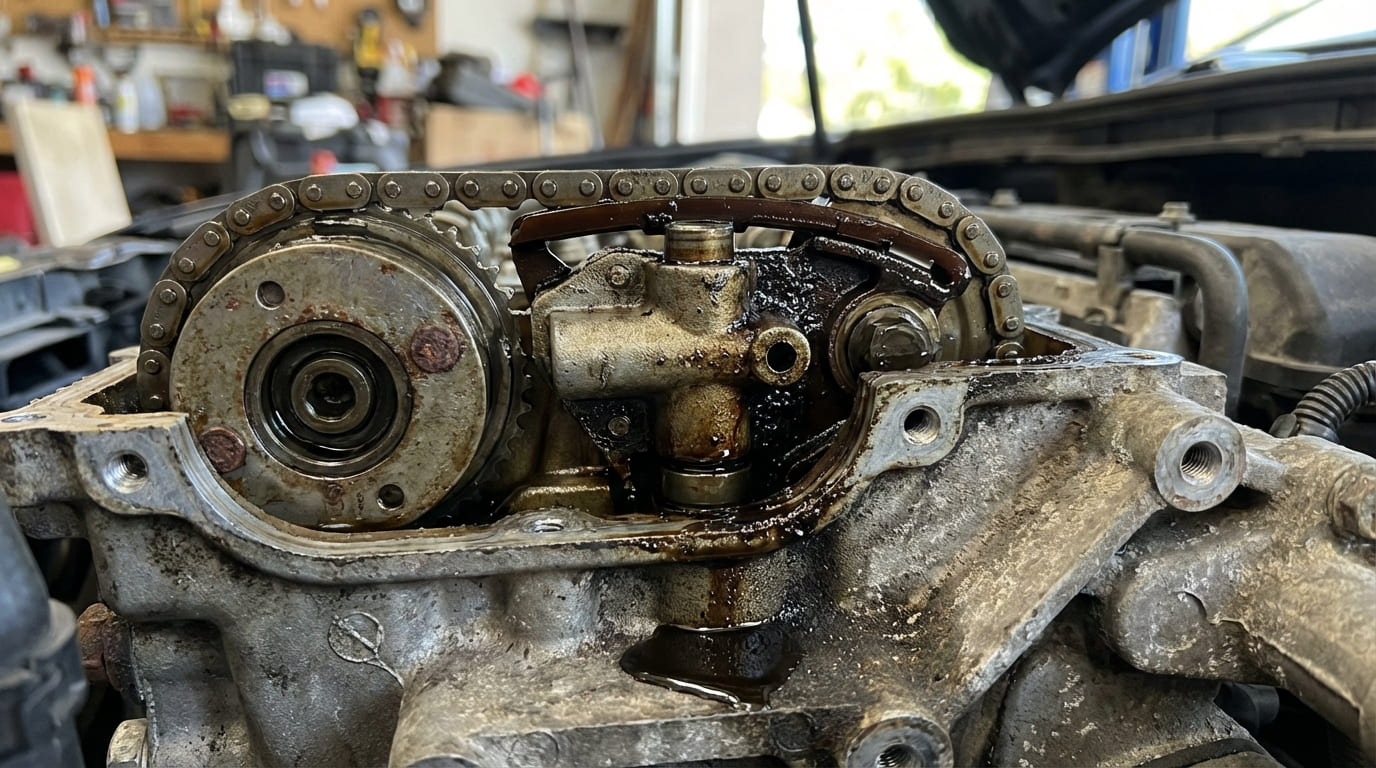
In my experience across thousands of engine repairs, timing chain tensioner failure is rarely due to a single cause. More often than not, it’s the result of a chain of contributing factors—some mechanical, some maintenance-related, and some design-specific. While a noisy timing cover might point you toward the tensioner, I’ve learned not to jump straight to replacement without investigating the full system. Let’s walk through the real-world mechanics behind tensioner breakdowns.
Primary Failure Modes of Timing Chain Tensioners
Hydraulic vs. Mechanical Tensioners: Key Differences
Hydraulic tensioners use engine oil pressure to maintain constant chain tension and are common on modern engines. Mechanical (spring-loaded) tensioners rely on physical spring force and are simpler but less adaptive. Both types can fail, but the root causes differ.
Hydraulic Tensioner Failures
These depend on clean oil flow and internal sealing. When either fails, so does the tensioner.
- Loss of Oil Pressure Supply: Low oil level, clogged feed passages, worn oil pump, or excessive bearing clearances can all reduce oil delivery. Even 1–2 quarts low can delay tensioner engagement at startup.
- Check Valve Failure: If the valve leaks, the tensioner loses pressure after shutdown. This causes a telltale 2–5 second rattle at cold start that clears as oil pressure builds.
- Internal Seal or Piston Wear: O-rings and piston seals degrade with heat and poor oil. Scoring in the bore allows oil bypass, reducing damping and extension.
- Spring Fatigue: Most hydraulic units have a backup spring. Over time, it weakens, reducing initial tension during oil pressure build-up.
- Ratchet Mechanism Issues: Some models use a ratchet to lock extension. If it sticks or wears, the piston can retract under chain load.
Mechanical Tensioner Failures
Simpler in design but still prone to wear under constant stress.
- Spring Breakage or Relaxation: After years of tension, the spring may lose force or snap—resulting in zero chain tension.
- Ratchet Wear or Binding: Dirt or poor lubrication can cause the ratchet to skip or jam, especially in high-mileage engines.
- Pivot Arm Wear: The mounting point can wear, leading to misalignment and inconsistent guide contact.
Failures Common to Both Types
- Material Cracking: Plastic or composite tensioner bodies can fracture due to heat, stress, or age—especially in turbocharged or high-output engines.
- Mounting Bolt Failure: Vibration and thermal cycling can loosen or shear bolts. Always use new torque-to-yield bolts if specified.
- Contamination: Sludge or metal debris can jam moving parts or accelerate wear in both hydraulic and mechanical units.
External Factors That Accelerate Tensioner Failure
Tensioner failure is often a symptom of a larger problem. Address these to prevent repeat repairs.
Timing Chain Wear or Stretch
Roller chains don’t “stretch” like a rubber band, but bushings wear, increasing pitch. On high-mileage engines, elongation beyond 0.5% exceeds the tensioner’s take-up range. This keeps the tensioner at maximum extension, accelerating internal wear.
In my shop, we measure chain wear with a ruler between pins. If 12 links exceed 6.05 inches, the chain is worn and must be replaced—don’t risk a new tensioner on a worn chain.
Chain Guide and Rail Wear
Worn or broken nylon guides allow chain slap, increasing dynamic load on the tensioner. I’ve seen guides delaminate after 120,000 miles, especially in engines prone to oil sludge.
Cost to replace: $20–$60 for parts. Labor is the same as tensioner replacement—always replace guides together.
Pro tip: Inspect the guide contact surface. If it’s grooved deeper than 1/16 inch, replace it. A cracked or delaminated guide will destroy a new tensioner in months.
Improper Installation
Incorrect assembly is a common cause of early failure.
- Forgetting to release the tensioner’s shipping lock pin results in zero tension.
- Using old or incorrect torque specs on mounting bolts can lead to loosening or shearing.
- Not pre-loading the tensioner during installation causes slack and noise.
Oil Quality and Maintenance Neglect
Hydraulic tensioners are oil-fed components. Poor oil quality is the #1 preventable cause of failure.
- Extended oil change intervals lead to sludge in feed passages.
- Using non-spec oil (wrong viscosity or poor shear stability) accelerates wear.
- Coolant contamination (from head gasket leaks) degrades seals and forms sludge.
I’ve pulled tensioners with completely clogged inlets after 80,000 miles on neglected oil. Clean oil is cheaper than a new tensioner—$50 vs. $500 in labor and parts.
How to Diagnose Timing Chain Tensioner Failure
Don’t assume noise means a bad tensioner. Rule out simpler causes first.
Step-by-Step Diagnostic Process
- Check oil level and condition: Low, dirty, or sludgy oil is a red flag. Top off and retest if low.
- Listen with a mechanic’s stethoscope: Place near the timing cover. If noise is loudest there, suspect tensioner, chain, or guides.
- Scan for DTCs: Codes P0016–P0019 indicate cam-crank correlation issues. Check freeze-frame data and cam timing advance/retard values.
- Test oil pressure: Connect a mechanical gauge. Expect at least 10 psi at idle and 40 psi at 2,000 RPM. Low pressure affects tensioners and VVT systems.
- Inspect timing cover (if accessible): On some engines, you can remove the cover without pulling the engine. Measure tensioner piston extension—most have a max of 8–10 mm. Exceeding this indicates internal leakage.
- Measure chain slack: Use a dial indicator or feeler gauge. Most manufacturers allow 8–12 mm of deflection. More than that means chain or tensioner wear.
Repair vs. Replace: Cost and Viability
Timing job costs vary widely by engine, but here’s a general breakdown:
| Component | Part Cost | Notes |
|---|---|---|
| Tensioner (hydraulic) | $60–$150 | OEM recommended; aftermarket units may lack durability |
| Timing chain | $80–$200 | Replace if elongation >0.5% or pins show wear |
| Chain guides and rails | $20–$60 (set) | Always replace with tensioner—cheap insurance |
| Oil pump (if clogged or worn) | $100–$300 | Check flow if oil pressure is low |
Labor: $600–$1,500 depending on engine access. Front-wheel drive V6 and transverse engines take longer.
Rule of thumb: If you’re doing the labor, replace the entire timing kit—chain, tensioner, guides, and sprockets. A $300 parts upgrade saves a $1,200 redo in 30,000 miles.
Best Practices: What to Do (and Not Do)
- ✅ Clean oil passages: Use a soft brush and solvent on the tensioner feed hole. I’ve prevented comebacks by clearing sludge others missed.
- ✅ Replace guides and rails: They’re cheap and wear faster than metal parts. A worn guide will ruin a new tensioner.
- ✅ Use OEM-specified oil: Correct viscosity and API rating matter. For example, 0W-20 with GF-6 for most modern engines.
- ⚠️ Don’t reuse torque-to-yield bolts: They stretch during tightening. Reusing them risks loosening and cover leaks.
- ⚠️ Don’t assume the tensioner is the problem: Always inspect the chain, guides, and sprockets. A worn chain mimics tensioner failure.
- ⚠️ Don’t install without verifying oil flow: On some engines, crank the engine (without starting) to confirm oil reaches the tensioner inlet.
Real-World Failure Scenarios and Lessons
| Symptom | Most Likely Causes | Less Common But Possible Causes |
|---|---|---|
| Cold start rattle (2–5 sec) | Check valve leak, low oil, clogged feed | Incorrect oil viscosity, worn VVT actuator |
| Persistent rattle under load | Failed tensioner, stretched chain, broken guide | Cracked tensioner body, misaligned sprocket |
| P0017 code + noise | Chain slack from tensioner failure | Low oil pressure, cam sprocket slippage, sensor issue |
| No noise, but chain slack found | Worn piston seal, spring fatigue | Guide collapse, chain wear beyond spec |
Situation: 2012 V6 sedan, 110,000 miles, cold-start rattle for 3–4 seconds. No check engine light.
Action: Checked oil—low by 1.5 quarts. Changed oil—rattle remained. Removed cover: tensioner extended within spec, but feed hole clogged with sludge.
Lesson: Restricted oil flow mimics internal failure. Always verify oil delivery before condemning the tensioner.
Situation: 2008 SUV, rattle and P0016 code. Tensioner replaced twice in six months.
Discovery: Chain stretched, tensioner-side guide cracked, oil sludgy.
Lesson: Replacing the tensioner without fixing chain stretch or guide wear is a temporary fix. Root cause was poor maintenance.
Situation: 2015 turbo four-cylinder, sudden rattle and misfires. Towed in.
Findings: Tensioner piston collapsed, guide shattered. Oil analysis showed coolant contamination (high silicon).
Lesson: Coolant in oil degrades seals. The real issue was a failing head gasket—fix the oil problem first.
In my two decades in the bay, I’ve learned that timing chain tensioner issues are rarely isolated. They’re often the last domino to fall in a sequence that starts with oil neglect, guide wear, or chain elongation. While some engines are more prone than others, the repair approach should always be systematic: inspect the whole system, verify oil delivery, and measure wear against manufacturer specifications—not assumptions. And above all, consult the service manual for your specific engine—what’s true for one may not apply to another.