Diagnosing a worn crankshaft early can save thousands in engine repairs. As a senior technician, I focus on real-world signs that point to crankshaft issues—not just textbook theory. Below are the key symptoms, how to check them, and what they mean for repair or replacement.
How to Diagnose a Worn Crankshaft: Practical Steps
Audible and Mechanical Symptoms
Most crankshaft problems start with noise or drivability issues. These are your first clues—don’t ignore them.
Deep, rhythmic knocking or thumping from the lower engine is the classic sign of main or rod bearing wear caused by crankshaft journal deterioration. This knock gets louder under load—accelerating uphill or towing—and is most noticeable at idle or low RPM.
How to check: Use an engine stethoscope or chassis ears. Place the probe near the oil pan, center and rear of the block. If the knock peaks there and follows engine RPM, it’s likely main bearing related. Rod knocks are sharper and usually forward. To confirm, perform a load test: hold brake and gently press gas in gear (automatic) or use a dynamometer. Increased knock under load confirms lower-end wear.
In my shop, we never assume a knock is a rod. Many “rod knocks” turn out to be main bearing walk, cracked flexplate, or even exhaust manifold rattles. Always verify with targeted listening and load testing before teardown.
Metallic scraping or grinding during clutch engagement or deceleration often points to excessive crankshaft end play. The crank moves forward and backward axially, rubbing against the thrust bearing.
How to check: With the engine off, attach a dial indicator to the harmonic balancer bolt. Gently pry the crank forward and backward using a pry bar (carefully—don’t damage components). Factory end play specs typically range from 0.002″ to 0.008″, but aluminum blocks (like LS engines) often require under 0.004″. Always consult your service manual. If end play exceeds spec and you hear grinding, inspect the thrust bearing and rear main cap.
I once saved a customer $3,000 by discovering that a “worn crank” was actually a binding transmission input shaft forcing the crank forward. Always rule out driveline issues before condemning the crank.
Lubrication and Oil System Clues
Oil system behavior is a direct window into crankshaft health. Pay attention to pressure and debris.
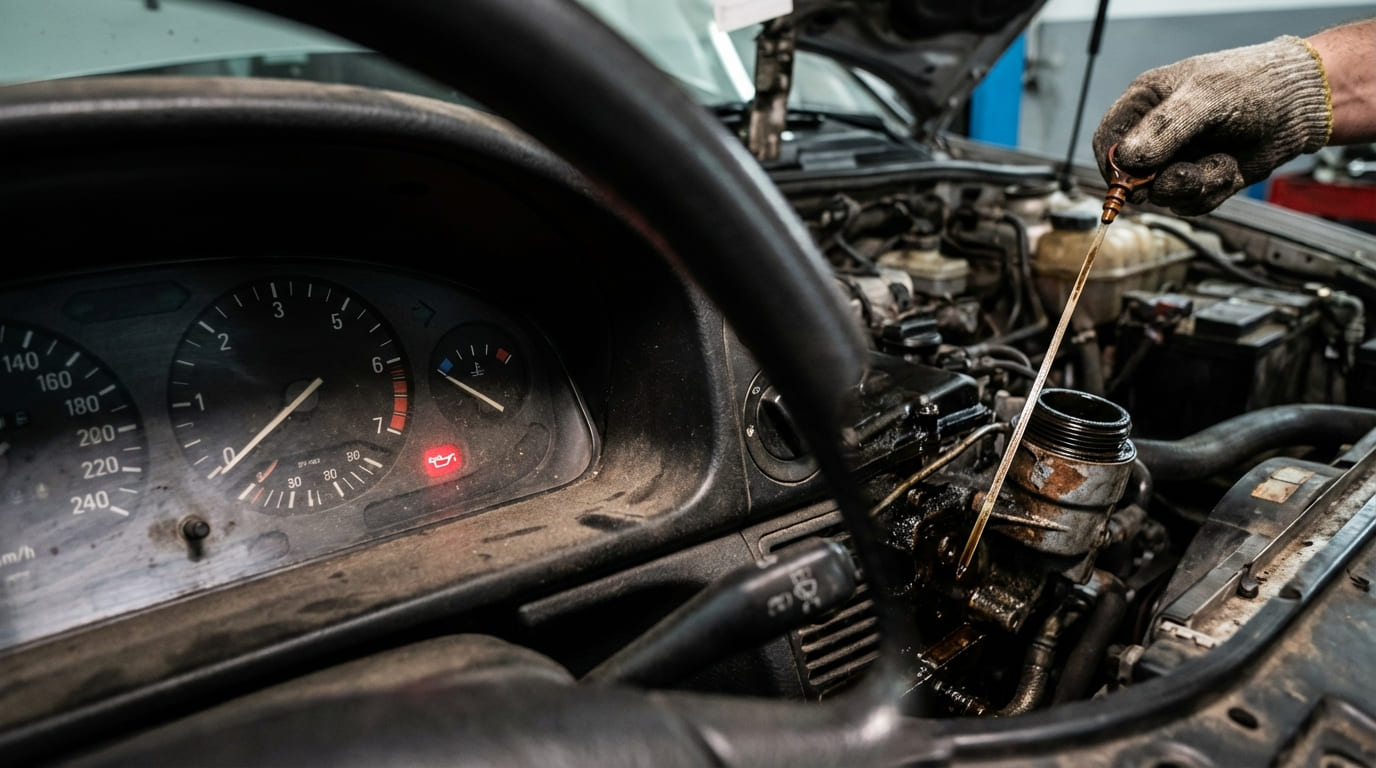
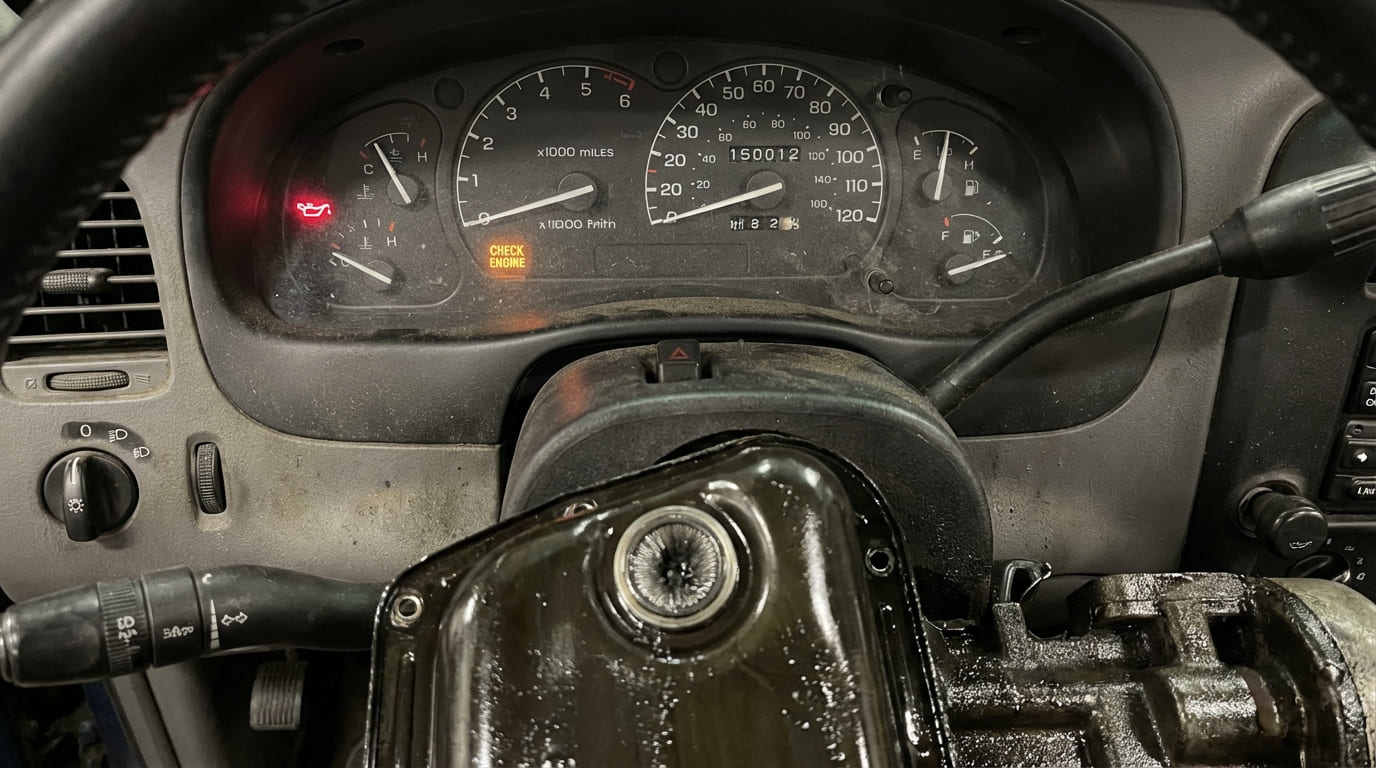
Low oil pressure at hot idle—especially with a knock—is a red flag. While oil pumps and filters can fail, excessive clearance between crank journals and bearings is a common cause. As oil thins when hot, too much clearance lets pressure bleed off.
How to check: Install a mechanical oil pressure gauge at the engine’s main oil gallery. If pressure drops below 10 psi at hot idle (on engines rated for 15–20 psi), and you have noise, the lower end is suspect. Rule out simple causes first: wrong oil viscosity, clogged pickup, or a failing oil pump. Use the correct oil grade—especially in high-mileage engines.
Metallic particles in oil or filter are a strong indicator of internal wear. Iron flakes suggest crankshaft journal wear; copper, lead, or aluminum point to bearing material.
How to check: Cut open the oil filter and inspect the media. Use a magnet: iron sticks, but bearing material doesn’t. For accuracy, send an oil sample for spectroscopic analysis. A rising iron trend over 2–3 changes confirms active wear. One-time debris could be leftover from a rebuild—context matters.
I’ve seen engines run 50,000 miles with metal in the filter. Consistency matters more than presence. If iron levels keep climbing, tear down before catastrophic failure.
Performance and Secondary Indicators
These aren’t primary symptoms, but they can point to crank issues when combined with other signs.
Engine misfires under load can stem from crankshaft deflection altering the crank position (CKP) sensor signal. If the crank wobbles, the reluctor wheel moves in and out of sensor range, causing timing errors.
How to check: Scan for misfire codes and check cam-to-crank correlation data with a lab scope. If timing fluctuates under load and fuel/spark systems test fine, suspect mechanical instability. This is rare—but when it happens, it’s often missed.
Sudden engine seizure or rod throw means failure has already occurred. At this point, the crank is usually damaged, but may not be the root cause. Oil starvation, detonation, or a spun bearing often takes out a good crank.
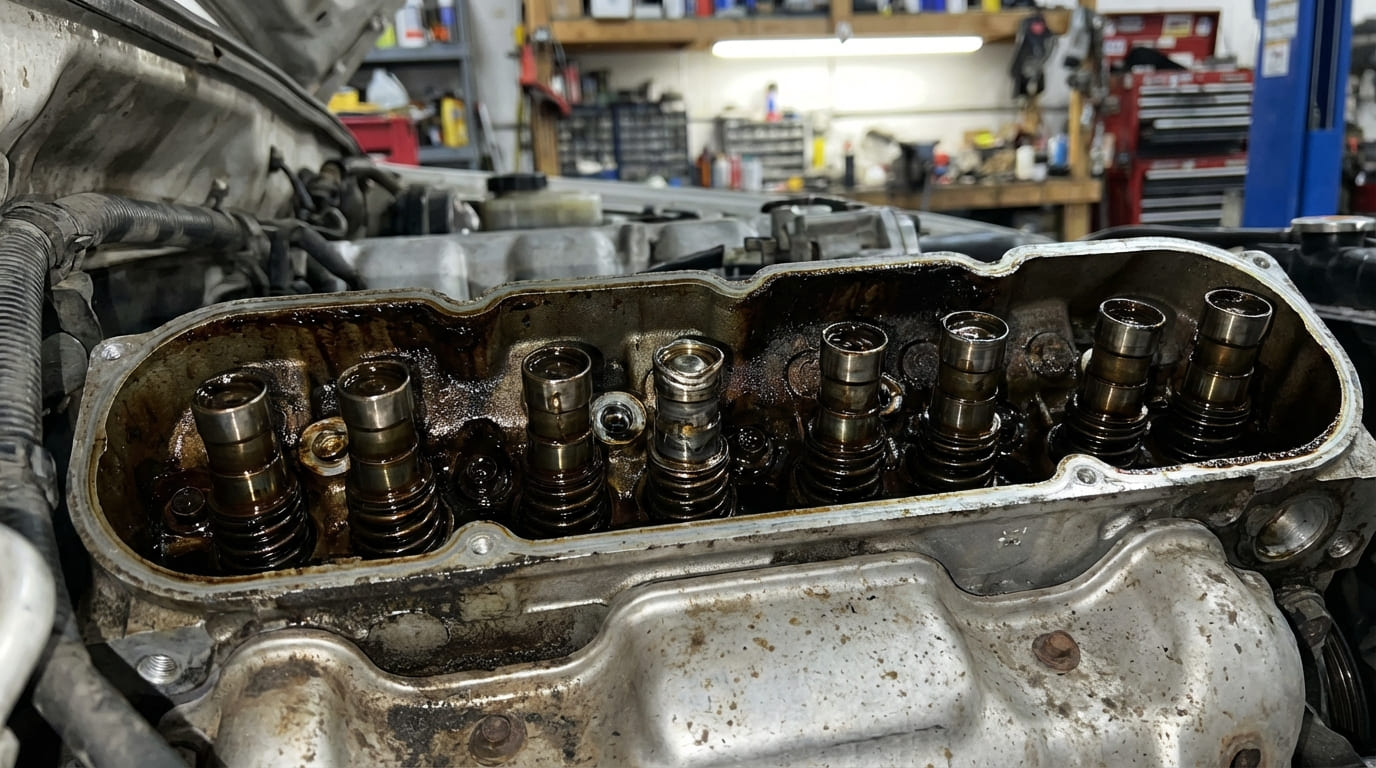
How to check: If the engine won’t turn by hand at the balancer bolt, disassembly is required. Look for wiped bearings, scored journals, or broken rods. A spun rod bearing leaves a dark, smeared pattern on the journal.
Visual and Measurement Inspection (After Disassembly)
Once the engine is apart, here’s what to look for—and how to measure it.
Scoring, pitting, or discoloration on journals: Scoring comes from dirt or debris in oil. Pitting may indicate corrosion or cavitation. Blue or black discoloration means overheating from metal-to-metal contact.
How to check: Clean journals with solvent and inspect under bright light. Use a micrometer to measure each journal at three points: front, center, and rear, and rotate 90° for out-of-round. Taper or out-of-round beyond 0.0005″ is a concern. Surface finish should be smooth—roughness over 16 microinches (Ra) accelerates bearing wear.
Excessive end play: Even if the crank turns freely, axial movement must be within spec.
How to check: Mount a dial indicator on the flywheel flange or balancer. Apply hand pressure—no pry bars—to avoid damage. Inspect the thrust bearing halves for uneven wear, which can indicate misalignment or block warpage.
Cracks or fractures: These are fatal. Cracks often form in fillet radii or near oil holes—high-stress zones.
How to check: Perform a magnetic particle (Magnaflux) inspection on forged or high-performance cranks. Dye penetrant works for surface cracks, but MPI is more reliable. Any crack means replacement—no exceptions.
I’ve seen shops weld or grind cracked cranks. I don’t recommend it. The risk of recurrence is too high, especially under load. Replace it—your engine depends on it.
Repair vs. Replace: Cost and Viability
Rebuilding a crankshaft isn’t always cost-effective. Here’s how to decide.
| Condition | Repair Option | Cost Range | Verdict |
|---|---|---|---|
| Minor scoring or taper | Grind and polish | $200–$400 | Worth it if block is sound and bearings are replaceable |
| Journal undersized beyond standard grind | Oversize bearings or replacement | $150 (bearings) or $400+ (new crank) | Replace crank if multiple grinds already done |
| Crack in fillet or oil hole | None—replace only | $400–$1,200 | Always replace. No safe repair. |
| Thrust surface wear | Rebuild or replace | $300–$800 | Replace if scoring deep or block alignment is off |
For most daily drivers, a remanufactured crank ($400–$700) beats custom grinding. It’s clean, certified, and often comes with warranty. Save the blueprinting for race builds.
Diagnostic Decision Table
| Symptom | Most Likely Causes | Less Common But Possible | Action Step |
|---|---|---|---|
| Low oil pressure + knock | Worn main/rod bearings, crank journal wear | Oil pump wear, wrong oil viscosity | Confirm with mechanical gauge; inspect bearings during disassembly |
| Grinding on clutch engagement | Excessive crank end play, thrust bearing wear | Transmission input shaft binding, pilot bearing failure | Measure end play; inspect thrust bearing and transmission alignment |
| Metallic debris in oil | Bearing wear, crank journal scoring | Previous repair debris, timing chain wear | Perform oil analysis; inspect filter and bearing surfaces |
| Engine misfires under load | Crank deflection affecting CKP signal | Ignition fault, fuel delivery issue | Rule out primary systems first; check crank and timing components |
Best Practices: What I Do in My Shop
- ✅ Clean all main and rod bolt threads with a tap and blow out oil galleries. Debris causes false torque and bearing spin.
- ✅ Measure bearing clearance with Plastigage or micrometer + bore gauge. Never assume fit.
- ✅ Check crank alignment (barrel test) on rebuilt engines. Misaligned mains cause rapid wear.
- ⚠️ Never reuse torque-to-yield (TTY) bolts. They stretch—reusing risks bolt failure and bearing damage.
- ⚠️ Don’t ignore block deck flatness. A warped block distorts main bores and destroys bearings.
- ⚠️ Never install a crank without verifying oil clearance. Even new cranks can be out of spec.
A 2008 Ford F-150 with 180,000 miles came in with a deep knock. Assumed rod bearing. Found main bearing clearances excessive—especially rear. Journals had taper, no scoring. Oil analysis showed high iron, low copper. The block’s main caps were moving under load due to worn dowels. Replaced caps and align-honed mains. Fixed. Lesson: not every knock is a rod. Pinpoint the source.
A rebuilt SBC lost oil pressure. Assumed oil pump. Found mechanical gauge confirmed low pressure. Disassembly revealed main bearings glazed, crank journals undersized by 0.0015″—grinder overcut. Bearings couldn’t compensate. Lesson: measure every crank, even “new” ones. Assumptions cost money.
A diesel pickup ground on startup. Replaced starter, then flywheel—twice. Third flywheel failed. Measured crank end play: 0.018″ (spec: 0.007″). Thrust bearing destroyed. Root cause: clogged PCV system pushing crank forward. Lesson: diagnose the system, not just the broken part.
Crankshaft wear is rarely isolated. It’s the end result of oil issues, contamination, poor assembly, or overlooked clearances. Diagnose the why, not just the what. Always use the factory service manual for specs—what works on a cast V8 may not apply to an aluminum import. The engine doesn’t care what you think. It only responds to what’s actually there.