In my 20+ years turning wrenches in independent shops and dealing with the aftermath of botched timing jobs, one question comes up more than almost any other: “How much should a timing belt replacement cost?” The short answer? You’re typically looking at between $500 and $1,500, but that number can shift dramatically based on several factors. Let me break it down the way I would for a tech walking into my bays or a serious DIYer asking for real talk.
Average Cost Range for Timing Belt Replacement
That $500–$1,500 range reflects real-world data across hundreds of jobs—from economy sedans to European performance models. The cost breaks down into two main components: labor and parts. Understanding both helps you evaluate quotes and avoid surprise bills.
Labor and Parts Breakdown
Labor typically makes up 60–80% of the total cost. Most timing belt jobs take 4 to 10 hours, depending on engine layout and access. Independent shops charge $75–$125/hour; dealerships and specialty shops often bill $120–$200/hour, especially in metro areas. A difference of $50/hour over 8 hours adds $400 to your bill—so shop rate matters.
Parts usually run $150–$500. A quality timing belt kit includes the belt, tensioner, and idler pulleys. I always recommend replacing the water pump if it’s driven by the timing belt—it’s behind the cover, and labor dominates the cost. A new pump is $50–$200. While you’re at it, replace crank and cam front seals ($10–$50 each) if there’s any sign of seepage. Factor in $20–$50 for coolant and possibly $30–$100 for serpentine belts if they’re due.
In my shop, we always replace the water pump and front seals during a timing belt job on interference engines. The labor is already there—spending $100 on parts now saves $800 in labor later.
Key Factors That Affect Cost
There’s no one-size-fits-all price. These variables determine your final bill.
Engine Design and Accessibility
Inline-4 engines with good access (like in most Toyotas) are faster to work on—4 to 6 hours. V6 engines, especially transverse-mounted ones, often require removing the radiator, fans, or even engine mounts. That can push labor to 8–10 hours. Some Volvos and Audis need AC compressor removal—adding two hours and complexity.
If the water pump is timing-belt-driven (common in Honda, Toyota, Subaru, VW), it should be replaced. If it’s externally driven (like on some Nissans), you can skip it—unless it’s leaking or noisy.
Service Facility Type
Dealerships use OEM parts and charge higher labor rates, often totaling $1,200–$1,800. Independents may use quality aftermarket kits (Gates, Aisin) and charge less—$600–$1,200 for the same job. Specialty shops (e.g., European-only) invest in OEM tools and training, so their rates reflect that expertise.
Don’t assume dealership = best. I’ve seen independents with ASE-certified techs and OEM-level tooling outperform dealers on complex timing jobs. Ask about their experience with your specific engine.
Additional Components to Replace
While not mandatory, replacing these parts during a timing belt job is smart—and often cost-effective:
- Water pump: Replace if timing-belt-driven. Even if it looks fine, heat and age degrade internal seals.
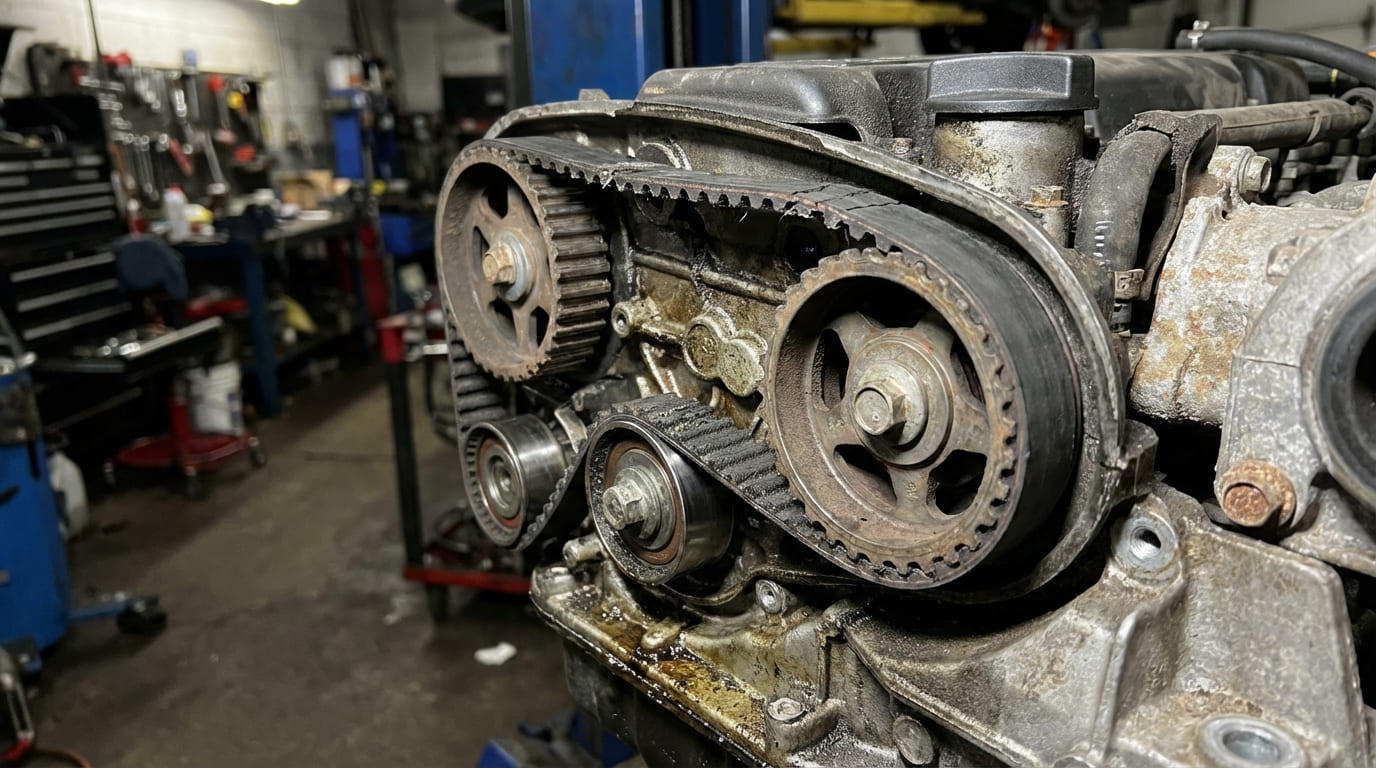
- Tensioner and idler pulleys: Bearings wear out. Spin them by hand—any roughness or play means replace.
- Front crank and cam seals: If you see oil residue near the timing cover, replace them now.
- Serpentine belts: Often removed for access. If cracked or glazed, swap them.
How to Diagnose Timing Belt Wear (Before Failure)
You can’t always see belt damage without removal, but here’s how to check:
- Remove the timing belt inspection cover (if equipped) to visually inspect for cracks, fraying, or missing teeth.
- Check for glazed or shiny spots—signs of slippage.
- Listen for ticking or slapping noises from the front of the engine.
- Scan for trouble codes like P0016 (cam/crank correlation) or P0300 (random misfire)—can indicate timing jump.
- Inspect the tensioner: if the plunger is fully extended or stuck, it’s failed.
If your car has over 60,000 miles and you don’t know the belt’s history, assume it needs replacement. Don’t rely on mileage alone—time degrades rubber.
Interference vs. Non-Interference Engines: The Stakes
This is the biggest risk factor. If your engine is interference, a broken belt can destroy the engine. Pistons hit open valves, bending them or cracking pistons. Repair costs often exceed $3,000—more than a used engine.
Non-interference engines won’t suffer internal damage, but you’ll still be stranded. Tow and labor add up.
How to check your engine type:
- Consult your owner’s manual.
- Use a trusted database like Gates or Gates Timing Belt Reference.
- Search “[Your Year, Make, Model] interference engine” and verify with multiple sources.
I don’t trust forums for this. I pull up the factory service manual or use OEM databases. One wrong assumption can cost thousands.
Recommended Service Interval
Replace the timing belt every 60,000 to 100,000 miles or 5 to 7 years—whichever comes first. Some turbocharged engines (like GM Ecotec or VW TSI) require changes at 60,000 miles. Always follow the factory schedule for your specific model.
Low-mileage cars aren’t immune. Heat cycles and ozone degrade rubber. I’ve seen belts on 40,000-mile cars that were cracked and delaminating.
DIY: Is It Worth the Risk?
I’ll be straight: this isn’t a beginner job. On interference engines, a one-tooth timing error can cause catastrophic damage. You’ll need:
- Timing belt kit (belt, tensioner, idlers)
- Water pump (if applicable)
- Torque wrench (critical for cam bolts)
- Cam locking tools and crank pin (OEM-specific)
- Harmonic balancer puller (some models)
- OBD2 scanner to check cam/crank correlation
Steps to verify your work:
- Rotate the engine by hand two full revolutions—should be smooth with no resistance.
- Recheck all timing marks with crank at TDC.
- Use live data on an OBD2 scanner to confirm cam and crank sensors are synchronized.
- Listen for unusual noises on startup. Rough idle or misfires could mean incorrect timing.
In my shop, we never reuse torque-to-yield (stretch) bolts. They lose clamping force. If the manual says “replace,” do it—$5 for a bolt isn’t worth a dropped cam gear.
Smart Practices vs. Costly Mistakes
- ✅ Do: Clean bolt threads with a tap before reinstalling. Oil on threads increases clamping force and can stretch bolts.
- ✅ Do: Replace the water pump if it’s behind the timing cover. Labor is 90% of the cost—parts are cheap insurance.
- ✅ Do: Inspect idler and tensioner bearings for smooth rotation and zero play.
- ⚠️ Don’t: Reuse torque-to-yield bolts unless the factory explicitly allows it.
- ⚠️ Don’t: Skip the full timing kit. Old tensioners cause 30% of premature belt failures.
- ⚠️ Don’t: Assume timing marks are foolproof. Some engines have two TDC positions—verify with a piston stop or dial indicator.
Real-World Lessons from the Shop
Situation: 2012 Subaru Outback, 98,000 miles. Previous shop quoted $1,400 for timing belt, water pump, seals. Owner delayed. Broke down a month later.
Discovery: Not a broken belt—collapsed idler bearing caused timing jump. Engine was non-interference, but still left owner stranded.
Lesson: Idlers and tensioners wear out too. Replace the full kit—it’s the weakest link.
Situation: DIYer replaced belt on 2008 Honda Accord. Engine ran rough, threw P0300.
Discovery: Cam timing was one tooth off. Crank gear had slipped on a worn harmonic balancer.
Lesson: Verify TDC with a piston stop. Don’t trust marks alone—especially on engines with known balancer issues.
Situation: 2015 VW Passat, 72,000 miles. Skipped water pump replacement two years prior. Now leaking coolant.
Discovery: Original pump seal failed, impeller corroded. Coolant flow was restricted, causing minor overheating.
Lesson: Heat and coolant degrade pumps over time. Replace it during timing job—it’s not overkill, it’s smart.
Cost Estimates by Vehicle Type
| Vehicle Type | Labor Hours | Parts Cost | Labor Cost (Avg $100/hr) | Total Estimate | Notes |
|---|---|---|---|---|---|
| Inline-4 (e.g., Toyota Camry) | 4–6 | $200–$300 | $400–$600 | $600–$900 | Good access, common parts |
| V6 (e.g., Honda Pilot) | 6–8 | $250–$400 | $600–$800 | $850–$1,200 | More disassembly, water pump often included |
| Transverse V6 (e.g., Ford Fusion) | 7–10 | $300–$450 | $700–$1,000 | $1,000–$1,500 | Tight space, possible mount removal |
| DOHC Turbo 4-Cyl (e.g., GM Ecotec) | 6–8 | $350–$500 | $600–$800 | $950–$1,300 | Special tools, higher parts cost |
Some people stretch timing belts to 120,000 miles if the car “feels fine.” I’ve seen too many engines ruined by that gamble. Rubber degrades invisibly. Always follow the factory service interval for your exact model and year. What’s true for one engine may not apply to another—even in the same brand.