After two decades in the shop, I’ve seen hybrids go from curiosities to common customers. The biggest mistake? Assuming complexity means fragility. In reality, these systems are built for efficiency and longevity—but they demand a different diagnostic mindset. This guide cuts through the theory and gives you what you need: how the system works, how to spot problems, and how to avoid costly mistakes.
How a Hybrid Powertrain Works: The Practical View
At its core, a hybrid combines an internal combustion engine (ICE) and one or more electric motor/generators (MGs) to maximize efficiency. The system decides—based on speed, load, and battery charge—whether to use electric power, engine power, or both. The goal isn’t complexity; it’s using the right power source at the right time.
Key Components and How to Check Them
Understanding each part helps you diagnose issues faster. Focus on function, not just names.
| Component | Role | Common Failures | Diagnostic Tips |
|---|---|---|---|
| Internal Combustion Engine (ICE) | Drives wheels or charges battery; often Atkinson-cycle for efficiency | Carbon buildup, infrequent oil changes due to short trips | Check oil level and condition regularly. Use scan tool to see if engine starts unnecessarily—could point to battery or control issues. |
| Electric Motor/Generator (MG1 and MG2) | MG1: Starts engine, generates power. MG2: Drives wheels, regenerates | Open windings, bearing noise, coolant leaks into stator | Listen for whining or grinding. Use scan tool to check motor resistance and temperature. High temps may indicate cooling issues. |
| High Voltage (HV) Battery Pack | Stores energy for electric drive and regen | Cell imbalance, cooling pump failure, capacity fade | Monitor state of charge (SoC) via scan tool. If SoC drops below 40% or won’t rise above 60%, check cooling system and cell voltages. |
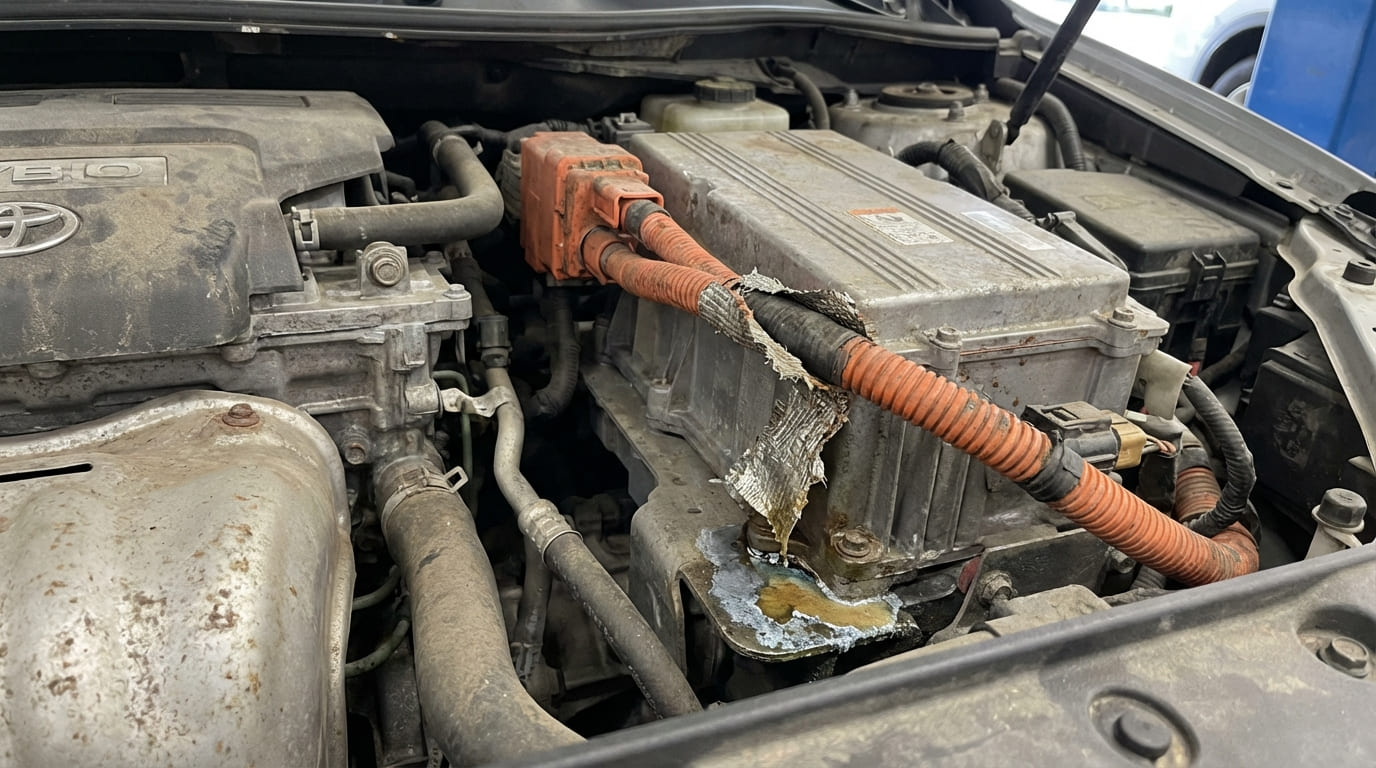
| Power Control Unit (PCU) / Inverter | Converts DC to AC for motor, manages power flow | Failed IGBTs, coolant ingress, overheating | Check for error codes like P0A80 (battery module). Inspect inverter coolant hoses for leaks. Verify DC-DC output with multimeter. |
| Hybrid Transaxle | Combines power from ICE and MGs; often uses planetary gear set | Worn seals, low fluid, solenoid issues (in Honda systems) | Check fluid level and color. Dark or burnt fluid needs replacement. Shuddering during mode shifts? Scan for solenoid performance. |
How to Diagnose Without Guessing
Hybrid problems often look like major failures but stem from simple causes. Always follow this order:
- Check the 12V battery first. A weak 12V battery prevents the hybrid system from engaging. Test voltage (should be 12.6V resting) and load-test it.
- Scan for codes with a factory-level tool. Generic OBD2 scanners miss HV and motor data. You need access to hybrid-specific PIDs: SoC, MG temps, inverter voltage, regen status.
- Inspect fuses and grounds. A corroded ground near the fuse box can kill communication with the hybrid ECU. Clean and reseat all relevant connections.
- Verify brake switch operation. The hybrid system needs to know the brake pedal is pressed to enter “Ready” mode. Use a multimeter to test switch continuity.
- Check HV interlock loop. This safety circuit disables HV if a connector is loose. Inspect under-hood and underfloor HV connectors for damage or moisture.
In my shop, we always test the 12V system before touching the HV battery. I’ve saved customers thousands by replacing a $120 battery instead of condemning a $2,500 inverter.
When the Battery Isn’t the Problem
Most owners assume “Check Hybrid System” means a bad battery. Often, it’s not. Here’s what to consider first:
- Cooling system failure: If the HV battery overheats, the system limits EV mode and regen. Check coolant level, pump operation, and fan function.
- Driver settings: Some PHEVs have “Hold Charge” or “Mountain Mode” that prevents battery depletion. Verify mode via instrument cluster or scan tool.
- Low ambient temperature: Below 40°F, many hybrids limit regen and EV driving. This is normal—don’t assume failure.
One Prius came in with “engine runs constantly.” Owner thought the battery was dead. Scan data showed the battery coolant pump wasn’t running. $180 pump fixed it. Moral: thermal issues mimic battery failure.
Repair vs Replace: Cost and Viability
Replacing major hybrid components is expensive. Know when to repair, rebuild, or replace.
| Component | Repair Option | Replace Cost (OEM) | Rebuild Option |
|---|---|---|---|
| HV Battery | Cell replacement, reconditioning | $1,800–$4,500 | $800–$1,500 (third-party) |
| Inverter (PCU) | Capacitor or IGBT replacement | $2,000–$3,500 | $600–$1,200 (refurbished) |
| Transaxle | Seal or solenoid replacement | $2,500–$4,000 | $1,000–$2,000 (rebuilt) |
Before replacing a $3,000 inverter, check the DC-DC output. If it’s not delivering 14V, the issue might be a $200 converter, not the inverter.
Operational Modes: What’s Normal vs What’s Not
Hybrids shift between modes automatically. Know what to expect:
- EV Mode: Normal at low speeds and light loads. If unavailable, check SoC, temperature, and drive mode.
- Hybrid Driving: ICE and MG2 work together. Engine may restart frequently in cold weather—this is normal.
- Regenerative Braking: Should engage when lifting off throttle. If brake pedal feels “grabby,” regen may be disabled—scan for faults.
- Engine-Off Coasting: Engine shuts off during decel. If it stays on, check for high electrical load (e.g., HVAC).
- Power Boost: Both ICE and MG2 deliver max power during hard acceleration. Expect loud engine noise—it’s working as designed.
Diagnostic Flow: If X, Then Check Y
| Symptom | Most Likely Causes | Action |
|---|---|---|
| No “Ready” mode | Low 12V battery, brake switch fault, HV interlock open | Test 12V battery, verify brake light operation, inspect HV connectors |
| Limited EV driving | Cold battery, “Hold” mode active, cooling issue | Warm up vehicle, check drive mode, scan battery temp |
| Engine runs constantly | Battery not charging, high load, failed MG | Scan for MG output, check HVAC settings, test battery charge acceptance |
| Excessive brake effort | Vacuum pump failure, brake booster leak, regen disabled | Check vacuum at booster, scan for regen status, inspect pump operation |
A Honda Accord Hybrid wouldn’t start. Scan tool showed no hybrid ECU communication. Found a corroded ground near the fuse box. Cleaned it—fixed. Lesson: high-voltage systems rely on low-voltage signals. Never skip the basics.
Best Practices: Do This, Avoid That
- ✅ Do: Use insulated tools and disconnect HV before working near battery or inverter.
- ✅ Do: Update hybrid control software—TSBs often fix false fault codes.
- ✅ Do: Monitor battery health over time using scan tool data.
- ⚠️ Avoid: Opening the HV battery pack unless trained. Risk of shock or thermal runaway.
- ⚠️ Avoid: Assuming SoC fluctuation means failure. Systems adjust usable range as battery ages.
- ⚠️ Avoid: Using non-OEM replacement parts for PCU or battery—compatibility issues are common.
Hybrid powertrains reward methodical diagnosis. The system protects itself—so when a fault occurs, it’s often due to a small, fixable issue. Always start simple: 12V battery, fuses, grounds, and driver settings. Save the big repairs for when diagnostics confirm it. And never forget: what works on a Prius may not apply to a Volt or Fusion. Use the right service manual, and respect the details.