The Diesel Particulate Filter (DPF) is a critical component in modern diesel emissions systems. As a master mechanic, I’ve seen countless DPF-related breakdowns that could’ve been avoided with proper understanding and maintenance. This guide cuts through the noise and gives you what you need to know to diagnose, maintain, and avoid costly failures.
What the DPF Does: Real-World Function
The DPF’s job is simple: trap soot from diesel exhaust before it exits the tailpipe. It captures 85% to over 95% of particulate matter, especially during low-speed or cold operation when combustion is incomplete. Without it, you’d see black smoke on acceleration. But the DPF isn’t a set-and-forget part—it actively manages soot through regeneration and must be monitored.
Ash, unlike soot, doesn’t burn off. It comes from engine oil additives and fuel impurities. Over time, ash builds up permanently. In my shop, DPFs typically last 100,000 to 300,000 miles before ash becomes a problem—highly dependent on oil quality and driving habits.
How to Check DPF Health: Diagnostics That Work
Don’t wait for a warning light. Proactive checks prevent derates and limp mode. Here’s how to assess DPF condition:
- Scan for DPF soot load: Use a capable scan tool to read real-time soot accumulation (usually in grams). Most systems trigger regeneration between 40–60% load. Over 80% and you’re at risk of forced reg or derate.
- Check differential pressure: The delta-P sensor measures pressure before and after the DPF. If readings are flat or erratic, inspect the pressure tubes. Condensation or soot blockage is common—replace hoses with drip loops to prevent recurrence.
- Verify regeneration history: Look for completed, aborted, or failed regens. Frequent active regens suggest a problem—either driving pattern or mechanical fault.
- Inspect exhaust flow: Remove the DPF (if accessible) and check for heavy soot or ash. A flashlight down the inlet channels can reveal blockage. If you can’t see through, it’s time for cleaning or replacement.
In my shop, we always check the DOC’s efficiency before condemning a DPF. If the DOC isn’t heating properly, regeneration fails—not because the DPF is bad, but because the system upstream is compromised.
DPF Construction: What’s Inside and Why It Matters
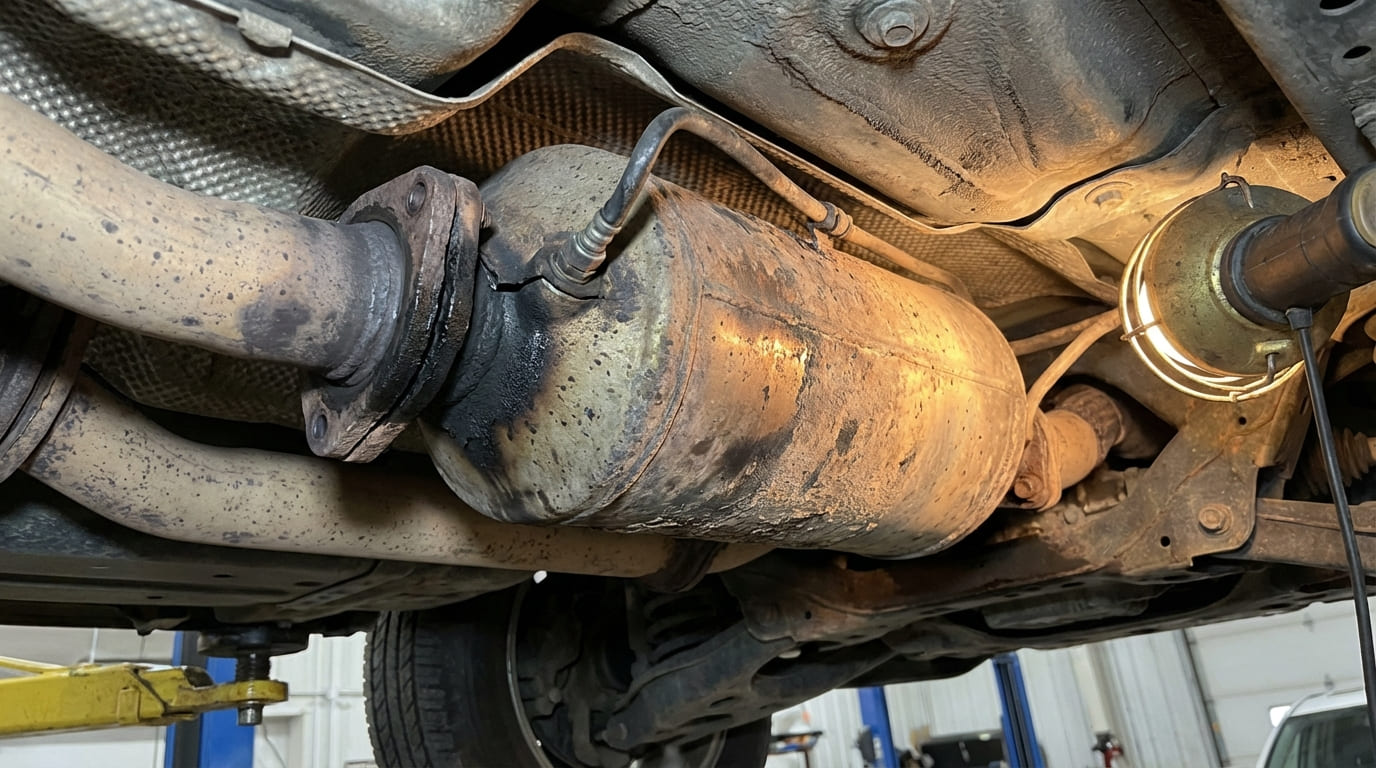
The DPF is a ceramic filter housed in a stainless steel can. Three materials are common:
| Material | Max Temp | Best For | Weakness |
|---|---|---|---|
| Cordierite | 1,000°F | Light-duty trucks | Degrades above temp; prone to cracking |
| Silicon Carbide | 1,600°F | Heavy-duty engines | Brittle; expensive |
| Aluminum Titanate | 1,400°F | Newer high-load engines | High cost; limited availability |
The filter uses a wall-flow monolith design: exhaust enters open inlet channels, but each is plugged at the far end. Gas must pass through porous 10–20 micron walls to exit adjacent outlet channels. This forces all exhaust through the filter media.
The “cake layer” of soot on the inlet side actually improves filtration over time—but increases backpressure. When pressure climbs too high, the system must regenerate.
Regeneration: How the DPF Cleans Itself
Regeneration burns off soot at high temperatures. There are three types:
Passive, Active, and Forced Regeneration
Passive regeneration happens during highway driving when exhaust temps exceed 575°F. The DOC oxidizes hydrocarbons, creating heat that burns soot in the DPF. No driver input needed—but short trips prevent it.
Active regeneration is triggered by the ECM when soot load reaches threshold. The system raises exhaust temps to 1,000–1,200°F using:
- Fuel post-injection: Late fuel shot ignites in the DOC. Risk: if injectors leak, excess fuel can overheat the DPF.
- Intake throttling + EGR control: Reduces airflow to increase exhaust temp. Slower but safer. Fails if EGR valve is sticky or intake is clogged.
Forced regeneration is done with a scan tool. Takes 20–40 minutes. Vehicle must stay running, undisturbed. Never run a forced reg with low coolant or oil—thermal runaway can melt the substrate.
Forced reg failed? Don’t repeat it. Check for root causes: leaking injectors, degraded DOC, or EGR issues. Repeating the cycle without fixing the problem just adds heat and risk.
When Regeneration Fails: What Really Causes It
Most “DPF failures” aren’t the filter’s fault. Here’s what to check first:
| Symptom | Most Likely Causes | Less Common but Possible |
|---|---|---|
| High backpressure code | Soot overload, failed regeneration, blocked pressure lines | Cracked DPF, collapsed housing, faulty delta-P sensor |
| Regeneration incomplete | Short drive cycles, low exhaust temp, DOC degradation | Post-injection fault, EGR valve sticking, wrong oil type |
| Frequent regeneration requests | Engine blow-by, poor combustion, wrong fuel | Incorrect DPF size, aftermarket tuning |
| Excessive fuel in exhaust | Leaking injectors, over-fueling, late combustion | Faulty temp sensors, flawed reg strategy |
A 2015 Ram 3500 came in with constant DPF warnings. No DOC or EGR faults. We assumed a clogged DPF. After forced reg failed, we tested the DOC—its light-off temp was 150°F too high. Lab results showed washcoat loss from coolant contamination due to a cracked head. Replaced the head, and the DPF worked fine. Lesson: diagnose upstream first.
A delivery van kept derating despite highway runs. Data showed normal temps and speeds. Delta-P readings were erratic. Found one pressure tube filled with condensation. Replaced it with a drip loop—problem solved. Sensor lines are cheap, but when they fail, they mimic catastrophic DPF issues.
A rebuilt engine threw DPF faults in 2,000 miles. Assumed DPF issue. Compression test revealed one cylinder with high blow-by. Piston ring gap was wrong—letting oil and carbon into the exhaust. Fixed the engine, and the DPF stabilized. Mechanical health directly impacts aftertreatment.
Repair vs Replace: Cost and Viability
DPFs are expensive. New OEM units range from $1,500 to $4,000+, plus labor. Before replacing:
- Try a professional DPF cleaning service—costs $200–$500. Effective if ash load is under 70% of capacity.
- Check ash level via OEM diagnostic software if available. Some systems report ash accumulation in grams.
- Avoid “universal” or aftermarket DPFs. Flow characteristics and substrate design are engine-specific. Mismatches cause regen failure and high backpressure.
If ash exceeds 70% or the substrate is cracked, replacement is the only reliable fix.
Best Practices for Long DPF Life
- Use only low-ash oil: CJ-4, CK-4, or FA-4 as specified. High-ash oil accelerates ash buildup.
- Inspect pressure hoses every oil change: Blow them out or replace if clogged. Install drip loops to prevent condensation traps.
- Avoid interrupting regeneration: If the “regen in progress” light is on, don’t shut off the engine. Stalled regens increase soot load.
- Verify regen completion with a scan tool: Don’t rely on dashboard lights. Some systems show completion even if the cycle aborted.
- Never force a regen with low coolant or oil: Overheating can destroy the DPF and downstream components.
The DPF works well when the entire system is maintained. It’s not a flaw—it’s a precision component that depends on proper operation, quality fluids, and smart diagnostics. Always refer to the OEM service manual for regeneration procedures, fault thresholds, and component specs. What works on a Duramax may not apply to a Power Stroke or Cummins.