Loss of engine power, sluggish acceleration, or hesitation under load are among the most common complaints we see in the shop. These issues can stem from multiple systems, and guessing the cause wastes time and money. As a master mechanic with 20 years in the field, I’ve learned that a structured diagnostic approach beats part-swapping every time. This guide focuses on real-world causes, how to test for them, and when repair makes sense over replacement.
Fuel System Deficiencies
When the engine can’t get enough fuel under demand, performance suffers—especially during acceleration or uphill driving. Don’t assume the fuel pump is bad right away. Test first.
How to Check Fuel Delivery
Start with a fuel pressure and volume test. Pressure tells you if the system is strong at idle; volume shows whether it can sustain demand. A pump might hold pressure at idle but fail under load due to wear or clogged inlet.
- Clogged fuel filter: Common on older port-injected engines. Replace every 30,000–60,000 miles. Cost: $15–$50. If your vehicle doesn’t have an in-line filter, check the in-tank strainer.
- Failing fuel pump: High-mileage vehicles (100k+ miles) are prime candidates. Listen for whining or delayed startup. Test volume: most engines need 1 pint (16 oz) in 15 seconds. Pump replacement: $150–$400 (DIY), $500–$1,000 (shop).
- Leaking fuel pressure regulator: Found on return-style systems. A ruptured diaphragm pulls fuel into the intake, causing a rich condition. Check vacuum line for fuel smell or residue. Replace regulator: $50–$120.
- Clogged injectors: Direct injection engines are prone to tip carbon. Use a cylinder balance test via scan tool. If one cylinder lags, swap injectors and retest. Professional cleaning: $100–$200. Replacement: $150–$300 (set).
- Contaminated fuel: Water or debris in tank. Drain a sample from the fuel rail or filter. Add isopropyl alcohol to absorb water (only if small amount). Major contamination: fuel tank removal and cleaning ($300+).
In my shop, we always test fuel volume under load—not just pressure. A weak pump or clogged sock can pass idle pressure but fail during acceleration. Don’t skip the volume test.
Air Intake and Induction System Issues
Airflow problems directly affect the air-fuel ratio. Restrictions reduce power; unmetered air (vacuum leaks) leans the mixture and hurts efficiency.
How to Check Airflow and Leaks
Begin with a visual inspection: air filter, intake hose, clamps. Then use live data to check MAF readings and fuel trims. Long-term fuel trim (LTFT) above +10% at idle suggests a vacuum leak.
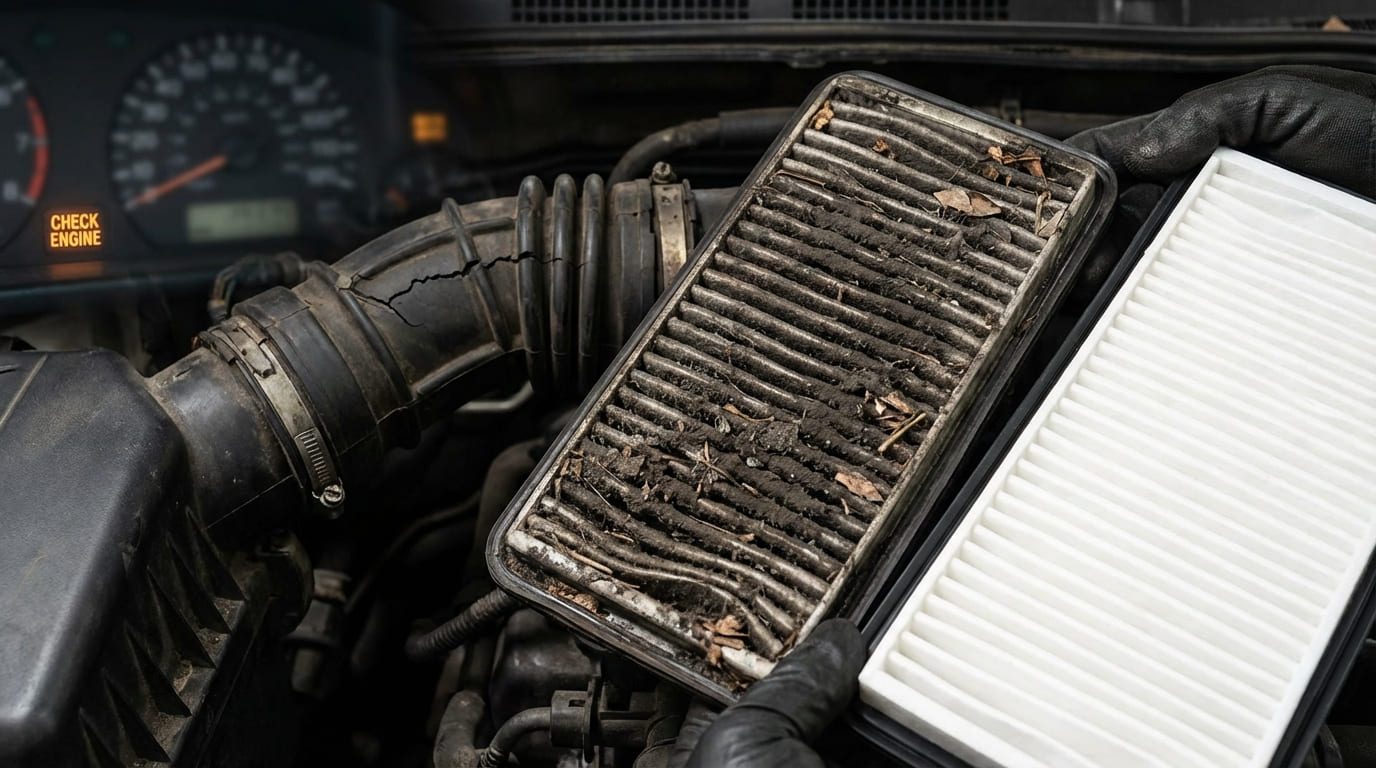
- Clogged air filter: Replace every 12,000–15,000 miles in dusty conditions. Cost: $15–$30. A dirty filter won’t cause major loss on modern engines but can contribute.
- Carbon buildup on intake valves: Common in direct injection engines. Symptoms: rough idle, hesitation, reduced low-end torque. Perform intake cleaning with a professional solvent tool. Cost: $150–$300. DIY kits exist but are less effective.
- Vacuum leaks: Cracked hoses, loose PCV lines, or intake manifold gaskets. Use a smoke machine or propane enrichment (carefully) to find leaks. Fix: replace hose or gasket ($20–$100).
Vacuum leaks are silent killers. They often don’t trigger codes but cause drivability issues. I always run a smoke test on cars with high fuel trims and no codes.
Turbocharger and Supercharger Problems
For forced-induction engines, boost delivery is critical. A 20% drop in boost can feel like a 40% power loss.
Use live data to compare commanded vs. actual boost. If actual lags, suspect:
- Stuck wastegate (mechanical or actuator)
- Leaking intercooler or charge pipe
- Clogged intercooler (road debris or oil buildup)
- Failing boost pressure sensor
Inspect all intercooler piping and clamps under boost. A leak may only appear at high pressure.
Boost leaks after the intercooler are easy to miss. I’ve found splits hidden behind brackets. Always pressurize the system or road-test with data logging.
Ignition System Failures
Weak spark doesn’t always cause a misfire code. It can delay combustion, reducing torque and efficiency—especially under load.
How to Diagnose Ignition Issues
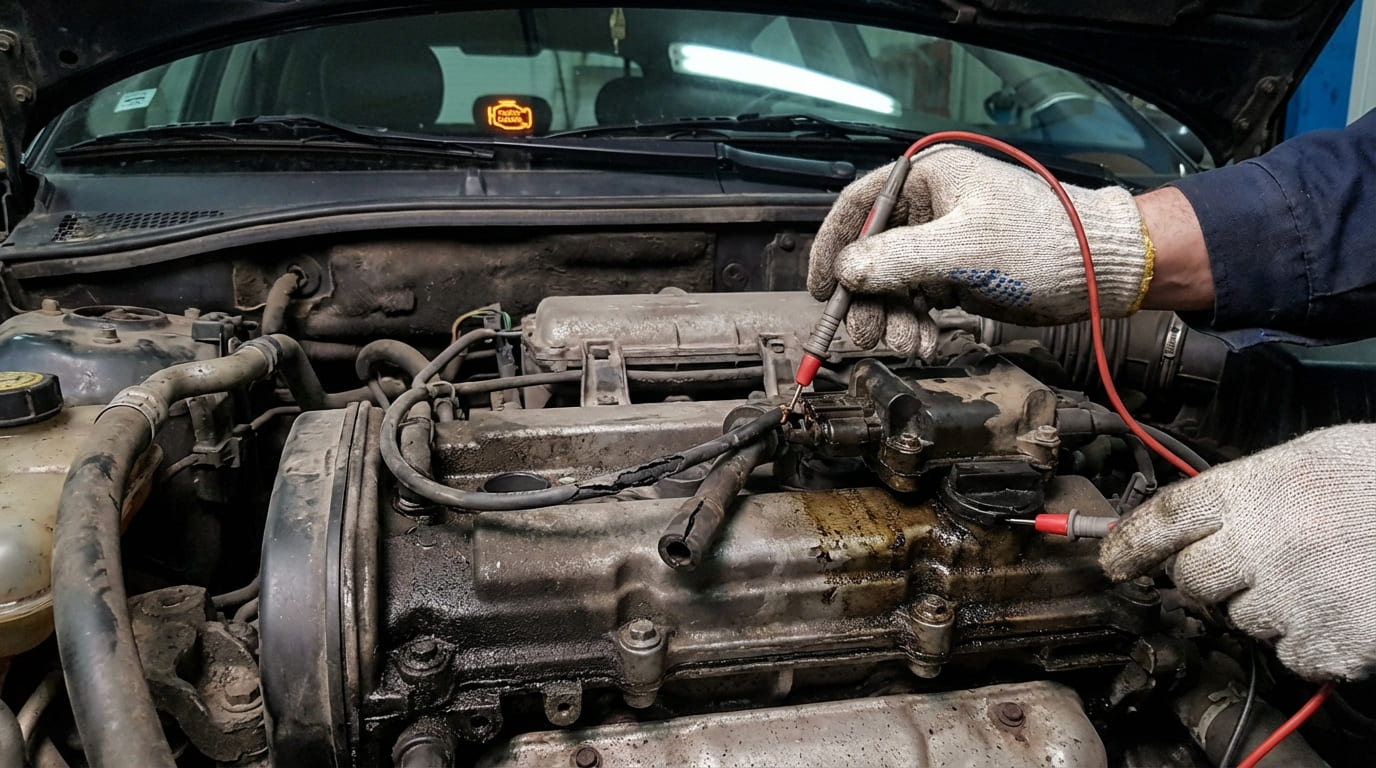
If you suspect ignition, perform a coil swap test: move a coil from a weak cylinder to a strong one. If the problem moves, replace the coil. Use an OBD2 scanner to check for pending misfire codes—even without a check engine light.
- Worn spark plugs: Check gap and electrode wear. Replace every 30,000–100,000 miles depending on type. Iridium lasts longer but costs more ($10–$20 per plug). Gapping is critical—use a wire gauge.
- Failing ignition coils: Common on high-mileage engines. Coils break down under heat and load. Replace in pairs if one fails—others are likely near end-of-life. Cost: $80–$150 per coil.
I always check spark plug gap and condition first. A stretched gap or eroded electrode can cause hesitation even if the plug “fires.” Don’t assume new plugs are gapped correctly from the box.
Exhaust System Restrictions
A clogged catalytic converter is a common but overlooked cause of power loss. The engine may idle fine but struggle to breathe at higher RPM.
How to Test for Clogged Cat
Perform a back pressure test: remove the upstream O2 sensor and install a pressure gauge. At 2,500 RPM, pressure should be less than 1.25 psi. Higher? Cat is likely clogged.
- Clogged catalytic converter: Replacement: $500–$2,000 (OEM vs. aftermarket). Theft is common—check if your vehicle is targeted.
- Crushed exhaust pipe: Inspect undercarriage. Even a slight crush can restrict flow.
I’ve seen engines run perfectly except for a lack of top-end power—all due to a melted substrate in the cat. Back pressure testing is fast and definitive.
Engine Mechanical Problems
When fuel, air, and spark check out, look inside the engine. Low compression or timing issues mimic other problems.
How to Test Engine Health
Perform a dry and wet compression test on all cylinders. Then follow up with a leak-down test if compression is low. Wet test helps determine if rings or valves are the issue.
- Low compression: Worn rings, damaged valves, or head gasket. Leak-down test will show where air escapes. Repair: $1,500–$4,000+.
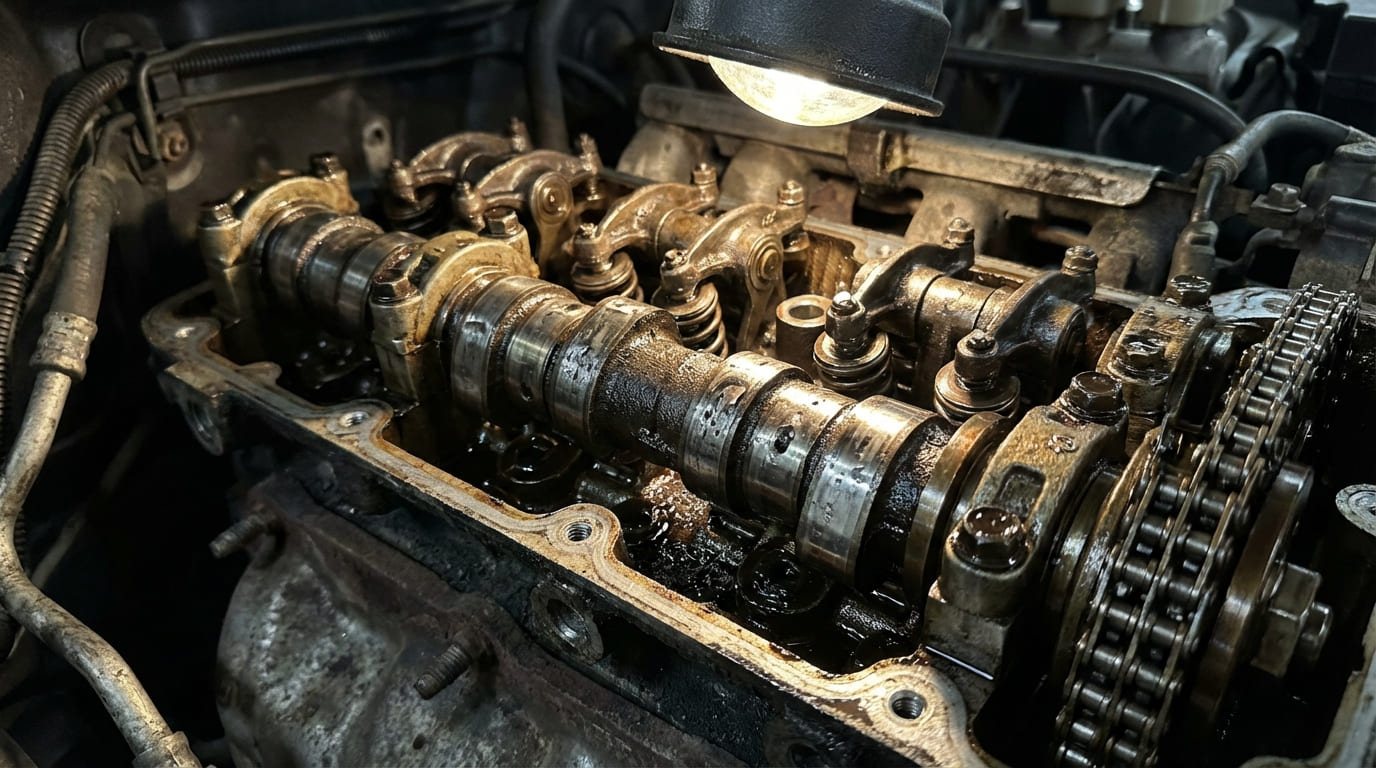
- Timing chain/belt jump: Common on engines with stretched chains (e.g., GM Ecotec, Ford 3.5L). Check camshaft timing with a scanner or physical marks. Jumped timing retards valve events, killing performance.
- VVT system failure: Oil pressure operates VVT actuators. Clogged solenoid screens (from sludge) delay timing. Clean solenoid and screen: $100–$200. Replacement: $200–$400.
On VVT engines, always check oil condition and screen on the solenoid. Sludge kills performance silently. Change oil every 5,000–7,500 miles, especially in stop-and-go driving.
Engine Management Sensor Failures
Modern engines rely on sensors. A faulty reading can throw off fuel, timing, and airflow control.
Key Sensors to Test
Use live data to verify sensor operation. Compare to known-good values.
| Sensor | Failure Symptom | Test Method | Repair Cost |
|---|---|---|---|
| MAF | Hesitation, lean/rich codes | Clean with MAF cleaner; check live data at idle and 3,000 RPM | $100–$300 |
| O2 (upstream) | Poor fuel economy, rough idle | Monitor cross-counts and response time | $150–$300 |
| ECT | Hard start, rich idle, retarded timing | Compare coolant temp to ambient at cold start | $50–$150 |
| MAP | Surging, poor load calculation | Compare to barometric pressure at key-on | $100–$200 |
Never replace a MAF sensor without cleaning it first. Most are dirty, not dead. After replacement, some vehicles require a relearn procedure—check service manual.
Drivetrain Power Loss
Sometimes the engine runs fine, but power doesn’t reach the wheels.
How to Check Clutch and Torque Converter
For manual: accelerate in 3rd gear at 2,500 RPM. Hold brake and release clutch slightly. If RPM climbs without car moving, clutch is slipping.
For automatic: perform a “flash stall” test (if safe). Hold brake, gently press throttle to WOT. Note RPM before movement. Compare to spec (usually 2,000–2,800 RPM). Higher? Torque converter slipping.
- Slipping clutch: Replacement: $800–$1,500 (DIY saves labor).
- Failing torque converter: Shudder during acceleration, high stall speed. Replacement: $1,000–$2,000.
I’ve diagnosed more “turbo problems” as clutch slip than I can count. Always verify power transfer before tearing into the engine.
Diagnostic Priority and Cost Guide
Fix the most likely and cheapest issues first. Here’s how to prioritize:
| Issue | Test | Cost to Fix | Repair vs Replace |
|---|---|---|---|
| Vacuum leak | Smoke test, fuel trim check | $20–$100 | Always repair |
| Fuel pump (weak) | Volume test | $150–$1,000 | Replace if volume low |
| Clogged catalytic converter | Back pressure test | $500–$2,000 | Replace if restricted |
| Ignition coil | Swap test, misfire data | $80–$150 | Replace faulty unit |
| Engine mechanical | Compression/leak-down test | $1,500–$4,000+ | Consider replacement if major damage |
Final Diagnostic Tips
- ✅ Always start with a visual inspection. A loose hose or disconnected plug takes 5 minutes to spot.
- ✅ Use live data. Fuel trims, MAF g/s, O2 response—these tell the real story.
- ✅ Test under load. Idle checks miss fuel volume, ignition breakdown, and exhaust restrictions.
- ⚠️ Don’t assume a code points to the failed part. A P0302 misfire could be fuel, compression, or even a clogged injector.
- ⚠️ Don’t reuse torque-to-yield (TTY) bolts. Head, main, and rod bolts stretch. Reusing them risks engine failure.
- ⚠️ Don’t skip oil and filter changes. Sludge kills VVT systems and camshafts over time.
Power loss is rarely one big failure. It’s usually a chain of small issues—dirty MAF, weak fuel pump, minor vacuum leak. Fix one, and the car feels better. Fix all, and it feels like new. Diagnose system by system, and you’ll save time and money.