Over two decades in the shop, I’ve seen diesel emissions systems evolve from simple mechanical setups to complex, computer-controlled ecosystems. One of the most misunderstood components is the Diesel Particulate Filter (DPF). When it works, it’s invisible. When it doesn’t, it can bring a vehicle to a crawl—or worse, trigger costly repairs. Let’s break down DPF regeneration the way we do it in the bay: methodically, with an eye for nuance and real-world conditions.
What Is DPF Regeneration?
DPF regeneration burns off soot trapped in the diesel particulate filter. If not cleared, soot builds up, increases exhaust back pressure, and causes power loss, poor fuel economy, or limp mode. Regeneration converts soot into gas (CO₂ and water vapor) through high heat, typically between 550°C and 650°C. This process is essential—and automatic—on modern diesel vehicles.
There are three types: passive, active, and forced. Each plays a role in keeping the DPF clean. Understanding how and when they occur helps avoid unnecessary repairs and costly replacements.
Passive Regeneration: The Silent Worker
Passive regeneration happens during normal highway driving when exhaust temperatures naturally reach 250–450°C. It requires no driver input or ECU intervention beyond normal operation. The Diesel Oxidation Catalyst (DOC) upstream converts NO into NO₂, which burns soot at lower temperatures—critical for daily driving.
How to check if passive regeneration is working:
- Monitor long highway drives: Vehicles used primarily for short trips often fail to complete passive regen.
- Use a scan tool to review soot load history: Look for gradual decreases after sustained driving.
- Check for split or leaking hoses on the DPF pressure sensor—common cause of false readings.
If your vehicle spends most time in city traffic, passive regeneration likely isn’t completing. This sets the stage for active cycles—and potential issues if those fail too.
Active Regeneration: When the System Takes Charge
When soot load reaches 40–60%, the ECM triggers active regeneration. This raises exhaust gas temperature (EGT) to 550–650°C using several methods:
- Post-injection: Extra fuel injected late in the combustion cycle burns in the exhaust, heating the DOC and DPF.
- Intake throttling: Partially closing the intake restricts airflow, increasing exhaust temperature.
- EGR reduction: Limiting exhaust gas recirculation raises combustion temps.
- Electric heaters (some models): Used to initiate heat in cold conditions.
Active regen typically lasts 15–30 minutes. You might notice:
- Higher idle speed (1,100–1,500 RPM)
- Slight fuel smell from the exhaust
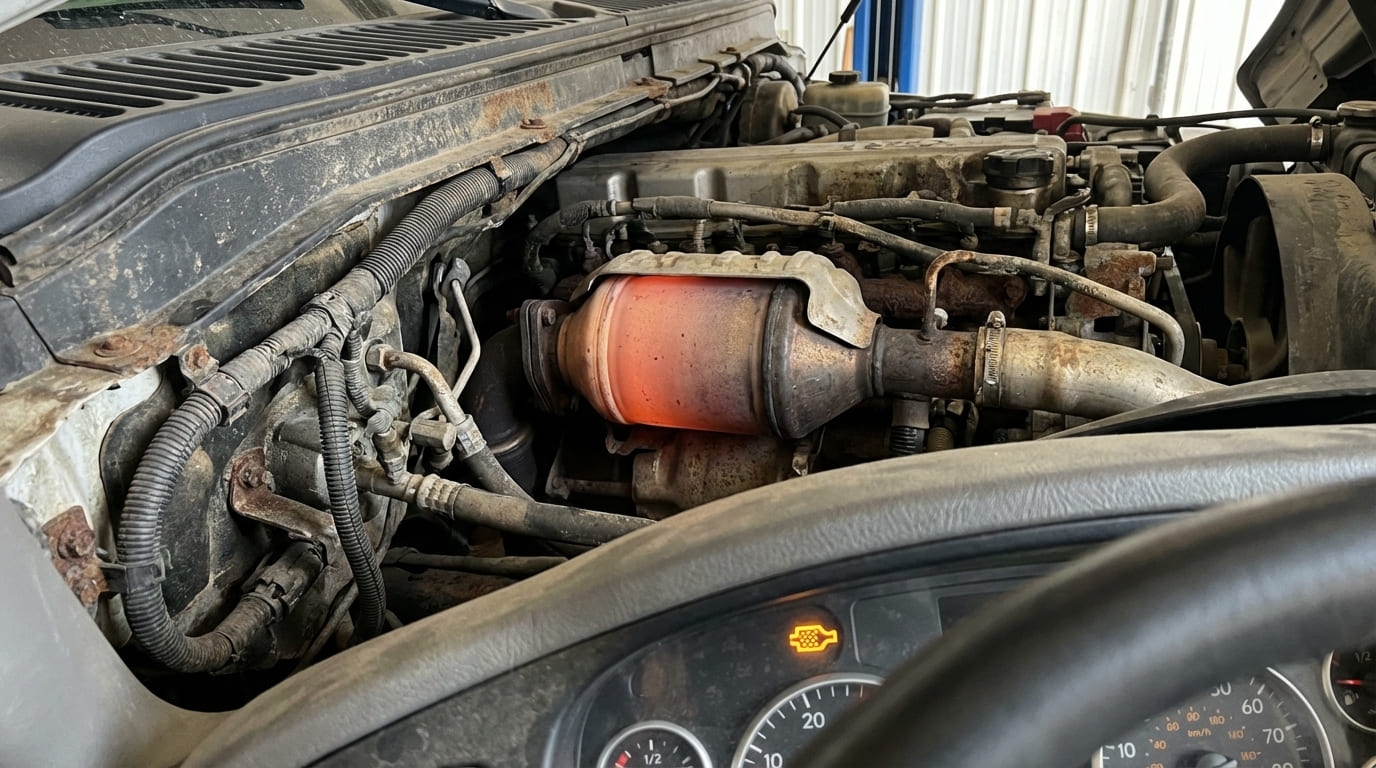
- Warm underbody or glowing exhaust components in darkness
It runs only when conditions are met: engine at operating temperature, sufficient fuel, no active DTCs. If interrupted—like shutting off the engine mid-cycle—the soot remains. Repeat failures lead to warning lights and diagnostic trouble codes (DTCs).
In my shop, we always verify active regen success with a scan tool. Watch for a clear drop in soot load percentage and normalized differential pressure. If values don’t reset, don’t assume the DPF is clogged—check sensors first.
Forced Regeneration: The Shop Intervention
When passive and active regen fail, soot accumulates and triggers DTCs like P2002 (low efficiency) or P2463 (high soot load). Forced regeneration uses a scan tool to manually start the burn-off cycle. But it’s not a fix-all—prerequisites must be met:
- Engine coolant and oil at full operating temperature
- Fuel level above 1/4 tank (post-injection consumes fuel)
- No active sensor faults (EGT, pressure, or intake air)
- Parking brake engaged (required by some OEMs)
During forced regen, monitor:
- EGT rise: Should reach 550–650°C and hold steadily
- Soot load: Must drop from 60%+ to under 15%
- Differential pressure: Should normalize across the DPF
If the cycle fails, don’t repeat it blindly. High exhaust temps (over 700°C) can damage components. Investigate why it failed first.
Never walk away during forced regeneration. I’ve seen exhaust manifolds glow red-hot. Perform in a fire-safe, ventilated area. And always check oil temp—some systems require 80°C minimum, not just coolant temp.
What About Ash? The Hidden Killer
Regeneration burns soot—but not ash. Ash comes from engine oil additives (calcium, zinc, phosphorus) and fuel impurities. It accumulates permanently, reducing DPF capacity over time.
Signs of ash buildup:
- Frequent regenerations despite no driving changes
- High back pressure even with low soot load
- Failed forced regen with no sensor faults
DPF cleaning is recommended every 100,000–150,000 miles, but can extend to 200,000 with proper maintenance. Cleaning methods:
| Method | How It Works | Cost Range |
|---|---|---|
| Pneumatic Cleaning | Compressed air pulses dislodge loose ash | $100–$200 |
| Thermal Cleaning | DPF heated to 700°C, then air-blown | $250–$400 |
| Wet Chemical Cleaning | Solvents dissolve ash, followed by drying | $300–$500 |
Cleaning isn’t always viable. If the DPF is cracked, melted, or contaminated with oil (from internal engine leaks), replacement is required. OEM units cost $1,500–$3,500. Aftermarket or “delete” pipes may seem cheaper but can fail emissions tests and void warranties.
Use only low-ash (low-SAPS) oil. I’ve seen DPFs fail at 80,000 miles on regular oil. The right oil can double its life. Check your owner’s manual—look for ACEA C2, C3, or OEM spec like MB 229.51.
Diagnostic Decision Tree: If You See X, Consider Y
Diagnose DPF issues by symptoms, not just codes. Here’s a practical guide:
| Symptom | Possible Causes | Diagnostic Priority |
|---|---|---|
| DPF warning light, high soot load | Short-trip driving, failed passive regen, faulty pressure sensor | Review driving pattern, then validate sensor data with scan tool |
| Frequent regenerations | Leaking injectors, EGR faults, wrong oil, high idle time | Check fuel trims and injector balance before blaming DPF |
| Regeneration starts but fails | Low fuel, EGT sensor error, exhaust leak, intake restriction | Monitor real-time EGT and pressure; look for sudden drops |
| High back pressure, low soot | Ash buildup, melted substrate, DOC shedding | Inspect with borescope or remove for visual check |
| No regen attempts, no codes | Driving pattern, oil temp too low, software lockout | Check freeze frame data; replicate highway conditions |
Recommended Practices: Do and Avoid
- ✅ Do: Use OEM-specified low-ash engine oil. It’s the single best way to extend DPF life.
- ✅ Do: Clear intake and exhaust restrictions before forced regen. A clogged air filter or crushed pipe sabotages temperature rise.
- ✅ Do: Verify EGT sensor readings with a reference tool. A 50°C offset can prevent successful regeneration.
- ⚠️ Avoid: Forced regen with less than 1/4 tank of fuel. Risk of incomplete cycle and ECM rollback.
- ⚠️ Avoid: Ignoring EGR system issues. A stuck-open valve cools combustion, preventing regen temps.
- ⚠️ Avoid: Assuming failed regen = clogged DPF. Over 60% of the time, it’s a sensor, leak, or operational fault.
Situation: A 2015 Ram 3500 came in with P2463 and reduced power. Driver did only short trips. Forced regen failed twice—EGT rose but soot load didn’t drop.
Discovery: DPF inlet blocked by debris from degraded DOC coating. No soot or ash issue—upstream failure.
Lesson: Always inspect upstream components. DOC breakdown can mimic DPF clogging.
Situation: Diesel SUV regenerating every 200 miles. No DTCs, but driver complained of noise and fuel use.
Discovery: Cylinder balance test revealed leaking injector. Excess fuel created extra soot.
Lesson: Frequent regens often point to combustion problems. Fix the engine, not the exhaust.
Situation: Van wouldn’t start forced regen. Scan tool said “conditions not met” despite warm engine.
Discovery: Oil temperature was 75°C—below the OEM’s 80°C minimum. Cycle wouldn’t start until oil warmed further.
Lesson: Regen depends on multiple inputs. Always check oil temp, not just coolant.
In my shop, we don’t just clear codes and run regens. We treat the DPF as a symptom of engine health. Driving habits, oil quality, sensor accuracy, and mechanical condition all affect its performance. When in doubt, consult the factory service manual for your specific model—it lists exact regen thresholds and diagnostic steps no generic guide can match.