The Exhaust Gas Recirculation (EGR) valve is a critical emissions control component found on most gasoline and diesel engines since the 1970s. Its primary role is to reduce nitrogen oxide (NOx) emissions by recirculating a portion of exhaust gases back into the engine’s intake manifold. This article breaks down how the EGR system works, how to diagnose common failures, and what repairs actually fix the problem—based on real-world shop experience.
What the EGR Valve Does and Why It Matters
The EGR valve lowers combustion temperatures to prevent the formation of NOx, a harmful pollutant created when nitrogen and oxygen react under high heat (above 1,370°C / 2,500°F). By introducing inert exhaust gas into the intake charge, the EGR system dilutes the air-fuel mixture, slows combustion, and reduces peak cylinder temperatures—keeping NOx production in check.
This isn’t about fuel economy or performance. It’s emissions compliance. But when the EGR fails, driveability suffers. Misunderstanding its function leads to misdiagnosis and wasted money.
How the EGR System Operates
The Powertrain Control Module (PCM) determines when and how much exhaust gas to recirculate based on engine load, RPM, coolant temperature, and throttle position. The EGR is inactive at idle, wide-open throttle, and during cold starts to maintain drivability and combustion stability.
Under moderate load—like highway cruising—the PCM activates the EGR valve to allow a metered flow of exhaust gas (typically 5–15%) into the intake. This reduces oxygen concentration and acts as a thermal buffer due to the high heat capacity of exhaust gases, effectively lowering peak combustion temps.
Types of EGR Systems and Actuation Methods
There are two main EGR designs: vacuum-operated and electronically controlled. Each has distinct failure modes and diagnostic approaches.
- Vacuum-Controlled EGR: Uses engine vacuum, regulated by a PCM-controlled solenoid, to lift a diaphragm and open the valve. Common on older vehicles.
- Electronic EGR: Uses a DC or stepper motor commanded directly by the PCM. More precise, with position feedback for closed-loop control. Standard on modern engines.
- High-Pressure EGR (HP-EGR): Draws exhaust gas pre-turbine (higher pressure). Common on turbocharged gasoline and diesel engines. Often includes an EGR cooler.
- Low-Pressure EGR (LP-EGR): Recirculates exhaust post-turbine, after DPF and SCR systems. Cleaner gas, less soot, but complex plumbing. Typically found on modern diesels.
In my shop, we always test the control system before replacing the valve. A failed vacuum solenoid or wiring issue mimics a stuck or clogged EGR valve. Don’t assume the valve is bad just because the code points to flow problems.
Where the EGR Valve Is Located and How It’s Integrated
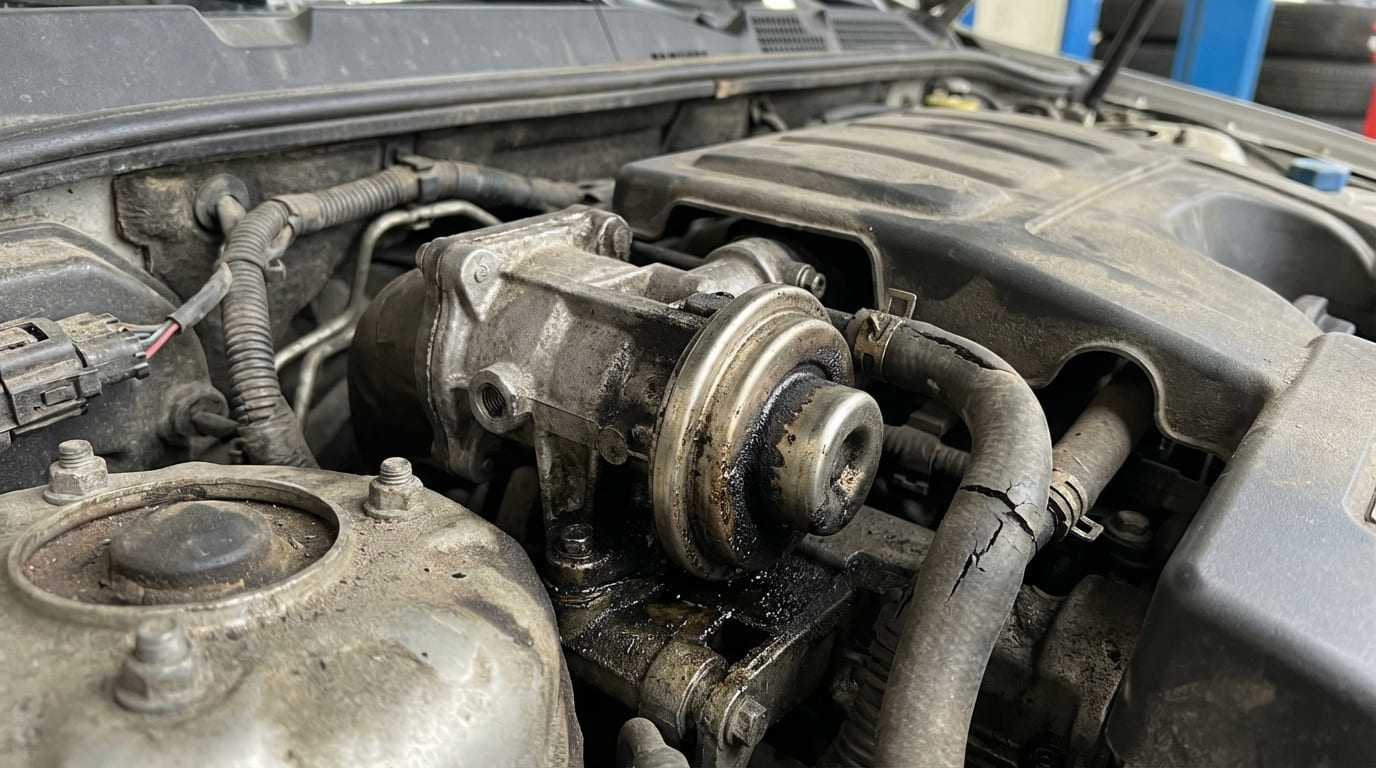
The EGR valve bridges the exhaust and intake systems. On many four- and six-cylinder engines, it mounts directly to the intake manifold. On others, especially older V8s, it’s mounted on the exhaust manifold with a metal pipe running to the intake.
HP-EGR systems tap exhaust pre-turbine. LP-EGR systems pull from downstream of the DPF and inject into the turbo compressor inlet. This allows cleaner, cooler gas recirculation but increases the risk of oil and soot contamination in the intake if seals degrade.
Common EGR Problems and How to Diagnose Them
EGR issues often trigger check engine lights with codes like P0401 (insufficient flow) or P0402 (excessive flow). But replacing the valve without diagnosis is a gamble. Here’s how to approach real-world failures.
How to Check EGR Function
For vacuum EGR systems:
- Check for vacuum at the solenoid with the engine at operating temperature and under load (e.g., 2,000 RPM).
- Apply vacuum manually with a hand pump. The engine should stumble or stall if the valve is working and passages are clear.
- Inspect vacuum lines and solenoids for cracks or internal leaks.
For electronic EGR systems:
- Use a scan tool to command EGR valve open. Watch live data for position feedback.
- If the valve doesn’t move, check power, ground, and control signals with a multimeter.
- Remove the valve and inspect for carbon buildup jamming the pintle.
Check EGR passages: Even with a new valve, carbon can block the intake or exhaust ports. Remove the valve and use a flashlight and pick to verify clear flow.
On GDI engines, don’t mistake normal intake carbon for EGR failure. Fuel doesn’t wash over the intake valves, so buildup is common—even with a properly functioning EGR system.
Costs and Repair vs. Replace Decisions
Replacing an EGR valve costs $250–$600 depending on engine type and labor access. Electronic and diesel valves are more expensive ($150–$400 for the part). But replacement isn’t always the answer.
Repair first: Cleaning carbon from passages or replacing a $50 solenoid can fix flow issues without touching the valve.
When to replace: If the diaphragm is ruptured, motor is dead, or pintle is seized, replacement is necessary. Use OEM or equivalent—aftermarket valves often have calibration mismatches.
| Component | Average Cost (Part Only) | Viability of Repair |
|---|---|---|
| Vacuum EGR Valve | $60–$120 | Low – usually replace |
| Electronic EGR Valve | $150–$400 | Low – replace if motor or sensor failed |
| EGR Vacuum Solenoid | $40–$80 | High – common failure point |
| EGR Cooler (diesel) | $300–$800 | Low – replace if leaking |
Never clean an electronic EGR valve with carb cleaner. Residue can damage motor windings or position sensors. If cleaning is needed, use a brake cleaner that leaves no residue—and only if the manufacturer allows it.
Common Symptoms and Likely Causes
Use this table to narrow down EGR-related issues before tearing into the engine.
| Symptom | Most Likely Causes | Less Common But Possible |
|---|---|---|
| Check Engine Light – P0401 (Insufficient Flow) | Carbon blockage in EGR passage, failed vacuum solenoid, clogged valve | Wiring fault, PCM issue, faulty MAP sensor |
| Rough Idle or Stalling | Stuck-open EGR valve, vacuum leak in EGR system | Failed IAC motor, ignition misfire, fuel pressure issue |
| Excessive Intake Carbon | Normal on GDI engines; enhanced by EGR use | PCV system leak, oil consumption |
| Coolant Loss with No External Leak | Failed EGR cooler (internal leak), especially on diesels | Head gasket, cracked head, heater core leak |
| Poor Fuel Economy and Hesitation | Stuck-open EGR valve causing excessive dilution | Dirty MAF, clogged injectors, exhaust restriction |
Real-World Case Studies: Lessons from the Shop
Situation: A 2012 Ford F-250 6.7L Power Stroke had a P0401 code and reduced power. Two aftermarket EGR valves already installed—no fix.
Discovery: The valve moved freely, but the passage between the exhaust manifold and EGR cooler was 90% blocked with carbon. The cooler was clean; the blockage was upstream.
Lesson: Flow depends on the entire system. Always inspect passages, not just the valve. Aftermarket valves may not match OEM specs, leading to false diagnostics.
Situation: A 2008 Toyota Camry 2.4L had rough idle and P0402 (excessive flow). New EGR valve installed—problem returned in three weeks.
Discovery: The vacuum solenoid was leaking internally, applying constant vacuum. The valve wasn’t faulty—the control system was.
Lesson: Diagnose the circuit, not just the component. A $50 solenoid can save you from replacing a $120 valve twice.
Situation: A 2015 BMW 328d lost coolant weekly with white exhaust smoke. No overheating, no mixing in the coolant tank.
Discovery: The LP-EGR cooler had an internal crack. Coolant was being pulled into the intake and burned.
Lesson: On modern diesels, EGR coolers are part of the combustion path. Coolant loss without classic head gasket signs? Test the cooler.
Best Practices for EGR Service
- ✅ Inspect passages when replacing the valve. Carbon builds up downstream and will reoccur if not cleaned.
- ✅ Replace gaskets with OEM-spec. Aftermarket paper gaskets often fail under high heat and pressure.
- ✅ Test solenoids and wiring before replacing electronic valves. Use a multimeter or lab scope.
- ⚠️ Don’t rely solely on scan tool data. A valve can show “commanded open” but be mechanically blocked.
- ⚠️ Avoid carb cleaner on electronic valves. Use only residue-free cleaners if cleaning is permitted.
Understanding the EGR system goes beyond emissions. It’s tied to combustion efficiency, intake health, and engine longevity. Always consult vehicle-specific service data—designs vary too much to generalize. But with proper diagnostics, you can avoid unnecessary parts swaps and fix the real problem.