I’ve worked on everything from turbo-four econoboxes to twin-turbo V8s over the last two decades, and one thing I’ve learned is that forced induction systems aren’t just about power—they’re about balance. Twin-turbo setups are often misunderstood, sometimes glorified, but rarely simple. Let’s break down what they really are, how they work in practice, and what you should actually be watching for when diagnosing or maintaining them.
What Is a Twin-Turbo Setup and Why It Matters
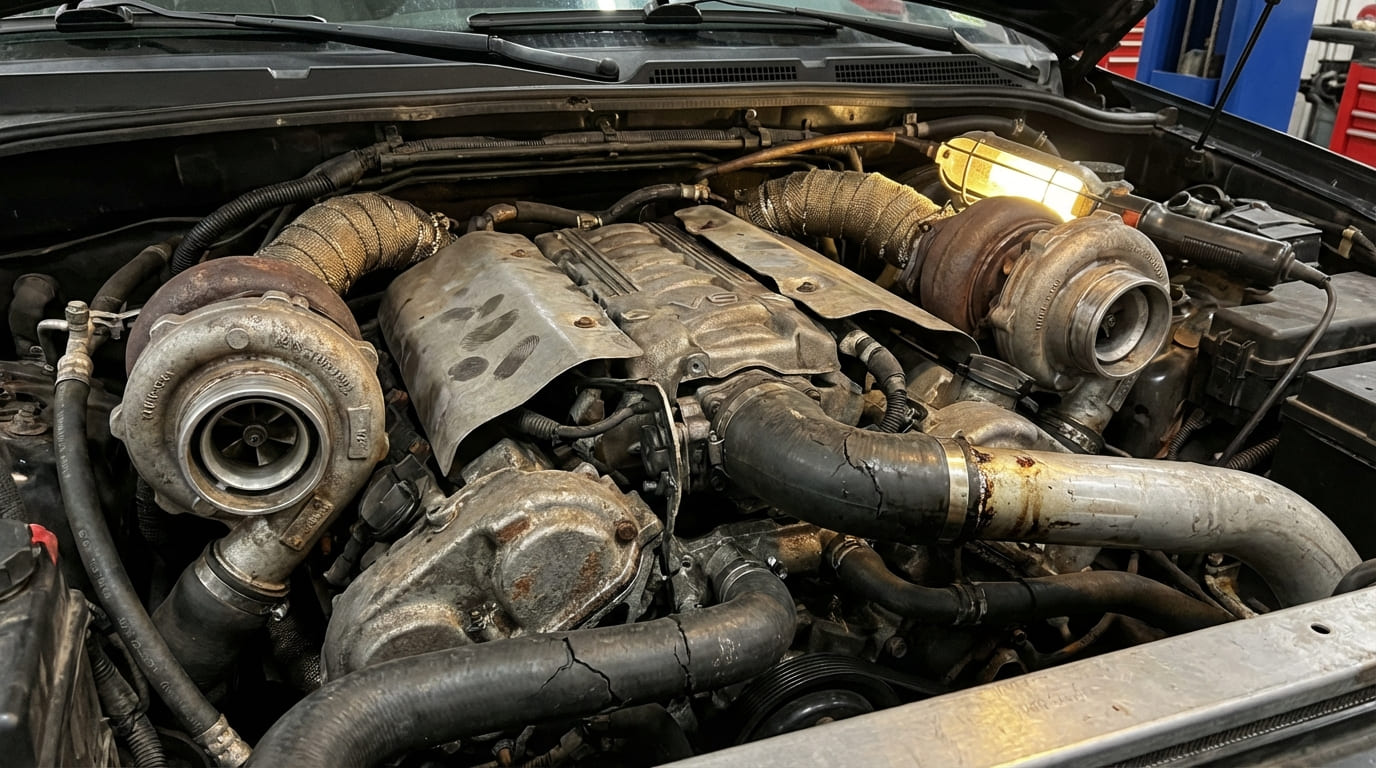
A twin-turbo system uses two turbochargers to compress intake air, improving engine power and efficiency. Unlike a single large turbo, which often suffers from lag, twin turbos allow smaller units to spool faster while still delivering high-end power. This setup is especially common on V6 and V8 engines, where each turbo typically serves one cylinder bank. The real-world benefit isn’t just peak horsepower—it’s a broader, more usable torque curve.
How Twin-Turbo Systems Work: Practical Breakdown
Each turbo has a turbine wheel driven by exhaust gases, a compressor wheel that pressurizes intake air, and a center housing with bearings and oil feed/return lines. The system relies on exhaust flow, boost control solenoids, wastegates, and intercoolers to manage pressure and temperature. Modern systems use sensors to monitor boost, exhaust pressure, and actuator position, feeding data to the ECU for precise control.
Key Configurations You’ll Encounter
There are three main twin-turbo layouts, each with distinct behavior and failure modes.
Parallel Twin-Turbo: Each turbo handles one bank of cylinders (e.g., left and right on a V8). Both feed into a shared intake. This is the most common in modern performance cars like BMWs and Corvettes. Turbos are usually identical, simplifying tuning and balance.
Sequential Twin-Turbo: A smaller turbo provides low-RPM response; a larger one (or both) engages at higher RPM. Common in older Japanese performance cars like the Supra and 300ZX. Relies on vacuum or electronic actuators to switch flow. More complex, more failure points.
Series (Compound) Twin-Turbo: Air passes through a high-pressure turbo, then a larger low-pressure turbo. Exhaust flows in reverse order. Rare in gas engines, common in diesel trucks. Delivers extreme boost but demands robust cooling and tuning.
Diagnosing Twin-Turbo Issues: Step-by-Step Approach
When boost problems arise, don’t assume the turbos are bad. Most failures stem from supporting systems. Follow this diagnostic path:
- Scan for trouble codes (e.g., P0299 – underboost, P02B6 – boost imbalance).
- Check for boost leaks with a smoke test—focus on intercooler piping, diverter valves, and charge hoses.
- Inspect turbo actuator movement: manually test wastegate arms for binding or carbon buildup.
- Verify exhaust flow: use a backpressure gauge on each bank to detect clogs in up-pipes or catalytic converters.
- Test vacuum lines and solenoids in sequential systems—listen for hissing, check reservoirs.
- Inspect turbo shaft play: use a non-magnetic dial indicator. More than 0.003″ radial play indicates bearing wear.
- Check oil feed/return lines for kinks or sludge—restricted oil flow kills turbos fast.
Common Problems and How to Fix Them
Here’s what typically goes wrong—and what to do about it.
| Problem | Most Likely Cause | Less Common But Possible | Diagnostic Tip |
|---|---|---|---|
| Uneven boost between turbos | Exhaust restriction (clogged up-pipe or catalytic converter) | Wastegate actuator failure, boost control solenoid issue | Check exhaust backpressure on each bank with a probe gauge |
| Boost spikes at high RPM | Wastegate not opening fully (stuck or weak spring) | Blow-off valve failure, ECU tuning anomaly | Inspect wastegate arm movement under vacuum and boost |
| Oil in intake piping | Failed turbo seal or clogged PCV system | Overfilled engine oil, excessive crankcase pressure | Check oil level and PCV flow before condemning the turbo |
| Whining or grinding noise under load | Bearing wear in turbo center section | Compressor surge, belt noise from accessories | Use a mechanic’s stethoscope to isolate the source |
Repair vs Replace: Cost and Practicality
Rebuilding or replacing turbos is expensive. Here’s what you’re likely to face:
| Service | Cost Range | Notes |
|---|---|---|
| Rebuild one turbo (labor + parts) | $400–$800 | Good for early wear; includes new seals, bearings |
| Replace one turbo (OEM reman) | $1,200–$2,000 | Includes core charge; factory-calibrated |
| Replace both turbos | $2,500–$4,500 | Recommended if one has failed—prevents imbalance |
| Intercooler replacement | $600–$1,500 | Often overlooked; cracked cores cause chronic boost leaks |
Unless the turbos are seized or have metal damage, rebuilding is often cost-effective. But if one turbo fails due to oil contamination or exhaust restriction, fix the root cause first—or the new unit will fail too.
Best Practices for Installation and Maintenance
Proper setup prevents premature failure. Follow these rules:
- ✅ Clean all exhaust and intake threads with a tap or die before reassembly. Cross-threading causes leaks and cracked flanges.
- ✅ Replace copper crush gaskets and use anti-seize on high-heat bolts (manifold, up-pipe, turbo housing).
- ✅ Always use new oil and filter when installing turbos. Flush the oil lines if debris is suspected.
- ✅ Prime the turbo oil system before startup: remove the fuse for the fuel pump, crank the engine for 10 seconds to build oil pressure.
- ⚠️ Never reuse torque-to-yield (TTY) bolts. This includes turbo manifold and head bolts. They stretch permanently.
- ⚠️ Don’t assume both turbos wear equally. One can fail while the other is fine—especially if exhaust flow is uneven.
Situation: A 2010 BMW 335i came in with poor throttle response and a P0299 code (boost pressure too low). The owner had already replaced the diverter valves, thinking that was the issue.
Initial Assumption: We suspected a boost leak or failing turbo.
Deep Dive: After smoke testing showed no leaks, we checked turbo actuator movement and found one side wasn’t opening fully. Further inspection revealed carbon buildup in the exhaust manifold on that bank, restricting flow to the turbo.
Nuanced Lesson Learned: Don’t jump to replacing turbos without verifying exhaust flow and actuator function. Carboned-up manifolds are common on direct-injection engines and can mimic turbo failure.
Situation: A 2005 Toyota Supra with a sequential turbo system had no boost above 4,000 RPM. The small turbo seemed fine, but the large one wasn’t engaging.
Initial Assumption: We thought the second turbo was seized.
Deep Dive: After pulling the turbo and bench-testing it (which showed it spun freely), we traced the issue to a failed vacuum reservoir and a split hose in the control circuit. The ECU was sending the signal, but no vacuum was reaching the actuators.
Nuanced Lesson Learned: Sequential systems rely heavily on vacuum integrity. Before tearing into the engine, test the entire control system—hoses, solenoids, reservoirs, and actuators.
Situation: A modified Ford F-150 with compound turbos was overheating under load, and the intercooler outlet temps were excessive.
Initial Assumption: We suspected the intercooler was undersized.
Deep Dive: While the intercooler was small, the real issue was poor airflow due to a shroud gap and a slipping fan clutch. Once airflow was restored, temperatures dropped significantly.
Nuanced Lesson Learned: Even the best turbo system depends on supporting systems. Thermal management is just as important as boost control—don’t overlook airflow, cooling fans, and radiator condition.
When working with twin-turbo systems, I always remind junior techs: the turbos are rarely the root cause of the problem. They’re usually the symptom. Diagnose the airflow, the exhaust, the controls, and the supporting systems first. And above all—always consult the factory service manual for torque specs, calibration procedures, and system-specific diagnostics. What works on one engine might not apply to another, even if they look similar.