Primary Causes of MAF Sensor Failure
MAF sensor issues are among the most misdiagnosed problems in modern vehicles. As a master technician, I’ve replaced far too many sensors that didn’t need replacing. The key is understanding what actually causes failure — and what only mimics it. Below are the real-world causes, how to diagnose them, and when replacement is truly necessary.
Contamination, Electrical Faults, and Physical Damage
These are the three broad categories of MAF failure. Contamination is the most common and often reversible. Electrical and physical issues usually require replacement — but only after verifying the root cause.
How to Check for Contamination
Before touching the sensor, inspect the air filter and housing. A torn filter, loose clamp, or cracked intake boot allows unfiltered air and debris to reach the MAF. If the vehicle uses an oiled aftermarket filter (like K&N), check for excess oil smell or residue downstream.
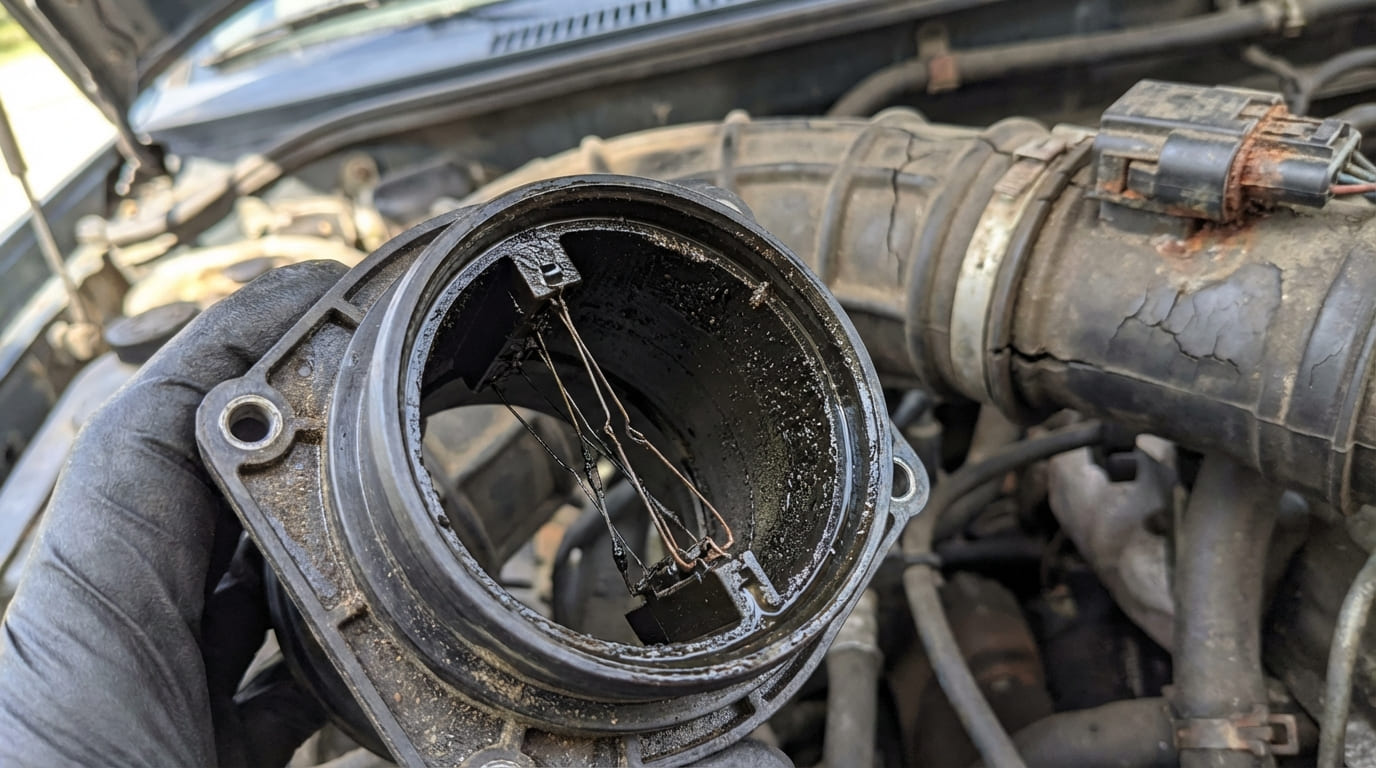
Remove the MAF sensor and examine the sensing element with a magnifier. On hot-wire types, look for a gray film or sticky residue. Do not touch the wire. Spray with manufacturer-approved MAF cleaner only — no carb cleaner, no brake cleaner. Let it dry completely before reinstalling.
After cleaning, clear codes and test drive. Monitor live MAF data at idle and wide-open throttle (WOT). Typical idle readings range from 2–7 g/s depending on engine size; WOT on a 2.0L might hit 250–300 g/s. If values remain low or erratic, contamination wasn’t the only issue.
In my shop, we always test MAF response by snapping the throttle from idle to WOT. A healthy sensor shows a smooth, rapid rise and fall. If the graph is jagged or flat-lined, suspect contamination or internal damage.
How to Diagnose Electrical Issues
Electrical faults are often mistaken for sensor failure. Use a multimeter to test the three main circuits at the MAF connector (key on, engine off):
- Power supply: Should read 5V or 12V per specs. Check against service manual. More than ±0.2V deviation indicates a problem in the harness or PCM.
- Ground: Measure resistance between the ground pin and a clean chassis point. Should be under 0.5 ohms. Over 1 ohm means corrosion or bad ground connection.
- Signal return: Should show reference voltage (often 0.3–0.5V) with no airflow. Use a back-probe method to avoid damaging pins.
If power or ground is off, trace the circuit. Check for chafed wires, rodent damage, or corroded connectors. A damaged harness is cheaper to repair than a new MAF.
I once saved a customer $380 by finding a chewed wire under the intake. The MAF tested bad — but only because it wasn’t getting power. Fix the circuit first, then condemn the sensor.
Physical and Thermal Damage: What to Look For
Dropping a MAF sensor can break the internal hot wire. Even if it looks fine, a microscopic crack can cause intermittent failure. If the sensor reads zero airflow and all circuits test good, suspect impact damage.
Thermal stress from chronic overheating or nearby exhaust leaks can degrade internal electronics. Use an infrared thermometer to check sensor housing temperature after a drive. If it’s over 300°F, look for heat sources like exhaust manifolds or turbochargers too close to the intake.
Age and Internal Degradation: When to Replace
High-mileage sensors (150k+ miles) can develop signal drift due to sensing element fatigue. This isn’t sudden failure — it’s gradual. Fuel trims slowly go positive, setting lean codes over time.
To confirm, compare live data to a known-good vehicle of the same model and engine. If your MAF reads 10% low across the range and cleaning made no difference, internal wear is likely.
Internal circuit board failures (failed capacitors, cracked solder joints) are not repairable. These often follow voltage spikes from a failing alternator. If the alternator output exceeds 15.5V, replace it before installing a new MAF — or you’ll repeat the failure.
Distinguishing a Dirty MAF from a Failed MAF
This is the #1 diagnostic mistake. A dirty MAF still responds — just inaccurately. A failed MAF gives no signal, a flatline, or nonsensical data.
If you have lean codes (P0171/P0174) and low MAF readings, clean it first. If P0102 (low input) persists after cleaning and circuits are good, replacement is likely needed. But always rule out unmetered air — a leak downstream of the MAF fools the system the same way a bad sensor does.
On a 2012 Ford F-150 with repeated P0171 codes, I found the air filter was misaligned and the PCV hose cracked. Two new sensors had been wasted. Fix the air path first — then worry about the sensor.
Diagnostic Decision Table
| Symptom / Condition | Most Likely Cause(s) | Diagnostic Priority |
|---|---|---|
| Lean codes (P0171/P0174), reduced power | Contamination, air intake leak | Inspect air filter, clean MAF, check for vacuum leaks |
| P0100-P0104 (circuit malfunction) | Wiring fault, power/ground issue, internal failure | Test voltage, ground, signal integrity before replacement |
| Erratic MAF live data | EMI, poor ground, contaminated element | Scope signal, check ground resistance, inspect for noise sources |
| No MAF signal, no-start | Open circuit, impact damage, PCM issue | Verify power and ground, inspect for physical damage |
| Gradual performance decline, high mileage | Sensing element fatigue, internal drift | Compare live data to known good unit, rule out contamination |
Best Practices and Cost-Saving Tips
- ✅ Clean only with MAF-specific aerosol. It leaves no residue. Cost: ~$10. Avoid anything not labeled safe for MAF sensors.
- ✅ Always inspect the air filter and intake tract for leaks or damage. A $20 air filter can save you a $300 sensor.
- ✅ Test power, ground, and signal with a multimeter or oscilloscope. An hour of testing beats a wrong replacement.
- ⚠️ Never reuse damaged MAF connectors. Bent or corroded pins cause false readings. Replace the connector pigtail if needed (~$15–$30).
- ⚠️ Avoid cheap aftermarket MAF sensors. OEM or reputable brands (Bosch, Denso) cost more ($120–$300) but match factory calibration. Generic units often cause ongoing issues.
- ⚠️ Never touch the sensing element. Skin oils can cause contamination. Handle by the housing only.
A Subaru WRX came in with idle surging. MAF data jumped wildly. Power and ground were good. Cleaning did nothing. On the scope, I saw spikes timed with ignition events. The harness was routed next to coil wires — EMI was the culprit. Re-routing fixed it. No sensor needed.
A Honda Accord had P0102 and 0.0 g/s MAF reading. New sensor installed — same result. I checked the PCM connector and found a bent pin. After repair, signal returned. Always test the full circuit — including the PCM side.
MAF sensor problems are rarely about the sensor itself. Start simple: check the air path, test the circuits, clean if needed. Use live data and basic tools to confirm. Replacement should be the last step — not the first.
OEM MAF sensors range from $150 to $400. Labor adds $50–$100. Before spending that, invest $10 in cleaner and an hour with a multimeter. More than half the time, you’ll avoid the cost entirely.
Always consult your vehicle’s service manual for exact specifications and test procedures. MAF calibration varies by engine. What’s normal for one may be faulty on another.